
Union Minister Jyotiraditya M Scindia led India’s engagements at Mobile World Congress 2026 in Barcelona, Spain, presenting the country’s vision for affordable, inclusive and intelligent digital connectivity while strengthening global partnerships in telecommunications and emerging technologies.
During the international gathering, Jyotiraditya M Scindia participated in the GSMA Ministerial Programme and addressed the main stage of the global technology summit, highlighting India’s experience in expanding digital connectivity through policy reform, innovation and large scale infrastructure deployment. The minister emphasised that affordable access to connectivity and devices remains central to bridging the global digital divide.
Delivering the closing keynote address at the GSMA Ministerial session titled Breaking the Cost Barrier, Jyotiraditya M Scindia highlighted that nearly 3.1 billion people worldwide remain excluded from meaningful participation in the digital economy due to affordability challenges. He stressed that reducing the cost of devices and services is essential for ensuring universal digital inclusion.
Jyotiraditya M Scindia noted that India’s digital transformation demonstrates how scale, competition and stable policy frameworks can dramatically reduce the cost of connectivity. He emphasised that next generation networks including 5G and emerging 6G ecosystems must remain affordable, inclusive and scalable in order to deliver real societal impact. The minister called for coordinated collaboration among governments, industry, financial institutions and global organisations to develop innovative financing models and sustainable digital ecosystems.
Later, addressing the main stage keynote session titled Built for What’s Next, Jyotiraditya M Scindia spoke about the evolution of telecommunications networks into intelligent and adaptive platforms powered by artificial intelligence, cloud native technologies and advanced digital infrastructure. He stated that connectivity is increasingly becoming a driver of economic growth, innovation and social empowerment rather than merely a tool for access.
The minister highlighted that modern networks are evolving into intelligent, autonomous and anticipatory systems capable of delivering seamless digital experiences. According to him, the future of connectivity will depend not only on faster data speeds but also on resilient infrastructure, secure digital ecosystems and sustainable technology development.
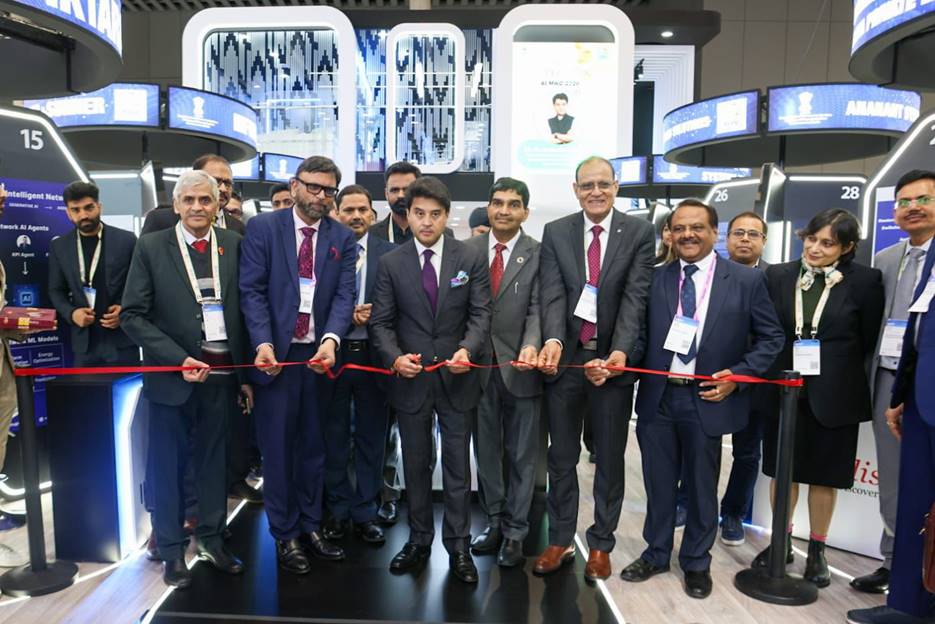
A major highlight of India’s participation at the global event was the inauguration of the Bharat Pavilion, which showcased the country’s growing telecom manufacturing and innovation ecosystem. The pavilion featured participation from 40 Indian companies and innovators demonstrating advanced solutions across 4G and 5G radio networks, optical transport systems, IP MPLS routing, broadband access, satellite communications, artificial intelligence driven network management, Internet of Things applications and semiconductor enabled hardware platforms.
The exhibition also highlighted India’s growing capabilities in next generation data centre technologies and cloud infrastructure, reflecting the country’s emergence as a design led manufacturing hub and a trusted partner in secure and cost effective connectivity solutions.
Jyotiraditya M Scindia also unveiled the curtain raiser for India Mobile Congress 2026 at the GSMA Insights Hub. He announced that the next edition of India Mobile Congress will be held in New Delhi from 7 to 10 October 2026, positioning India as a key global platform for collaboration in advanced telecommunications, artificial intelligence powered networks and emerging digital technologies.
During the event, the minister launched the TJ1600 D3 hyper scalable data centre interconnect platform developed by Tejas Networks. The advanced optical networking solution represents an important milestone in India’s development of high capacity data centre interconnect technologies designed and engineered domestically.
Jyotiraditya M Scindia also held several strategic interactions with global industry leaders and international organisations during the congress. He met with Doreen Bogdan Martin, Secretary General of the International Telecommunication Union, who acknowledged India’s progress in building a vibrant telecom ecosystem and expanding digital connectivity.
The minister conducted bilateral meetings with satellite communications companies Eutelsat and Viasat to explore ways to strengthen universal, resilient and meaningful connectivity frameworks across India. Both companies expressed support for India’s vision of providing secure and high speed connectivity to citizens.
In addition, Jyotiraditya M Scindia interacted with representatives of the Bharti Group led by Sunil Bharti Mittal, highlighting the strong partnership between government and industry in advancing India’s digital ambitions.
During his visit to technology booths at the congress, the minister reviewed several emerging innovations. At Meta, he observed artificial intelligence enabled wearable technologies and neural interface solutions and experienced the Meta Ray Ban smart display glasses, including a feature designed to enhance accessibility by isolating voices in crowded environments.
At Rakuten, he examined software defined and artificial intelligence native network architectures for scalable 5G deployment and held discussions with chief executive Hiroshi Mikitani. At VVDN Technologies, he reviewed indigenous artificial intelligence driven Wi Fi and networking solutions.
At Ericsson, demonstrations included advanced network technologies and early 6G capabilities such as a 6G data call using centimetre wave spectrum and new radio solutions designed specifically for India’s connectivity requirements. The demonstrations were attended by Ericsson board chairman Jan Karlsson.
During his interaction at Nokia, the minister experienced generative artificial intelligence enabled edge applications and immersive 6G use cases and held discussions with Nokia president and chief executive Justin Hotard. At Intel, he reviewed artificial intelligence optimised virtual radio access network solutions powered by next generation processors.
Technology demonstrations at Cisco focused on artificial intelligence powered edge computing and network automation, while at Qualcomm the minister reviewed advanced 5G modem systems, artificial intelligence driven radio access network automation and edge artificial intelligence platforms.
India’s participation at Mobile World Congress 2026 began with a high level dinner interaction hosted on 2 March 2026 with global and Indian technology leaders, where discussions centred on strengthening digital partnerships, accelerating innovation and building trusted technology ecosystems.
The participation of Indian telecom innovators at the global event has been organised by the Telecom Equipment and Services Export Promotion Council with support from the Department of Telecommunications under the Ministry of Communications.
Mobile World Congress 2026 is being held from 2 to 5 March 2026 at Fira Barcelona Gran Via in Barcelona, Spain. Organised by the GSMA, the event is the world’s largest gathering for the mobile and technology industry, attracting more than 109000 participants and around 2900 exhibitors, sponsors and partners. The theme for this year’s congress is The IQ Era, focusing on the convergence of artificial intelligence and connectivity to create smarter networks, business innovation and wider societal impact.