
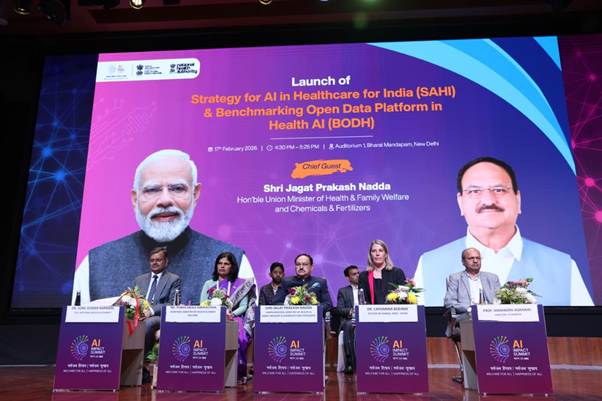
Union Minister for Health and Family Welfare Shri Jagat Prakash Nadda today launched two major national initiatives — SAHI and BODH — to institutionalise ethical, transparent and accountable use of Artificial Intelligence in India’s healthcare ecosystem. The announcements were made at the India AI Impact Summit 2026, positioning health AI governance at the centre of the country’s digital transformation agenda.
The two initiatives — SAHI, the Strategy for Artificial Intelligence in Healthcare for India, and BODH, the Benchmarking Open Data Platform for Health AI — are designed to create a structured, evidence-based and citizen-centric framework for AI adoption across the health sector.
Addressing the Summit, Shri Jagat Prakash Nadda described the moment as both timely and necessary, underlining that artificial intelligence cannot function in isolation and must be built on robust digital infrastructure and high-quality, consent-based data systems. He noted that India began laying this foundation nearly a decade ago through the Digital India programme launched in 2015 under the leadership of the Prime Minister, with the objective of building a digitally empowered society and knowledge economy.
He recalled that the health sector aligned itself with this broader national vision through the National Health Policy, 2017, which envisaged an interoperable, inclusive and scalable digital health ecosystem. This vision was operationalised through the launch of the Ayushman Bharat Digital Mission in 2020, which established a digital public architecture for healthcare.
Shri Nadda stated that India has since developed a strong digital public infrastructure in health, enabling interoperability across platforms and advancing large-scale, consent-based health data frameworks that protect citizen privacy while empowering individuals. In this context, he described SAHI not merely as a technology strategy but as a governance framework, policy compass and national roadmap for responsible health AI deployment.
According to the Minister, SAHI will guide the ethical, transparent, accountable and people-centric use of AI in healthcare. It provides a structured framework for collaboration among government agencies, state authorities, private sector stakeholders and academic institutions, ensuring that innovation advances in alignment with public interest and regulatory oversight.
He further emphasised the transformative role AI can play in pharmaceuticals and life sciences. AI applications in drug discovery, clinical research and trial design have the potential to enhance precision, reduce research timelines and lower costs, thereby strengthening India’s affordable healthcare model and expanding access to advanced therapies.
Shri Nadda also highlighted the importance of academic institutions in preparing a future-ready healthcare workforce equipped to develop, validate and deploy AI responsibly. This collaboration has led to the creation of BODH, which provides a structured and standardised benchmarking mechanism to test and validate AI tools before they are deployed at scale.
He stressed that AI solutions must undergo rigorous evaluation for performance, safety, reliability and real-world readiness. Together, SAHI and BODH represent India’s commitment to building a trustworthy and globally competitive health AI ecosystem anchored in innovation, responsibility and public trust.
Union Health Secretary Punya Salila Srivastava said that under the Prime Minister’s leadership, India has leveraged technology to make governance more inclusive, transparent and efficient. She described SAHI as a long-term policy commitment that provides a common framework for Union and State Governments as well as private partners to guide AI evaluation, adoption and integration across the healthcare system.
She added that BODH will play a critical role in ensuring that AI tools used by clinicians are validated against real-world parameters before deployment, thereby safeguarding patient safety and reinforcing accountability. Trust, safety and transparency, she said, must remain central to India’s health AI journey.
Dr Catharina Boehme, Officer-in-Charge of the World Health Organization South-East Asia Regional Office, commended India’s leadership in digital health innovation. She observed that India is among the first countries to adopt a comprehensive national AI strategy for health, setting an important global benchmark.
Dr Boehme said the strategy is designed to strengthen healthcare delivery, improve clinical and policy decision-making and extend services to underserved populations. She highlighted that India’s whole-of-government and whole-of-society approach ensures that SAHI reflects ground realities, thereby enhancing effectiveness and sustainability.
SAHI has been conceptualised as a comprehensive framework to promote secure, interoperable and trustworthy AI solutions in healthcare. It will facilitate collaboration among healthcare institutions, technology developers, researchers and policymakers to ensure that AI tools meet rigorous standards of safety, efficacy and ethical compliance prior to large-scale adoption. The platform will also function as a governance and knowledge-sharing hub, promoting best practices in health AI development while embedding safeguards for patient data protection and algorithmic accountability.
BODH, developed by the Indian Institute of Technology Kanpur in collaboration with the National Health Authority, will enable systematic evaluation of AI models using diverse and anonymised real-world health datasets. The platform will assess performance, robustness, bias and generalisability of AI systems before deployment at population scale. By institutionalising benchmarking standards, BODH aims to ensure that AI applications are clinically relevant, reliable and aligned with national public health priorities.
The launch of SAHI and BODH at the India AI Impact Summit 2026 marks a decisive step towards embedding responsible innovation within India’s health system. Senior officials from the Ministry of Health and Family Welfare, representatives of leading academic institutions, healthcare professionals, AI innovators and industry stakeholders participated in the event, reinforcing a shared commitment to building a safe, transparent and accountable AI-driven healthcare ecosystem.