
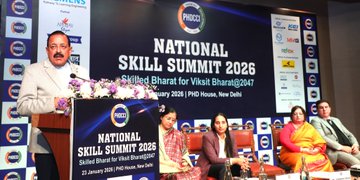
Union Minister of State with Independent Charge for Science and Technology, Earth Sciences, and Minister of State in the Prime Minister’s Office, Personnel, Public Grievances, Pensions, Atomic Energy and Space, Dr Jitendra Singh on Friday said India is witnessing an unprecedented democratisation of opportunities that has fundamentally transformed the aspirations, choices and confidence of the country’s youth.
Addressing the National Skill Summit 2026 organised by the PHD Chamber of Commerce and Industry at PHD House in New Delhi, the Minister observed that India’s youth today are more enlightened than ever before and stressed the need for mentors, institutions and policymakers to learn the art of listening. He said the role of educators must evolve from delivering rigid instructions to becoming facilitators who help young people discover their true aptitude and inner strengths.
Dr Jitendra Singh said that for the first time, India has built a holistic ecosystem that allows young citizens not only to dream but also to translate those dreams into sustainable livelihoods. He noted that young people today enjoy the freedom to choose their own paths rather than being constrained by imposed career options, adding that effective mentorship should guide without dominating decision-making.
Highlighting the shift from degree-centric thinking to skill-centric growth, the Minister cautioned against equating academic qualifications with aptitude. He cited the Council of Scientific and Industrial Research Aroma Mission as a powerful example, noting that thousands of young people, many without formal degrees, are earning substantial incomes through cultivation of lavender and other aromatic crops. He said India has moved beyond an exclusive focus on information technology and is now recognising the economic potential of agriculture, traditional skills and local strengths.
Dr Jitendra Singh underlined that the past eleven years have seen a surge in aspirations due to the widening of access and opportunity. Referring to the National Education Policy 2020, he said the policy corrected long-standing rigidities by freeing students from narrow subject combinations and ending the practice of imposed career choices. He remarked that students are no longer prisoners of their subjects and are better equipped to align education with personal aptitude.
The Minister said this transformation is clearly visible across sectors. He pointed out that civil services toppers today increasingly come from tier-2 and tier-3 cities, rural areas and small towns that were earlier underrepresented in merit lists. Similarly, he noted that more than half of India’s startups now originate beyond metropolitan cities, dispelling the notion that innovation is limited to a few urban hubs.
Emphasising women-led development, Dr Jitendra Singh said women are playing a central role in India’s growth story, from entrepreneurship to frontier science. He cited women-led achievements such as Chandrayaan-3 and the Aditya mission and noted that over 60 percent of beneficiaries under the Mudra scheme are women. He added that initiatives designed for youth are being adopted with even greater enthusiasm by women across the country.
The Minister also highlighted India’s rising global stature in innovation, noting significant improvement in patent filings and innovation indices. He said India now ranks among the leading countries in patent applications, with more than half of the filings coming from Indian residents who were educated and trained within the country. He described biotechnology as the next major industrial revolution after information technology.
Calling for a mindset shift among educators and policymakers, Dr Jitendra Singh said youth today belong to a different era and often possess greater awareness than their mentors. He urged institutions to move away from outdated teaching styles and create open, interactive and responsive learning environments that respect young voices.
Concluding his address, the Minister said India has always had abundant talent, but what was missing earlier was prioritisation and enabling political support. He said that gap has now been bridged through reforms such as the National Education Policy 2020, national skill missions, enhanced research funding and private sector participation. He added that the responsibility now lies with institutions and leaders to remain open, modest and willing to learn from the very youth they seek to guide.