

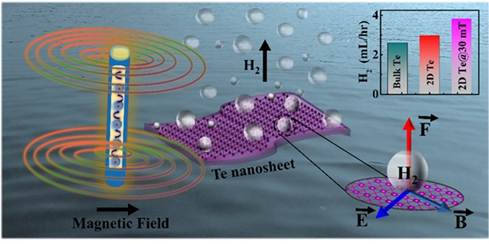
Scientists have developed a new class of nanosheets that could significantly improve the efficiency of hydrogen production and open new pathways for clean energy technologies. The breakthrough involves quasi two dimensional tellurium nanosheets that combine magnetism, ferroelectricity and catalytic activity in a single material platform.
The discovery has been made by researchers from the Institute of Nano Science and Technology, Mohali, an autonomous institute under the Department of Science and Technology. The research demonstrates how a specially engineered nano material can help reduce the energy required for hydrogen generation, potentially contributing to more efficient green hydrogen production systems in the future.
Hydrogen is widely viewed as a key clean energy carrier, but producing it efficiently and sustainably remains a technological challenge. Conventional materials used in hydrogen producing electrolysers often require high voltage and energy inputs. The newly developed nanosheets introduce a mechanism that can lower the voltage needed for hydrogen generation while accelerating the reaction process.
The research team led by Dipankar Mandal, along with Dalip Saini, developed quasi two dimensional alpha tellurium nanosheets by exfoliating bulk tellurium into ultra thin layers. When tellurium is transformed into this nanoscale structure, the material exhibits unusual electronic and magnetic properties that are not present in its bulk form.
The nanosheets reveal the emergence of unpaired five p electron spins on their surface. In bulk tellurium these spins remain suppressed, but when the material is converted into thin nanosheets, structural strain and the breaking of inversion symmetry activate these surface spins. This phenomenon leads to the formation of a ferromagnetic state in the nanosheets.
The researchers found that this surface magnetism interacts strongly with ferroelectric properties within the same material, producing a powerful magnetoelectric response. By exploiting this magnetoelectric coupling, the scientists were able to enhance the hydrogen evolution reaction, a critical process involved in splitting water to produce hydrogen gas.
The study demonstrates that the nanosheets can generate hydrogen more efficiently because magnetoelectric control reduces the voltage required for electrolysis and accelerates the catalytic reaction. As a result, less electricity is needed to produce hydrogen, which could significantly lower the energy cost of green hydrogen technologies.
The experimental procedure involved scalable liquid phase exfoliation of tellurium, followed by strain engineered lattice distortions and advanced spin sensitive measurements to monitor the behaviour of the surface spins. These techniques allowed the scientists to track how magnetic properties emerge in the nanosheets and how they can be controlled.
Under the influence of a magnetic field, the unpaired surface spins on the alpha tellurium nanosheets enhance the hydrogen evolution reaction and promote the formation of hydrogen gas bubbles. The research demonstrated that performance improves further as the magnetic field strength increases.
The findings, published in the journal Advanced Materials, show that an elemental two dimensional material such as alpha tellurium can host controllable surface magnetism without relying on transition metal ions or complex magnetic compounds. The ability to directly control the magnetic state through strain and electric fields offers new possibilities for advanced material design.
The research also establishes a link between three important technological domains: spintronics, multiferroic nanoelectronics and green hydrogen energy systems. This integration creates opportunities for the development of new devices that combine electronic control with catalytic performance.
Beyond hydrogen production, the nanosheets could also support future applications in low power memory devices, smart sensors and magnetoelectric driven electrolysers. Because the material remains stable and flexible at nanoscale thickness, it could be incorporated into flexible and portable devices.
Scientists note that the mechanical flexibility and stability of quasi two dimensional alpha tellurium nanosheets make them suitable for emerging technologies such as wearable electronics, portable energy systems and advanced environmental monitoring devices.
The development represents an important step toward indigenous advanced materials research aimed at enabling sustainable energy technologies and next generation electronic systems.