
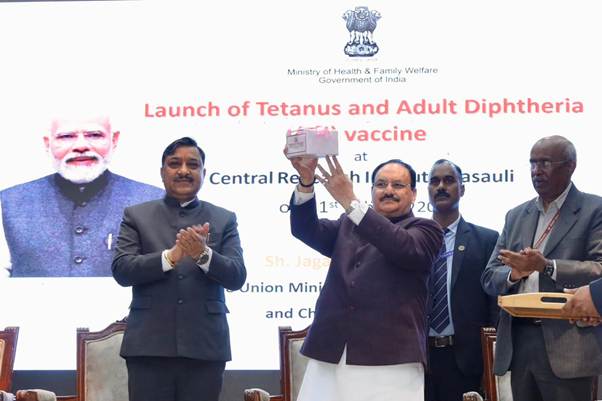
Union Health Minister Jagat Prakash Nadda today launched the indigenously manufactured Tetanus and Adult Diphtheria vaccine at the Central Research Institute in Kasauli, Himachal Pradesh, describing the development as a milestone in strengthening India’s public health infrastructure and advancing self reliance in vaccine manufacturing.
Addressing scientists, technical experts and staff of the Central Research Institute, Jagat Prakash Nadda congratulated the institute for achieving full indigenous development and production of the Td vaccine. He termed the occasion historic, stating that the introduction of the vaccine marks a decisive step towards safeguarding national health security while reinforcing the country’s capacity for high quality vaccine production under global standards.
The Minister underscored that under the leadership of Prime Minister Narendra Modi, the Government has set clear goals for achieving self reliance in the health and pharmaceutical sectors. He said the launch of the indigenously manufactured Td vaccine reflects the commitment to Atmanirbhar Bharat in health and medicine, reducing external dependence and strengthening domestic capabilities.
With its formal launch, the Td vaccine has now been introduced for supply under the Universal Immunization Programme. The Central Research Institute will supply 55 lakh doses to the programme by April 2026. Production is expected to scale up progressively in subsequent years to ensure sustained supply and support the expanding needs of the immunization drive.
Highlighting India’s position in global healthcare, Jagat Prakash Nadda said India is widely recognised as the pharmacy of the world and among the leading vaccine manufacturers globally. He noted that India has achieved Maturity Level 3 under the World Health Organization global benchmarking of regulatory systems, reflecting the robustness, transparency and scientific integrity of the country’s vaccine regulatory framework. Institutions such as the Central Research Institute, he said, have played a vital role in achieving and sustaining these standards.
Reflecting on the evolution of vaccine development, the Minister observed that historically vaccine and drug development processes were prolonged and complex. He noted that the tetanus vaccine took decades to develop globally, tuberculosis medicines evolved over nearly 30 years and the Japanese Encephalitis vaccine required almost a century of scientific progress. In contrast, during the COVID 19 pandemic, India developed two indigenous vaccines within nine months and administered over 220 crore doses, including booster doses. He also pointed out that vaccination certificates were delivered digitally, demonstrating India’s rapid digital transformation in public health delivery systems.
Referring to the Vaccine Maitri initiative, Jagat Prakash Nadda stated that India supplied vaccines to nearly 100 countries during the pandemic, with 48 countries receiving vaccines free of cost. He said the contributions of public sector institutions such as the Central Research Institute strengthened India’s ability to meet both domestic needs and global responsibilities.
The Minister emphasised that the Central Research Institute is the first government institute to manufacture vaccines under Good Manufacturing Practices standards, reflecting modernization and revitalization of public sector vaccine manufacturing units. He said this achievement demonstrates the Government’s sustained focus on upgrading infrastructure, compliance standards and production quality in public institutions.
Describing the Universal Immunization Programme as the world’s largest immunization initiative, Jagat Prakash Nadda stated that it currently provides 11 vaccines protecting against 12 vaccine preventable diseases. The Central Research Institute has contributed significantly to this programme over the years. He noted that approximately 2 to 2.5 crore children are born every year in India and a similar number of women become pregnant. From pregnancy registration onwards, beneficiaries are digitally tracked through platforms such as U WIN. The Government ensures that expectant mothers receive five antenatal checkups, including at least one by a specialist. Immunization and tracking continue until the child reaches 16 years of age, covering 27 doses under the programme.
He informed that the annual immunization cohort comprises nearly 5 crore beneficiaries, including around 2.5 crore pregnant women and 2.5 crore children. Through systematic tracking, sustained outreach and supply chain strengthening, vaccine coverage in the country has reached nearly 99 percent. He described this achievement as a transformative leap in India’s public health landscape, made possible by coordinated efforts of institutions like the Central Research Institute and health workers across the country.
Jagat Prakash Nadda also referred to Ayushman Bharat Pradhan Mantri Jan Arogya Yojana, describing it as the world’s largest publicly funded health coverage programme, benefiting over 62 crore people. He added that all citizens above 70 years of age are eligible for health coverage of up to five lakh rupees per year under the scheme, irrespective of socio economic criteria.
He highlighted improvements in maternal health indicators, stating that institutional deliveries have increased from 79 percent to 89 percent, reflecting stronger healthcare systems and improved access to medical facilities. He reiterated that sustained policy interventions, infrastructure strengthening and digital integration are collectively transforming public health outcomes and reinforcing national health security.
The transition from Tetanus Toxoid vaccine to Td vaccine aligns with global recommendations. The World Health Organization in 2006 recommended that countries shift from Tetanus Toxoid to Td vaccine, a position reaffirmed in the 2017 WHO Tetanus Vaccine Position Paper and through deliberations of the Strategic Advisory Group of Experts in 2002 and 2016. The National Technical Advisory Group on Immunization under the Ministry of Health and Family Welfare also recommended replacing the Tetanus Toxoid vaccine with the Td vaccine across age groups, including pregnant women, to strengthen protection against diphtheria while sustaining gains in maternal and neonatal tetanus elimination.
To operationalize this transition, the Central Research Institute undertook complete developmental studies, obtained a Test License, secured waivers for preclinical studies and Phase One, Two and Three clinical trials, received Marketing Authorization and license for manufacture and sale, initiated commercial production and obtained release from the Central Drugs Laboratory in Kasauli.
Senior officials from the Ministry of Health and Family Welfare, representatives of State Health Departments, Dimple Kasana, Director of the Central Research Institute Kasauli, public health experts and other stakeholders were present on the occasion.
The launch of the indigenous Td vaccine is expected to strengthen the Universal Immunization Programme, enhance protection against tetanus and diphtheria and further consolidate India’s capacity as a global leader in vaccine manufacturing and public health delivery.