
India’s leadership in decentralised and distributed solar energy took centre stage at the World Economic Forum Annual Meeting 2026 in Davos, as Shri Pradip Kumar Das, Chairman and Managing Director of Indian Renewable Energy Development Agency Ltd., highlighted how India’s experience offers scalable and affordable solutions for the Global South.
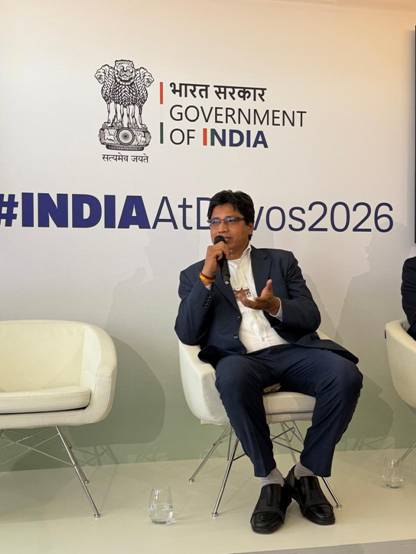
Shri Pradip Kumar Das participated in a high-level panel discussion titled “Scaling Solar Where It Matters: India’s Lessons on Rooftop, Agriculture and Decentralized Energy for the Global South,” which focused on expanding solar adoption through rooftop systems, agricultural applications and decentralised energy models. The session emphasised India’s growing role as a global reference point for inclusive and sustainable solar deployment.
Earlier in the day, Union Minister for New and Renewable Energy Shri Pralhad Joshi delivered the keynote address at the forum, outlining India’s progress and policy framework in advancing solar energy as a driver of economic growth, energy security and climate action.
Addressing the panel, Shri Pradip Kumar Das said that decentralised renewable energy can significantly improve system efficiency by reducing government subsidies and Aggregate Technical and Commercial losses, thereby lowering overall costs and improving affordability for consumers. He noted that India’s experience demonstrates how distributed solar solutions can strengthen utility finances while expanding clean energy access.
Shri Das underlined that although emerging renewable energy segments are often perceived as high-risk, robust project structuring and disciplined risk management can substantially de-risk investments. He cited IREDA’s track record, pointing out that the institution has recorded a cumulative write-off of only ₹149 crore over more than 38 years of operations, despite financing renewable energy projects worth approximately ₹1.81 lakh crore since inception. This, he said, reflects the strength of IREDA’s appraisal, monitoring and governance systems.
He further highlighted that IREDA finances around 70 to 80 percent of project costs under Rooftop Solar and PM-KUSUM schemes in aggregator mode, a model that has played a critical role in accelerating clean energy access, particularly in rural and agricultural regions.
Thanking Union Minister Shri Pralhad Joshi for facilitating IREDA’s participation at the World Economic Forum, Shri Das said the platform enabled India to present its renewable energy growth story, which has been driven by a mature policy ecosystem, institutional capacity and strong public-private collaboration.
Referring to progress in agricultural solarisation, including initiatives in Maharashtra, Shri Das stressed the importance of building an enabling ecosystem that reduces risk and attracts patient global capital. He said India’s institutional experience in financing and deploying decentralised renewable energy can serve as a valuable template for other countries seeking to expand clean energy while ensuring affordability and financial sustainability.
The discussions at Davos reaffirmed India’s position as a key global partner in the clean energy transition and highlighted IREDA’s pivotal role in supporting the country’s renewable energy ambitions through innovative financing and prudent risk management.