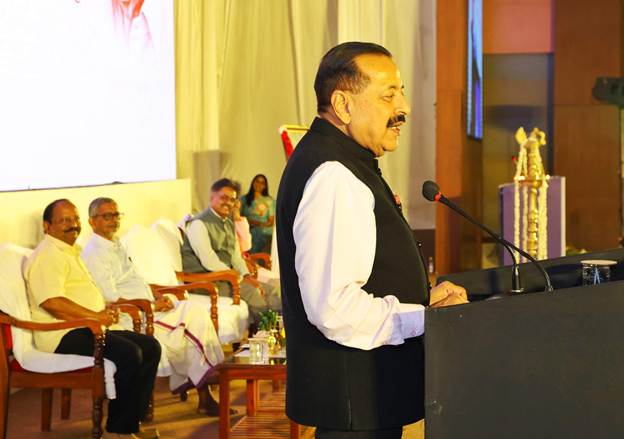

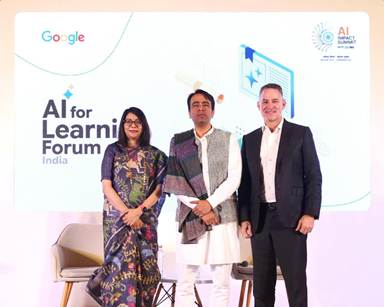
Union Minister of State Independent Charge for Skill Development and Entrepreneurship and Minister of State for Education Shri Jayant Chaudhary today outlined the Government of India’s comprehensive vision for integrating artificial intelligence across education and skilling ecosystems at Google’s AI for Learning Forum held in New Delhi. The Minister announced a landmark collaboration between the Ministry of Skill Development and Entrepreneurship, Google Cloud and Chaudhary Charan Singh University Meerut, positioning CCSU as India’s first AI enabled state university pilot, a major step towards realising the Prime Minister’s vision of a technology powered Viksit Bharat 2047.
The forum was attended by senior leadership from Google, including Ms Preeti Lobana Vice President and Country Manager Google India, Mr Chris Phillips Vice President and Global Lead for Education Google, Mr Wilson White Vice President Government Affairs and Public Policy Google APAC, and Ms Yolynd Lobo Director Government Affairs and Public Policy Google Cloud, along with senior government officials and education leaders.
Prior to the formal session, Shri Jayant Chaudhary interacted with students and faculty members of CCSU, engaging in an open dialogue on how artificial intelligence can expand learning pathways, improve employability and unlock opportunities for youth from Tier Two and Tier Three cities.
Delivering the keynote perspective during a fireside chat moderated by Ms Yolynd Lobo, the Minister stressed the need to dismantle long standing silos between education and skilling. He highlighted that technology, particularly artificial intelligence, can act as a critical bridge between classroom learning and industry requirements.
Shri Jayant Chaudhary said the vision of Viksit Bharat depends on converting India’s demographic dividend into demographic dynamism. He noted that degrees and skills were historically treated as separate tracks, and artificial intelligence now offers the opportunity to connect them. He emphasised that partnerships of this nature are not merely about deploying technology, but about creating a national employability engine that democratises access to world class skills regardless of geography.
CCSU To Function As National Living Laboratory
Under the pilot initiative, Chaudhary Charan Singh University Meerut will serve as a living laboratory for AI led institutional reform. The university will deploy personalised AI tutors for students, AI driven skill gap analysis tools and intelligent document processing systems to streamline administrative workflows. The initiative is designed to produce a scalable framework that can be adopted across the country’s higher education ecosystem.
The Minister highlighted that CCSU’s affiliated colleges would be immediate beneficiaries of the pilot, with learnings expected to be scaled across India’s more than forty five thousand colleges and over twelve hundred universities. He also underlined alignment with the Government’s sixty thousand crore rupees Model ITI Scheme, enabling vocational institutions to adopt AI enabled curricula alongside modernised infrastructure.
Describing the collaboration as a gold standard for the future of Indian education, Shri Jayant Chaudhary said CCSU is being treated not just as a university, but as a blueprint for institutional transformation, ensuring that students in Meerut have access to the same AI capabilities as learners in global technology hubs.
Focus On Digital Public Infrastructure And Teacher Empowerment
During the forum, Google announced an eighty five crore rupees Google org grant to Wadhwani AI to support integration of artificial intelligence tools into national platforms such as SWAYAM and Poshan Tracker, with an intended outreach to nearly seventy five million learners.
Calling for deeper grassroots engagement, the Minister urged Google to extend AI support to Kendriya Vidyalayas and Navodaya Vidyalayas, emphasising that empowering teachers in these institutions is essential to unlocking digital opportunities in remote and underserved regions.
India As A Global Model For Inclusive AI
Highlighting India’s emerging leadership role, Shri Jayant Chaudhary stated that solutions developed for India’s diverse linguistic, cultural and geographic context can serve as models for the Global South. He said that AI tools designed for low cost devices and vernacular users represent global public goods, and reaffirmed India’s commitment to sharing Made in India education models with partner countries across Africa, Southeast Asia and Latin America, in line with the ethos of Vishwa Bandhu.
Google Reaffirms Long Term Commitment
Ms Preeti Lobana said Google is deeply committed to supporting India’s aspiration to become a global AI hub. She noted that through this collaboration, CCSU will leverage Google Cloud and Gemini to develop solutions ranging from personalised learning to AI driven career guidance. She added that the initiative aims to pilot a framework for modernising education and skill development at population scale, ensuring equitable access to world class learning tools.
Mr Chris Phillips highlighted Google’s approach to responsible AI in education, emphasising learning science, productive struggle and the use of tools such as Gemini, Search and NotebookLM, which were demonstrated during the forum.
National Blueprint For AI Ready Institutions
Drawing on the CCSU implementation, the Ministry of Skill Development and Entrepreneurship will develop a National Best Practice Framework enabling colleges and universities to self certify as AI enabled institutions. CCSU will also function as a Centre of Excellence, hosting knowledge sharing sessions across the Ministry’s network.
The forum concluded with a joint interaction and photo opportunity with Shri Jayant Chaudhary and Google leadership, marking a significant milestone in India’s journey towards integrating artificial intelligence across education and skilling systems. The collaboration reinforces the Government’s commitment to ensuring that every learner, regardless of background or location, graduates not only with a degree but with future ready skills aligned to the demands of the AI driven economy.