
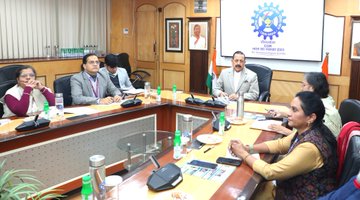
Union Minister of State for Science and Technology Jitendra Singh on 6 January 2026 chaired a high level review meeting of the Council of Scientific and Industrial Research at Anusandhan Bhawan in New Delhi, outlining priorities for strengthening mission oriented research and translating scientific outcomes into tangible economic and societal benefits.
During the review, the Minister lauded CSIR’s efforts to build indigenous capabilities in critical aerospace technologies, describing them as vital for India’s self reliance in the aviation sector and for long term economic growth. He said the future direction of publicly funded research must align closely with national priorities under the Viksit Bharat vision.
Director General of CSIR and Secretary of the Department of Scientific and Industrial Research N Kalaiselvi presented a forward looking roadmap detailing key programmes and initiatives aimed at strengthening India’s science and technology ecosystem. She highlighted CSIR’s focus on mission mode research, institutional reforms, and the translation of laboratory research into outcomes with direct relevance for society and the economy.
A major focus of the presentation was on aerospace related projects. Kalaiselvi said CSIR is planning a mission mode programme to develop indigenous capabilities in critical aerospace technologies, enhance strategic self reliance, and protect sensitive design and knowledge domains. She noted that the initiative is designed to reduce external dependencies in strategic sectors while promoting innovation led growth and high end research and development, core pillars of the Viksit Bharat vision.
Reviewing progress across multiple CSIR initiatives, the Minister stressed that scientific research must increasingly be evaluated in terms of real world impact. He said outcomes should be clearly linked to employment generation, startup creation, industrial scale up, and broader societal benefit, particularly for the youth.
Jitendra Singh also emphasised the need for a decentralised and structured communication strategy. He said CSIR’s 37 laboratories across the country should actively engage with media, industry, stakeholders, and local communities to showcase their achievements. The emphasis, he said, should be on explaining how laboratory innovations are delivering practical benefits on the ground rather than remaining confined to technical narratives.
Calling for a refreshed public narrative around science, the Minister urged CSIR to highlight success stories related to startups, technology deployment, job creation, and sectoral impact so that the value of scientific research is better understood by citizens and policymakers.