
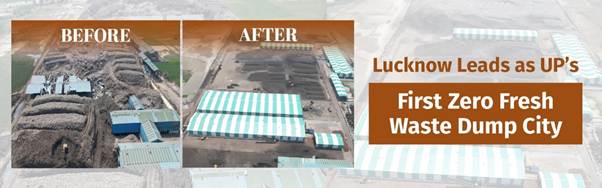
Lucknow has achieved a major milestone in urban sustainability by becoming the first city in Uttar Pradesh to attain 100 percent scientific processing of municipal solid waste, earning the distinction of a zero fresh waste dump city under the Swachh Bharat Mission Urban.
The achievement follows the commissioning of the Shivari Solid Waste Management Plant, the city’s third fresh waste processing facility. With a processing capacity of 700 metric tonnes per day, the Shivari plant completes Lucknow Municipal Corporation’s waste management infrastructure, enabling the scientific processing of the city’s entire daily waste generation of more than 2,100 metric tonnes.
Lucknow, a rapidly expanding urban centre with a population of nearly 40 lakh and about 7.5 lakh establishments, generates around 2,000 metric tonnes of municipal solid waste every day. To address the environmental and public health challenges arising from this scale of urban growth, the Lucknow Municipal Corporation has adopted a multi pronged strategy focused on scientific waste disposal, resource recovery and sustainable urban development.
With three waste processing plants of 700 metric tonnes per day capacity each, developed in partnership with Bhumi Green Energy, the city now processes all fresh waste without resorting to open dumping. Waste collected from households and establishments is segregated into organic and inorganic fractions. Organic waste, accounting for about 55 percent, is processed into compost and biogas, while inorganic waste is sorted for recycling or converted into refuse derived fuel for industrial use. Door to door waste collection efficiency in the city has improved to 96.53 percent, while source segregation levels have crossed 70 percent.
The city has also made substantial progress in addressing legacy waste. Out of an estimated 18.5 lakh metric tonnes of accumulated waste, about 12.86 lakh metric tonnes has already been scientifically processed. The by products generated include refuse derived fuel, construction and demolition waste, bio soil and coarse fractions, which have been utilised through recycling, co processing and environmentally appropriate landfilling. Around 2.27 lakh metric tonnes of refuse derived fuel has been dispatched to cement and paper industries across the country for co processing. Inert materials such as coarse fractions, bio soil and construction and demolition waste have been repurposed for infrastructure development and filling of low lying areas.
As legacy waste processing progressed, more than 25 acres of land at the site has been reclaimed and transformed into a fully functional waste treatment complex. The facility now includes windrow pads, internal roads, processing sheds, dedicated weighbridges and a complete ecosystem for handling and processing municipal waste.
Building on this progress, the Lucknow Municipal Corporation is preparing to establish a waste to energy plant at Shivari. The proposed 15 megawatt facility will convert 1,000 to 1,200 metric tonnes of refuse derived fuel per day into electricity, reducing both the cost and environmental impact of transporting RDF to cement plants located nearly 500 kilometres away.
Lucknow’s waste management model demonstrates a strong commitment to circular economy principles by maximising resource recovery, minimising legacy waste and promoting reuse and recycling. The city’s achievement positions it as a leading example of sustainable urban waste management and offers a replicable model for other cities in India and beyond.