
India’s metro rail network has undergone a dramatic transformation over the past decade, emerging as a major pillar of sustainable urban mobility and economic resilience. Rapid expansion of metro infrastructure across the country has not only improved connectivity and reduced congestion in major cities but has also delivered broader economic and social benefits, including improved household financial stability and reduced dependence on private vehicles.
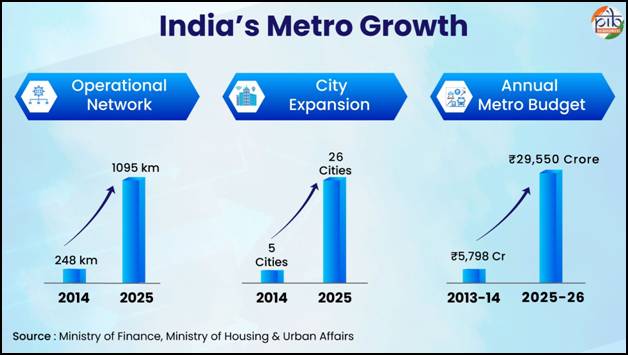
India’s metro network has expanded significantly from 248 kilometres in 2014 to approximately 1,095 kilometres by 2025. This includes about 55 kilometres of the Delhi–Meerut Regional Rapid Transit System corridor. During the same period, the number of cities with operational metro services increased from just five to 26, demonstrating the rapid scale and reach of modern urban transport infrastructure in the country.
The expansion has positioned India among the world’s leading metro networks. With more than a thousand kilometres of operational lines, India now has the third largest metro rail network globally. Metro systems currently operate across major urban centres including Delhi and NCR, Mumbai, Bengaluru, Kolkata, Hyderabad, Chennai, Lucknow, Pune, Ahmedabad and several other cities.
The rapid growth of metro rail infrastructure has been supported by strong government investment. Since 2014, a total of 38 metro rail projects covering 1,051 kilometres have been sanctioned across the country with an estimated cost of ₹3.44 lakh crore. The Union Government’s financial commitment to metro development has increased sharply, with the annual metro budget rising from ₹5,798 crore in 2013–14 to ₹29,550 crore in 2025–26.
This expansion forms part of the broader national infrastructure push. In the Union Budget 2024–25, the government allocated a record ₹11.21 lakh crore for capital expenditure, equivalent to 3.1 percent of the country’s GDP. Metro rail projects are a key component of this infrastructure strategy and are integrated within the PM GatiShakti National Master Plan to ensure seamless connectivity with other transport systems including railways, roads, aviation and logistics networks.
Metro corridors are also being prioritised under the National Infrastructure Pipeline, which identifies metro transport as a critical urban infrastructure asset supporting long term economic growth and urban development. The Network Planning Group regularly reviews metro rail and aviation projects together to strengthen integrated transport planning and improve overall urban mobility.
India’s metro journey has not been defined solely by expansion in network length. The country has also introduced several technological innovations and infrastructure achievements that reflect growing engineering capabilities and a strong commitment to sustainable mobility.
One major milestone was the introduction of the Namo Bharat regional train service in October 2023. This state of the art semi high speed train operates on the Delhi–Meerut Regional Rapid Transit System corridor. The train runs at an operational speed of 160 kilometres per hour and has a design speed of 180 kilometres per hour, marking a significant step forward in fast regional connectivity and modern rail transport.
Another landmark achievement came in 2024 when India launched its first underwater metro tunnel in Kolkata. The tunnel connects Esplanade to Howrah Maidan beneath the Hooghly River, representing a major engineering accomplishment and highlighting India’s growing expertise in complex infrastructure construction.
In April 2023, Kochi in Kerala became the first city in India to introduce a Water Metro system. The project connects ten islands through electric hybrid boats and offers an environmentally friendly and integrated transport system. The initiative has been widely recognised as a pioneering model for sustainable urban mobility in coastal regions.
Indian metro systems are also incorporating advanced technologies to improve safety, operational efficiency and environmental sustainability. The Namo Bharat Regional Rapid Transit System uses the European Train Control System for signalling. On the Delhi–Meerut corridor, a hybrid Level III radio based signalling system operating on a Long Term Evolution backbone has been deployed for the first time in the world, enabling smarter and safer train operations.
Safety at metro stations has been strengthened through the installation of Platform Screen Doors developed jointly by Bharat Electronics Limited and the National Capital Region Transport Corporation. These doors open only when trains are correctly aligned with the platform, helping prevent accidents and reducing trespassing.
Smart ticketing technologies are also transforming passenger convenience. The National Common Mobility Card system, based on the One Nation One Card concept, is currently operational across 11 metro projects and 11 bus corporations. This allows passengers to use a single card for travel across different modes of public transport.
In addition, QR code based ticketing systems accessible through mobile applications enable passengers to book and access digital tickets easily. Driverless train operations have already been introduced on the Delhi Metro’s Pink Line and Magenta Line, demonstrating the adoption of cutting edge automation technologies.
India has also developed its own indigenous Automatic Train Supervision system known as i ATS. This system has been implemented on the Delhi Metro’s Red Line through collaboration between Delhi Metro Rail Corporation and Bharat Electronics Limited.
Metro systems across the country are incorporating energy efficient practices to reduce their environmental footprint. Technologies such as regenerative braking systems help recover energy during train operations, while solar panels installed at metro stations and depots generate renewable electricity. Green building designs and energy efficient stations further support India’s climate and sustainability goals.
Beyond improving mobility, metro expansion has also delivered significant economic benefits for urban households. A recent study titled Golden Decade of Infrastructure Development in India with Special Reference to Metro Rail Network, prepared by the Economic Advisory Council to the Prime Minister in January 2026, highlights the broader financial and social impact of metro development.
The study finds that improved metro connectivity reduces household transport costs and improves financial discipline among urban families. With lower commuting expenses and reduced dependence on private vehicles, households experience lower financial stress and improved ability to manage loan repayments.
In Hyderabad, missed payments on home loans have fallen by 1.7 percent after metro connectivity expanded, while early loan repayments have increased by 1.8 percent. In Bengaluru, delays in home loan repayments have declined by 2.4 percent, and early repayments have increased by 3.5 percent.
In Delhi, the impact has been even more significant. Missed mortgage payments have declined by 4.42 percent while early repayments have risen by 1.38 percent, indicating improved financial discipline among households benefiting from efficient public transport.
The study also notes that metro connectivity has contributed to reduced purchases of entry level cars and two wheelers in areas served by metro systems. This shift away from private transport reduces household expenses related to fuel, maintenance and vehicle loans.
As a result, households experience lower debt burdens and improved liquidity. These improvements in repayment behaviour and financial discipline also contribute to strengthening the broader financial system by reducing default risks.
Metro infrastructure is therefore emerging as more than a transportation solution. It is becoming a critical driver of urban productivity, sustainable development and long term economic resilience.
With continued investment, integrated planning and technological innovation, India’s metro network is expected to expand further in the coming years. The transformation of urban transport systems is helping create cities that are more connected, environmentally sustainable and economically resilient.