
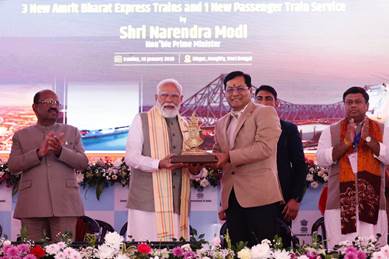
Prime Minister Narendra Modi on Saturday inaugurated, laid foundation stones for and flagged off a series of railways, ports and inland waterways projects worth more than ₹830 crore at Singur in Hooghly district, marking a significant expansion of transport and logistics infrastructure in West Bengal and eastern India.
Addressing the gathering, the Prime Minister said the development of eastern India is essential for building a developed India, and reiterated that the Union Government is working with sustained focus to unlock the region’s economic potential. He noted that within a span of 24 hours, West Bengal witnessed unprecedented improvements in rail and waterway connectivity, reinforcing the Centre’s commitment to balanced regional growth.
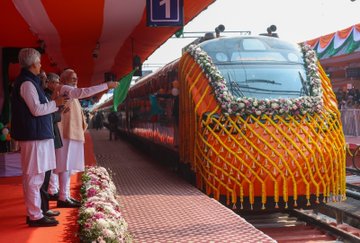
Highlighting recent rail initiatives, the Prime Minister recalled that India’s first Vande Bharat Sleeper Train was launched from West Bengal a day earlier, along with several new Amrit Bharat Express services. He said three additional Amrit Bharat Express trains were launched on Saturday, further strengthening connectivity between West Bengal and key destinations including Varanasi, Delhi and Tamil Nadu. These services, he added, will improve passenger mobility and support economic, cultural and religious travel corridors.
The Prime Minister underscored West Bengal’s vast potential in inland waterways, stating that the government is systematically reviving river transport through modern infrastructure and port-led development. He said the waterways and port projects inaugurated and launched on Saturday would serve as pillars for transforming West Bengal into a hub for manufacturing, trade and logistics.
Union Minister for Ports, Shipping and Waterways Sarbananda Sonowal said the projects dedicated by the Prime Minister mark a major step in scaling up waterways and rail-based transportation in the state. He noted that the initiatives will enhance cargo movement, strengthen multimodal connectivity, ensure smoother passenger transport and generate employment across the region.
As part of the inland waterways push, projects worth ₹552 crore were launched to expand river-based logistics and decongest traditional road and rail cargo routes. A key component was the inauguration of the Extended Port Gate System at Balagarh, developed by the Syama Prasad Mookerjee Port Authority. Located around 45 nautical miles upstream from Kolkata, the facility is designed to reduce congestion at the Kolkata Dock System while enabling efficient cargo movement through National Waterway 1 on the Ganga–Bhagirathi–Hooghly river system.
The Balagarh terminal includes a modern barge facility with two berths capable of handling containerised and coal cargo, with an annual capacity of 2.7 million tonnes. The site is supported by road and rail connectivity, a newly constructed road overbridge and advanced dredging facilities, enabling year-round navigation and faster cargo turnaround.
In a major step towards green passenger transport, the Prime Minister also launched a 50-passenger hybrid electric aluminium catamaran for operations on Kolkata’s waterways. Built at a cost of ₹12 crore, the vessel uses advanced lithium-titanate battery technology and represents a shift towards energy-efficient and environment-friendly inland water transport.
Strengthening the rail network, railway projects worth ₹280 crore were inaugurated, including the commissioning of the 15-kilometre Jayrambati–Barogopinathpur–Maynapur section, part of the 83-kilometre Tarakeswar–Bishnupur rail project. The new line is expected to spur socio-economic development in Bankura district. A passenger train on the Jayrambati–Maynapur route was flagged off to benefit daily commuters and students.
Additionally, three Amrit Bharat Express services were launched linking Santragachi with Tambaram, Howrah with Anand Vihar Terminal and Sealdah with Banaras, strengthening long-distance connectivity and integrating eastern India more closely with the rest of the country.
The inauguration, conducted virtually from Singur, was attended by the Governor of West Bengal and Union Ministers, among other dignitaries. Collectively, the projects reflect the government’s integrated approach to infrastructure development, combining sustainable inland water transport with modern rail connectivity to reduce logistics costs, ease congestion and reinforce West Bengal’s role as a key gateway for trade and connectivity with the North Eastern region.