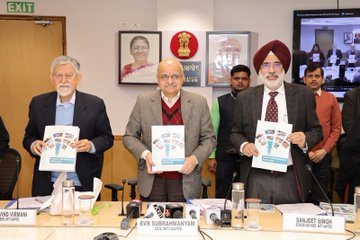

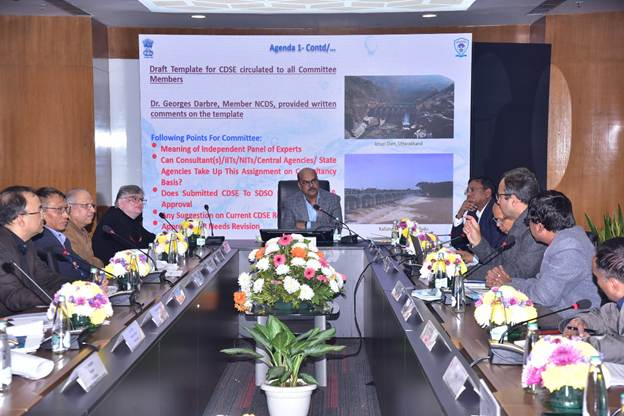
The 11th meeting of the National Committee on Dam Safety was held today at the Dr Ambedkar International Centre in New Delhi, bringing together central ministries, technical institutions, state governments and domain experts to review policies and frameworks aimed at strengthening dam safety across the country.
The meeting was chaired by Shri Anupam Prasad, Chairman, Central Water Commission and Chairman, National Committee on Dam Safety. It was attended by representatives from the Department of Water Resources, River Development and Ganga Rejuvenation; Central Water Commission; National Disaster Management Authority; Central Electricity Authority; Ministry of Environment, Forest and Climate Change; India Meteorological Department; Geological Survey of India; National Remote Sensing Centre; and the National Dam Safety Authority. Officials from Assam, Karnataka, Maharashtra, Mizoram, Odisha, Punjab and Uttar Pradesh participated, along with heads of 28 State Dam Safety Organisations and representatives from three Union Territories.
Eminent dam safety experts Shri S K Sibal, former Member, Central Water Commission, and Dr Yogendra Singh, Professor, IIT Roorkee, also took part in the deliberations, contributing technical perspectives to the discussions.
The National Committee on Dam Safety is constituted under Section 5 of the Dam Safety Act, 2021 and functions as a policy think tank for the National Dam Safety Authority. Its mandate includes deliberation on dam safety related policies and recommending regulations to ensure uniform safety standards and prevent disasters arising from dam failures.
In his opening remarks, Shri Anupam Prasad highlighted the achievements of the National Dam Safety Authority over the past four years. He drew attention to emerging challenges in dam safety, the extensive statutory responsibilities placed on dam owners under the Dam Safety Act, 2021, and gaps in in house capacity among dam owning agencies. He emphasised that effective implementation of the Act depends on close cooperation among stakeholders, strong technical capabilities and sustained collective commitment.
The Committee discussed several key agenda items, including standard operating procedures for Comprehensive Dam Safety Evaluation under Sections 38 to 40 of the Act, standard operating procedures for Pre Initial Filling Plans under Section 27, financial remuneration for national and international dam safety experts, and finalisation of frameworks for Level 2 Semi Quantitative Risk Assessment and Level 3 Quantitative Risk Assessment under Section 35(2). Other agenda items included clarification of definitions related to under construction dam and barrage projects, approval mechanisms for new dam construction and rehabilitation of existing dams under Section 26, appraisal and approval of non structural documents, optimisation of seismic instrumentation, and safety issues related to the Chandraprabha Dam in Uttar Pradesh.
The Committee noted that Comprehensive Dam Safety Evaluation, Semi Quantitative Risk Assessment and Quantitative Risk Assessment are relatively new elements for Indian dam owners and require careful institutional and technical preparation. Members advised the National Dam Safety Authority to revise and update draft frameworks for Comprehensive Dam Safety Evaluation reports to make them more comprehensive and practical. It was also recommended that Pre Initial Filling Reservoir Plans be strengthened by incorporating quantified parameters related to reservoir filling.
On the framework for Semi Quantitative Risk Assessment, the Committee decided that, given its national importance, a dedicated expert committee should be constituted. Regarding approvals for construction of new dams and rehabilitation of existing dams, the Committee advised wider consultations with dam owners and suggested that the matter be brought back for detailed discussion in the next meeting.
The appraisal and approval of non structural documents was recommended to be undertaken by State Dam Safety Organisations through expert committees. On seismic instrumentation, the Committee deliberated on optimisation proposals and decided to continue with the existing regulations notified by the National Dam Safety Authority.
The Committee appreciated the efforts of the Government of Uttar Pradesh in addressing seepage issues at the Chandraprabha Dam. It reiterated the need for strong coordination between the Centre and States, with particular emphasis on developing and implementing a comprehensive capacity building action plan to ensure compliance with statutory dam safety obligations.
The meeting concluded with a resolve to further strengthen the institutional framework, expedite implementation of the Dam Safety Act, 2021, and ensure long term safety and sustainability of dams, supporting national objectives related to water security, irrigation, power generation and flood moderation.