
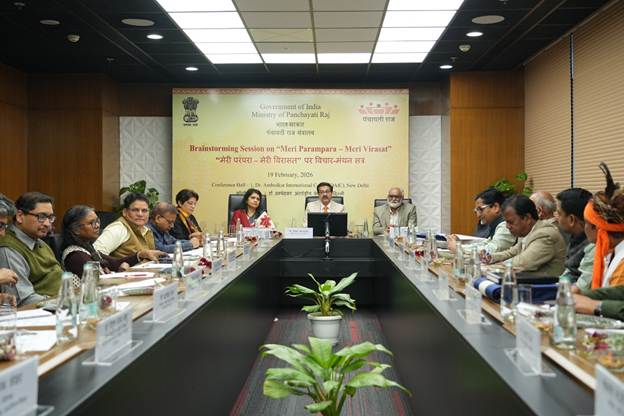
A day-long brainstorming session on Meri Parampara Meri Virasat was held in the national capital to strengthen efforts for documentation and digital preservation of tribal heritage in Scheduled Areas, with a focused implementation roadmap for Chhattisgarh.
The session was organised by the Ministry of Panchayati Raj in collaboration with Indira Gandhi National Centre for the Arts, Ministry of Culture, and the Panchayat and Rural Development Department, Government of Chhattisgarh. The initiative marks a structured push toward safeguarding tribal cultural traditions through community-led documentation and digital archiving.
Vivek Bharadwaj, Secretary, Ministry of Panchayati Raj, participated in the deliberations along with senior officials from the Ministry, Panchayat and Rural Development Department of Chhattisgarh, Indira Gandhi National Centre for the Arts, academicians, scholars, cultural experts, panchayat representatives and tribal community leaders from Chhattisgarh.
Community Centric Approach to Cultural Preservation
Addressing the gathering, Vivek Bharadwaj emphasised that traditions and customs define the identity of communities and that erosion of these traditions weakens collective identity. He highlighted that the Meri Parampara Meri Virasat initiative is distinguished by its community-centred model, under which documentation is undertaken by the very communities that practise and preserve these traditions.
He stressed that heritage documented by communities themselves carries authenticity, depth and long-term credibility. Calling for a collective effort, he underlined the need for structured documentation guided by shared responsibility between institutions and local communities.
Implementation Framework for Chhattisgarh
Niharika Barik Singh, Principal Secretary, Panchayat and Rural Development Department, Government of Chhattisgarh, presented the State’s implementation framework and expressed readiness to partner in operationalising the initiative. She noted that Chhattisgarh’s extensive tribal population and diverse cultural traditions offer a strong foundation for systematic documentation and preservation.
Chhattisgarh is home to 42 recognised Scheduled Tribes, including Particularly Vulnerable Tribal Groups, making it one of the most culturally diverse tribal regions in the country. The initiative seeks to ensure that these living traditions are preserved for future generations through structured and digitised processes.
Sachchidanand Joshi, Member Secretary, Indira Gandhi National Centre for the Arts, underscored the importance of local participation in documentation. He observed that documentation carried out by those who live and practise these traditions ensures both authenticity and contextual accuracy. He added that digitisation of tribal traditions would preserve living heritage, reconnect younger generations with their roots and strengthen community ownership of cultural narratives.
Digital Integration Through MGMD Portal
A detailed presentation was made on the upgradation of the Mera Gaon Meri Dharohar portal under the National Mission on Cultural Mapping. The portal is a joint initiative of the Ministry of Culture and the Ministry of Panchayati Raj.
Under the upgraded framework, the Gram Sabha has been adopted as the primary platform for village-level cultural documentation. Structured Gram Sabha meetings across Panchayats are enabling systematic data collection, verification and validation of local heritage assets. This institutionalisation of cultural mapping at the grassroots level is designed to ensure accuracy, participation and continuity.
The session focused on two core themes: documentation and digital preservation of tribal cultural heritage in Scheduled Areas of Chhattisgarh, and finalisation of the operational framework for implementation.
Ten Thematic Areas of Documentation
Deliberations were structured around ten thematic areas to ensure comprehensive coverage of tribal heritage:
Knowledge Traditions including philosophy, oral narratives and healing practices
Visual and Material Arts including sculpture and textiles
Performing Arts including dance, music and puppetry
Practices and Rituals including festivals, cuisines and life cycle ceremonies
Histories including places, movements and social transformations
Literature and Languages including authors, texts and linguistic traditions
Built Spaces including places of worship, memorials and historic sites
Natural Environment including ecosystems, native species and national parks
Institutions including museums, universities and cultural centres
People including artistes, scholars and community practitioners
By organising documentation across these categories, the initiative aims to create a structured digital archive that captures both tangible and intangible dimensions of tribal heritage.
Background and National Context
Meri Parampara Meri Virasat has been conceptualised and supported by the Ministry of Panchayati Raj and is being implemented in partnership with State Governments and relevant institutions. The initiative seeks comprehensive documentation and digital preservation of tribal cultural heritage in Scheduled Areas, covering folk songs, festivals, worship practices, oral traditions, art forms and customary governance systems.
Chhattisgarh is the second State to take up the initiative. The campaign was first launched by the Department of Panchayati Raj, Government of Jharkhand, on January 26, 2025 under the theme Hamari Parampara Hamari Virasat. The objective is to preserve and transmit to future generations the cultural heritage integral to traditional governance systems of Scheduled Tribe communities.
The New Delhi session reinforced the need for structured digital preservation anchored in community participation and institutional support. With Chhattisgarh initiating documentation in Scheduled Areas, the initiative is positioned to become a model for integrating grassroots cultural mapping with national digital heritage frameworks.