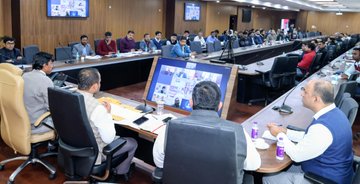

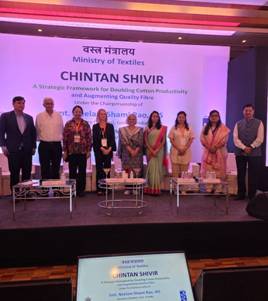
The Ministry of Textiles organised a Chintan Shivir in Nagpur on Saturday to deliberate on a strategic framework for doubling cotton productivity and enhancing quality fibre, bringing together policymakers, scientists, industry leaders and agricultural experts to strengthen India’s position in the global cotton value chain.
The discussions focused on improving farm productivity, advancing technology in cotton processing, promoting sustainability and positioning Kasturi Cotton Bharat as a premium global brand.
Addressing the gathering, Neelam Shami Rao, Secretary in the Ministry of Textiles, emphasised that the ideas emerging from the deliberations must be translated into concrete and actionable outcomes. She said the way forward for India’s cotton sector lies in advancing reforms and innovation across the value chain guided by the pillars of Reform, Perform, Transform and Inform.
She noted that expanding drip irrigation, strengthening agricultural extension networks and improving farmer advisory services can significantly enhance cotton productivity. She also stressed the importance of district level soil mapping to help farmers select suitable cotton varieties.
Neelam Shami Rao highlighted the need for innovation and healthy competition within the cotton seed ecosystem and recommended the development of region specific Cotton Calendars to guide farmers on best agronomic practices.
Speaking on the occasion, Padmini Singla, Joint Secretary Fibre in the Ministry of Textiles, said that strengthening the cotton sector requires a coordinated and integrated approach across the entire value chain to improve productivity, fibre quality and farmer incomes.
She emphasised that collaborative policy action and informed deliberation among stakeholders are necessary to address emerging challenges and unlock new opportunities for the cotton sector.
The Chintan Shivir included four thematic sessions covering key dimensions of the cotton value chain.
Key thematic sessions
• Prosperous Farmers Doubling Productivity Doubling Income
• Precision Ginning and Quality Assurance
• Sustainability and Circularity
• Kasturi Cotton Bharat positioning India as a Global Premium Brand
The session on prosperous farmers focused on strategies such as soil based crop planning, High Density Planting Systems, farm mechanisation, artificial intelligence based pest monitoring and strengthened digital advisory systems to improve productivity and farmer incomes.
The discussion on precision ginning and quality assurance highlighted the adoption of modern ginning technologies, contamination control mechanisms, improved fibre testing systems and robust traceability frameworks to supply premium quality cotton to global markets.
The sustainability and circularity session examined climate resilient agricultural practices, sustainable cotton production systems and circular textile economy models aligned with evolving global sustainability standards.
The session on Kasturi Cotton Bharat explored strategies to strengthen traceability systems, improve certification frameworks and promote the branding of Kasturi Cotton Bharat as India’s premium cotton identity in international markets.
In her valedictory address, Neelam Shami Rao emphasised the importance of building a cotton ecosystem that is efficient, technology driven and resilient to emerging challenges.
She said modern technologies, data driven decision making and innovative agricultural and industrial practices must be leveraged to enhance productivity, ensure superior fibre quality and improve value realisation across the cotton sector.
The Secretary also called for stronger collaboration among state governments, research institutions, industry stakeholders and farmers to build a future ready cotton ecosystem and reinforce India’s position as a leading global hub for cotton and textiles.
The Chintan Shivir concluded with a shared commitment to strengthen the cotton value chain under the guidance of Giriraj Singh, Union Minister of Textiles, in alignment with the Prime Minister’s 5F vision which focuses on Farm to Fibre, Fibre to Fabric, Fabric to Fashion and Fashion to Foreign.