
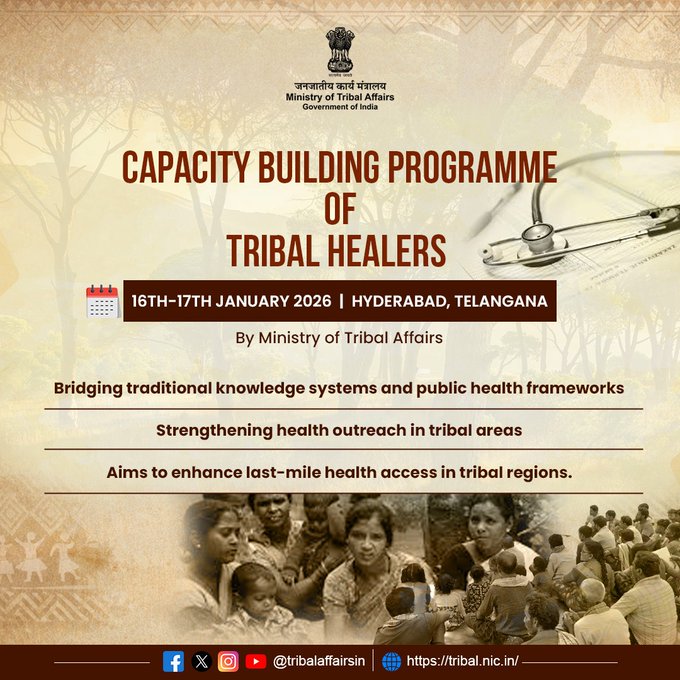
India is set to take a landmark step in strengthening healthcare delivery in tribal regions with the launch of the country’s first National Capacity Building Programme for Tribal Healers, to be organised by the Ministry of Tribal Affairs on 16 and 17 January 2026. The programme will be held at Kanha Shanti Vanam and represents a first of its kind national initiative to formally recognise, train and integrate tribal and indigenous healers as community level partners within the public health system.
The two day programme is aligned with the national vision of inclusive, equitable and culturally rooted development of tribal communities. It seeks to strengthen health outreach in tribal and remote areas by building the capacities of traditional healers who continue to be the first point of care for large sections of the tribal population. By acknowledging their social legitimacy and local trust, the initiative aims to bridge gaps between indigenous knowledge systems and modern healthcare delivery.
Senior leadership from the Government of India will participate in the programme, reflecting high level commitment to tribal health. The presence of Union Ministers for Tribal Affairs, the Minister of State for Tribal Affairs and senior officials from partner ministries and institutions underscores the priority being accorded to culturally sensitive and evidence based health interventions in tribal regions.
A major highlight of the programme will be the signing of a Memorandum of Understanding between the Ministry of Tribal Affairs and the ICMR Regional Medical Research Centre Bhubaneswar for the establishment of the Bharat Tribal Health Observatory under Project DRISTI. This collaboration will lead to the creation of India’s first National Tribal Health Observatory, a dedicated institutional platform to generate tribe disaggregated health data, strengthen disease surveillance and support research driven policy making in tribal districts.
The observatory will address a long standing national gap in the availability of reliable, tribe specific health data and analytics. It will support implementation research, disease elimination initiatives and evidence based interventions tailored to tribal realities. The initiative will also enable the rollout of the Bharat Tribal Family Health Survey and align disease specific research with national programmes on tuberculosis, malaria, leprosy and other priority conditions.
Over the years, the Ministry of Tribal Affairs has emerged as a nodal ministry for improving health outcomes in tribal areas through focused initiatives such as the National Sickle Cell Anaemia Elimination Mission, expansion of health infrastructure in tribal and Particularly Vulnerable Tribal Group regions, and convergence with flagship programmes including PM JANMAN and the Dharti Aaba Janjatiya Gram Utkarsh Abhiyan. These efforts have laid the foundation for more structured and data driven engagement with tribal health challenges.
The capacity building programme is being organised with strong technical and knowledge partnerships involving leading national and international institutions, including the Indian Council of Medical Research, premier medical institutes, the Ministry of Health and Family Welfare, the Ministry of AYUSH and the World Health Organization. These collaborations will bring scientific rigour, global best practices and ethical safeguards to the engagement with tribal healers.
Under the MoU, a secure digital tribal health surveillance platform will be developed with dashboards, GIS enabled analytics and periodic health outputs. The collaboration will also support capacity building of state and district health systems, alongside referral oriented and sensitisation training for tribal healers to strengthen early detection, referral and follow up within the formal health system.
Together, the national capacity building programme and the establishment of the Bharat Tribal Health Observatory mark a significant shift in tribal health policy. Moving beyond documentation of traditional practices, the initiative focuses on structured training, institutional linkages and data driven action. It reflects a growing commitment to harmonising indigenous knowledge with modern public health frameworks to deliver sustainable and equitable health outcomes in some of the country’s most underserved regions.