
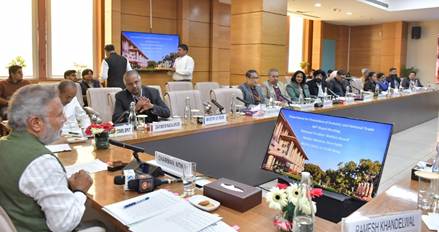
The eighth meeting of the National Traders Welfare Board was held in New Delhi on 9 January 2026 to review ongoing initiatives aimed at strengthening the retail trade sector and enhancing the welfare of traders across the country.
The meeting, chaired by the Board’s chairperson Sunil J Singhi, was attended by non official members representing trade associations from states and union territories, along with ex officio members from nine ministries and departments of the central government.
Addressing the meeting, the joint secretary of the Department for Promotion of Industry and Internal Trade Sanjiv highlighted the critical role of the retail trade sector in the Indian economy. He encouraged members to expand awareness of the Board’s initiatives, including virtual interactive sessions, and noted that the progress achieved by the Board reflects effective coordination and a clear strategic vision.
The chairperson briefed members on key initiatives undertaken by the Board to achieve its objectives. He said that representations received from trade associations and members had been forwarded to the concerned ministries and departments for appropriate action. He also invited suggestions to further strengthen outreach and awareness of welfare schemes designed for the retail trade community.
The Board reviewed developments related to next generation goods and services tax reforms and their positive impact on traders and consumers. The chairperson referred to the nationwide traders led campaign GST Bachat Utsav, which reflects the trading community’s appreciation of recent tax reforms. He reiterated the government’s commitment to fostering a conducive business environment through simplified procedures, reduced compliance burden, financial support and improved infrastructure.
Members emphasised the importance of the Vocal for Local initiative to promote indigenous industries and locally made products. In this context, discussions were held on organising the Swadeshi Sankalp Daud as a nationwide campaign from 12 to 23 January to encourage citizens to support domestic production and consumption.
The meeting also focused on the need for digital transformation in the retail sector. Small traders were encouraged to adopt digital platforms such as the Open Network for Digital Commerce to expand market access and enhance income opportunities. It was noted that future policies and schemes will continue to prioritise traders’ welfare through capacity building, financial assistance, social security measures, stronger market linkages and transparent grievance redressal mechanisms.
Reaffirming the mission of the Board, the chairperson said sustained efforts will be made to ensure that traders remain competitive, secure and prosperous in an evolving economic landscape.