
India has launched the second rangewide estimation of riverine and estuarine dolphins, marking a major step forward in strengthening conservation of freshwater and coastal cetaceans under Project Dolphin. The nationwide exercise began from Bijnor in Uttar Pradesh, building on the outcomes of the first comprehensive population survey whose results were released last year.
The new survey has been rolled out by the Ministry of Environment Forest and Climate Change and follows the launch of the second round of pan India dolphin estimation and its updated protocol during Wildlife Week at Dehradun. The programme is being coordinated by the Wildlife Institute of India in collaboration with State Forest Departments and conservation partners, including WWF India, Aaranyak and Wildlife Trust of India.
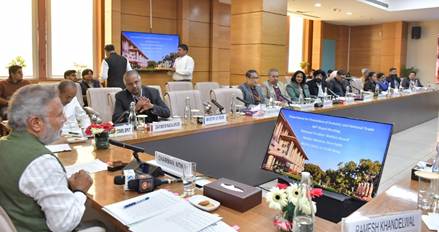
To ensure uniform data collection and scientific rigour, a regional training workshop for forest staff from 13 districts of Uttar Pradesh was conducted at Bijnor. Similar capacity building programmes will be organised in phases across every 10 to 15 districts as the survey progresses, enabling standardised field implementation across the country.
Fieldwork commenced with 26 trained researchers operating from three boats. The teams are recording ecological and habitat parameters while deploying advanced technologies such as hydrophones for underwater acoustic monitoring of dolphins. In the first phase, the survey will cover the main stem of the Ganga from Bijnor to Ganga Sagar as well as the Indus River. The second phase will extend to the Brahmaputra, major tributaries of the Ganga, the Sundarbans delta and riverine and estuarine systems in Odisha.
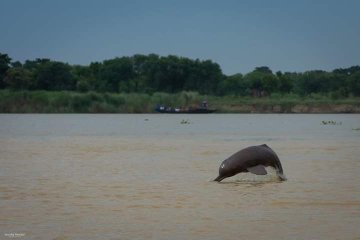
Beyond the Ganges river dolphin, the survey will assess the status of the Indus river dolphin and Irrawaddy dolphins. It will also document habitat conditions, human induced pressures and threats, and the presence of other conservation priority aquatic fauna. The data generated will provide a robust scientific foundation for evidence based conservation planning, policy formulation and long term river ecosystem management.
The first nationwide dolphin estimation conducted between 2021 and 2023 recorded an estimated population of around 6,327 riverine dolphins across India. These included Ganges river dolphins in the Ganga, Yamuna, Chambal, Gandak, Ghaghara, Kosi, Mahananda and Brahmaputra river systems, along with a small population of Indus river dolphins in the Beas. Uttar Pradesh and Bihar accounted for the largest numbers, followed by West Bengal and Assam, underlining the critical importance of the Gangetic basin for dolphin conservation.
While the second survey follows the same standardised methodology as the earlier exercise, it expands spatial coverage and operational scope. For the first time, systematic estimation of Irrawaddy dolphins in the Sundarbans and Odisha has been incorporated. This enhancement will enable updated population assessments, improved understanding of species specific threats and more targeted conservation interventions under Project Dolphin.