
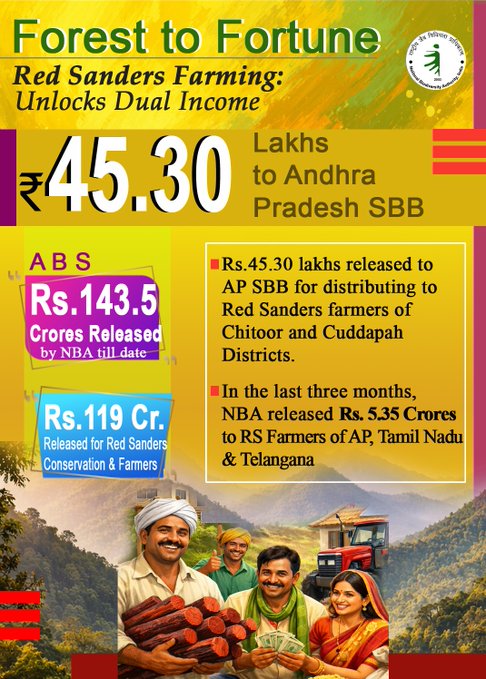
The National Biodiversity Authority has disbursed ₹45 lakh to Red Sanders farmers in Andhra Pradesh, reinforcing India’s Access and Benefit Sharing framework and strengthening the link between biodiversity conservation and sustainable livelihoods. The funds were released through the Andhra Pradesh State Biodiversity Board, marking another milestone in India’s implementation of benefit sharing under the Biological Diversity Act 2002.
With this latest disbursement, India’s cumulative Access and Benefit Sharing payouts have crossed ₹143.5 crore, reflecting the growing scale and maturity of the country’s biodiversity governance framework. The initiative directly benefits Red Sanders cultivators by enabling a dual income model. Farmers earn income through the lawful cultivation and sale of Red Sanders wood and logs, while also receiving monetary benefits under the statutory benefit sharing mechanism linked to commercial utilisation of biological resources.
The National Biodiversity Authority has so far released more than ₹104 crore to Andhra Pradesh alone for Red Sanders conservation, protection, and benefit sharing with legitimate claimants. In addition, over ₹15 crore has been disbursed to other states including Tamil Nadu, Karnataka, Maharashtra, Odisha, and Telangana, extending the impact of the framework beyond the primary cultivation zones.
Over the past three months, the Authority has released ₹5.35 crore in Access and Benefit Sharing funds to more than 220 Red Sanders farmers across Andhra Pradesh, Tamil Nadu, and Telangana. These timely releases have provided direct financial support to farming households, helping stabilise incomes while reinforcing compliance with conservation norms.
The Access and Benefit Sharing mechanism promotes sustainable utilisation of Red Sanders, a globally valued endemic species, by rewarding farmers and communities that conserve and cultivate the resource legally. By ensuring that economic returns flow back to cultivators and local communities, the framework discourages illegal trade and over exploitation while incentivising long term stewardship of biodiversity.
Officials noted that the benefit sharing model has transformed Red Sanders from a strictly protected species into a livelihood supporting asset, aligning conservation objectives with rural economic development. The approach integrates conservation outcomes with tangible bio economic returns, ensuring that farmers become partners in biodiversity protection rather than passive stakeholders.
The National Biodiversity Authority continues to facilitate the flow of benefit sharing funds to rightful beneficiaries, contributing to conservation, scientific research, and socio economic development. These efforts underline India’s commitment to equitable biodiversity governance while supporting farmer livelihoods and reinforcing the country’s leadership in global biodiversity conservation.