
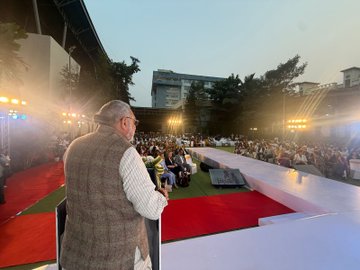
The National Institute of Fashion Technology emerged as a key economic driver for India’s textile and craft sectors, with the country steadily moving towards indigenous design standards, Union Minister of Textiles Shri Giriraj Singh said at the NIFT International Conference 2026 held at the NIFT Mumbai campus.
The two-day international conference, titled Design for Inclusive Futures, concluded on 22 January 2026, marking a major milestone as it coincided with the completion of four decades of NIFT’s contribution to fashion education, design innovation, sustainability and industry engagement in India. The concluding plenary session was addressed by Shri Giriraj Singh, who underscored NIFT’s growing role in shaping India’s creative economy.
Addressing the gathering, the Union Minister stated that NIFT has evolved into a significant economic catalyst for the textile, apparel and craft sectors. He noted that each NIFT graduate is estimated to support between 8,000 and 10,000 jobs over their professional lifetime, reflecting the multiplier effect of design-led growth on employment generation. He emphasised that India is consciously moving away from dependence on foreign benchmarks and developing its own indigenous standards through initiatives such as IndiaSize and VisionNxt, which strengthen India-specific design forecasting, sizing systems and cultural identity.
Shri Giriraj Singh highlighted that these initiatives align with the vision of Aatmanirbhar Bharat and Vision 2047, enabling India to define global trends rather than merely follow them. He added that NIFT’s expanding design expertise now extends beyond fashion into sectors such as automobiles, logistics and allied industries, demonstrating the institute’s increasing relevance across the broader industrial ecosystem. Encouraging NIFT alumni to play a leadership role in India’s growth journey, he urged them to build strong global networks and represent the “I AM NIFT” identity with pride on international platforms.
Referring to sustained policy support from the Government, the Union Minister highlighted measures such as the reduction of GST on affordable clothing from 18 percent to 5 percent and the removal of trade barriers, including cotton import duties. These interventions, he said, have provided momentum to the textile and apparel industry, improved competitiveness and supported inclusive growth.
The inaugural and concluding sessions of the conference were attended by Neelam Shami Rao, Secretary, Ministry of Textiles; Tanu Kashyap, Director General, NIFT; Prof Dr Noopur Anand, Dean, NIFT; Prof Dr Ajit Kumar Khare, Director, NIFT Mumbai; Prof Dr Sudha Dhingra, NIFT and Director, Centre of Excellence for Khadi; and Prof Dr Rupa Agarwal, Conference Chair, along with senior faculty members, researchers, industry leaders and students.
During the event, the book NIFT @40 “धरोहर”, documenting four decades of NIFT’s journey, was released. This was followed by the unveiling of the NIFT@41 logo and the inauguration of the Craft Bazaar by the Chief Guest, showcasing traditional crafts and artisan-led products.
Addressing the conference, the Secretary, Ministry of Textiles, highlighted the central role of design in national development and appreciated NIFT’s initiatives such as VisionNxt, IndiaSize and curriculum restructuring. She emphasised NIFT’s contribution to the Prime Minister’s 5F Vision — Farm to Fibre, Fibre to Factory, Factory to Fashion and Fashion to Foreign — and called for greater respect for artisans, ethical design practices, and systematic documentation and standardisation of traditional knowledge to build an inclusive and future-ready fashion ecosystem.
The conference featured robust academic and industry engagement through parallel technical sessions across four thematic tracks. A total of 23 peer-reviewed research papers were presented, offering multidisciplinary perspectives on inclusive design, sustainability, accessibility and innovation. A series of workshops further enriched the discourse, focusing on ethical practices, future-ready design thinking and sustainability. Curated exhibitions and craft bazaars ran parallel throughout the conference, providing participants with hands-on exposure to design innovation and traditional craftsmanship.
The NIFT International Conference 2026 reaffirmed the institute’s role as a national and global thought leader in design, reinforcing its contribution to economic growth, employment generation and the development of an indigenous, inclusive and globally competitive design ecosystem.