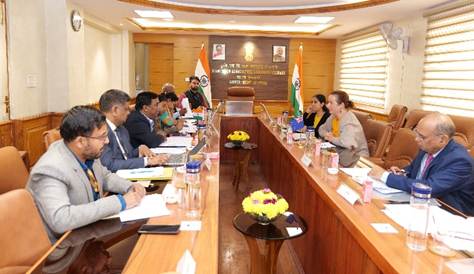


NITI Aayog on 15 January 2026 released a comprehensive report titled Achieving Efficiencies in MSME Sector through Convergence of Schemes, presenting a strategic framework to enhance the effectiveness, reach and impact of government support for India’s Micro, Small and Medium Enterprises. The report was released by senior leadership of NITI Aayog, underscoring the central role of MSMEs in employment generation, innovation and inclusive economic growth.
The report provides a detailed assessment of existing central government schemes for MSMEs, examining how fragmentation, overlapping objectives and siloed implementation across ministries have constrained their overall impact. It outlines a clear pathway to streamline scheme implementation, strengthen inter ministerial coordination and improve service delivery across finance, skills, technology, marketing and innovation support.
Aligned with India’s long term development vision, the report positions convergence as a critical reform lever to unlock higher productivity, reduce administrative inefficiencies and simplify access for millions of MSMEs operating across diverse sectors and regions.
Need for convergence
The Ministry of MSME currently administers 18 schemes covering credit access, skill development, marketing assistance, innovation and research, technology and quality upgradation, and infrastructure development. While these schemes have contributed significantly to MSME growth, the report highlights that overlapping mandates, parallel processes and limited data integration often result in duplication of efforts, higher compliance burdens and sub optimal outreach.
The report stresses that effective convergence and rationalisation can ensure better translation of public expenditure into measurable outcomes, reduce confusion for beneficiaries and enable policymakers to target interventions more precisely.
Framework for convergence
The report proposes a two pronged convergence framework based on information convergence and process convergence.
Information convergence focuses on integrating government generated data at central and state levels to improve coordination, enhance transparency and support evidence based decision making. Unified data systems are seen as essential to track beneficiary journeys, assess scheme performance and identify gaps in coverage.
Process convergence aims to align and unify scheme design and delivery by reducing redundancies, merging similar components and fostering collaboration across ministries and states. This approach seeks to create a cohesive MSME support ecosystem without diluting the objectives of targeted interventions.
Key recommendations
Centralised digital portal for MSMEs
The report recommends the creation of an AI powered centralised digital platform that integrates MSME schemes, compliance requirements, financial access and market intelligence. Drawing on international best practices, the portal would include information, process, compliance and market research modules, supported by AI chatbots, dashboards and mobile access to provide real time support to enterprises.
Convergence of cluster development schemes
Integration of the Scheme of Fund for Regeneration of Traditional Industries with the Micro and Small Enterprises Cluster Development Programme is proposed. The report recommends a dedicated sub scheme for traditional industries, a unified governance structure under MSE CDP and consolidated funding with earmarked resources to preserve crafts and endangered traditional industries while improving scale and efficiency.
Convergence of skill development programmes
Skill initiatives are proposed to be rationalised into a three tier structure covering entrepreneurship and business skills, MSME technical skills, and training for rural and women artisans. This structure would merge overlapping programmes, improve coordination among institutions and retain targeted interventions for inclusion and traditional crafts.
Dedicated marketing assistance wing
To streamline marketing support, the report proposes the creation of a dedicated Marketing Wing with domestic and international components. The domestic wing would facilitate MSME participation in national exhibitions, trade fairs and buyer seller meets, while the international wing would support overseas market access through global trade fairs, B2B events and buyer seller interactions.
Integration of ASPIRE with MSME Innovative
The report recommends integrating the Scheme for Promoting Innovation, Rural Industry and Entrepreneurship into MSME Innovative as a special category for agro rural enterprises. Existing ASPIRE funds would continue, while future MSME Innovative budgets would earmark a share for agro rural incubators, expanding access to advanced incubation and innovation support.
Safeguarding targeted programmes
While advocating convergence, the report emphasises the importance of preserving the distinct focus of targeted initiatives such as the National SC ST Hub and schemes supporting MSMEs in the North Eastern Region. Large flagship programmes including PMEGP and PM Vishwakarma are recommended to remain independent due to their scale and strategic significance.
The report calls for cautious convergence, merging schemes only where objectives clearly overlap, and strengthening collaboration where full integration is not feasible. Joint workshops, shared capacity building for administrators and coordinated monitoring are suggested to optimise resources while safeguarding beneficiary interests.
Throughout the transition, the report stresses careful change management, protection of beneficiaries and rigorous outcome tracking to ensure that convergence leads to sustained improvements in efficiency, outreach and impact.
By proposing a structured, data driven and technology enabled approach to scheme convergence, the report positions MSMEs to benefit from a simpler, more responsive and more effective support ecosystem, reinforcing their role as a key pillar of India’s economic transformation.