

An institute under the Department of Science and Technology based in North East India has synthesised a novel bio based surfactant with significant antibacterial and cleansing properties, offering a potential alternative to synthetic surfactants widely used in the cosmetic and pharmaceutical industries.
The newly developed compound has demonstrated effective action against Staphylococcus aureus, a bacterium responsible for various skin and wound infections. In addition, when blended with commercial face washes, it showed enhanced stain removal efficiency, underscoring its potential application in personal care formulations.
Surfactants are commonly used as lubricants, dispersants and emulsifiers across multiple industries, including cosmetics, pharmaceuticals, food processing and detergents. However, concerns over the toxicity and non biodegradability of synthetic surfactants have intensified the search for sustainable and environmentally friendly alternatives. The bio based compound developed by the North East institute is positioned as a promising substitute for artificial surfactants.
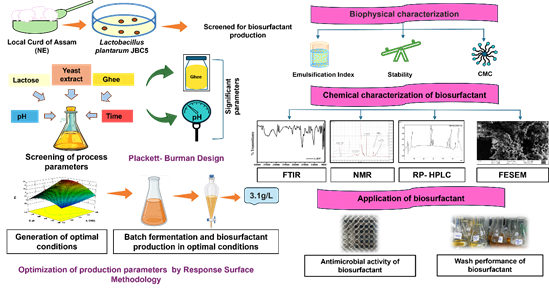
The research was led by Ashis K Mukherjee, Director of the Institute of Advanced Study in Science and Technology, along with M R Khan and Anushree Roy, Senior Research Fellow. The team synthesised the biosurfactant using the probiotic strain Lactobacillus plantarum JBC5. In a novel approach, they employed ghee, a widely used and culturally significant milk product, as a lipid rich substrate for biosurfactant production.
Optimal production of the compound was achieved using response surface statistical analysis, a technique that enables systematic process optimisation. The resulting lipopeptide biosurfactant achieved a maximum emulsification index of 60 percent for edible oils and demonstrated surface tension reducing properties comparable to conventional surfactants.
The compound also exhibited high thermal stability, remaining effective at temperatures up to 276 degrees Celsius, and maintained functional stability across a broad range of pH levels. These properties enhance its suitability for use in diverse industrial and cosmetic applications where thermal and chemical stability are critical.
Its antibacterial activity against Staphylococcus aureus, combined with improved stain removal performance in commercial face wash formulations, highlights its potential role in replacing synthetic surfactants in cosmetic and medicinal products. The researchers indicated that the compound could contribute to safer, biodegradable and environmentally sustainable formulations.
Further work is underway to conduct comprehensive toxicity assessments, standardise dosage parameters and initiate industry driven collaborative research to accelerate commercialisation. The development marks a significant step in advancing bio based innovations from the North East region and strengthening India’s capacity for sustainable industrial chemistry.