
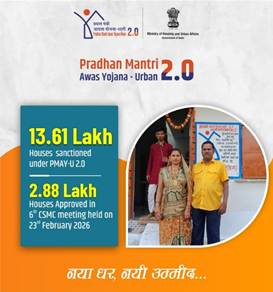
A total of 2.88 lakh additional houses have been sanctioned under Pradhan Mantri Awas Yojana Urban 2.0 during the sixth meeting of the Central Sanctioning and Monitoring Committee held in New Delhi under the chairmanship of Srinivas Katikithala, Secretary, Ministry of Housing and Urban Affairs.
The meeting was attended by Kuldip Narayan, Joint Secretary and Mission Director Housing for All, senior officials of the Ministry and PMAY Urban Mission Directors from various States and Union Territories.
With the approval of 2,87,618 houses in this round, the cumulative number of houses sanctioned under PMAY Urban 2.0 has crossed 13.61 lakh. The scheme continues to target Economically Weaker Section, Low Income Group and Middle Income Group families, reinforcing the Government’s commitment to ensure access to affordable and dignified urban housing.
The newly sanctioned houses span 16 States and Union Territories including Andhra Pradesh, Arunachal Pradesh, Chhattisgarh, Gujarat, Jammu and Kashmir, Punjab, Puducherry, Rajasthan, Tamil Nadu, Telangana, Maharashtra, Madhya Pradesh, Nagaland, Odisha, Uttar Pradesh and West Bengal.
Under different verticals of PMAY Urban 2.0, 1.66 lakh houses were approved under Beneficiary Led Construction, 1.09 lakh under Affordable Housing in Partnership and 12,846 under Affordable Rental Housing.
The Affordable Rental Housing vertical is being promoted to address the needs of urban migrants, industrial workers, construction workers, working women, homeless persons and other vulnerable groups. In the current meeting alone, 12,846 rental housing units were sanctioned to strengthen support for migrant and low income urban populations.
The Committee also approved three Demonstration Housing Projects in Chhattisgarh, Puducherry and Rajasthan, each comprising 40 dwelling units. These projects aim to showcase modern, cost effective and durable construction technologies that can be replicated across the country to improve speed and quality of housing delivery.
Addressing the meeting, Srinivas Katikithala emphasised the need to prioritise housing projects near mass transit corridors to enhance ease of living. He stressed that Affordable Housing in Partnership projects should be located within city limits to ensure access to employment, healthcare and education. He also called for documenting and showcasing successful projects as best practices for cross learning among States and Union Territories.
Kuldip Narayan highlighted the importance of beneficiary outreach, particularly for women, senior citizens, persons with disabilities and other vulnerable sections. He urged States and Union Territories to expedite project execution, streamline approval processes and strengthen monitoring mechanisms to ensure timely completion and delivery.
Of the 2.88 lakh houses sanctioned in the latest round, more than 1.60 lakh have been allotted to women, including widows and unmarried or separated women. Eight dwelling units have been sanctioned for transgender beneficiaries. Additionally, 22,581 houses have been allotted to senior citizens.
In terms of social inclusion, 35,525 houses have been sanctioned for Scheduled Caste beneficiaries, 9,773 for Scheduled Tribe beneficiaries and 82,190 for Other Backward Classes.
Across the 13.61 lakh houses sanctioned under PMAY Urban 2.0, 96 percent have been allotted in the name of the female head of the household or in joint ownership under Beneficiary Led Construction and Interest Subsidy Scheme verticals, underscoring the scheme’s strong focus on women’s empowerment. Overall, 22 percent of houses have been sanctioned for Scheduled Castes, 5 percent for Scheduled Tribes and 73 percent for other categories.
PMAY Urban 2.0 builds on the foundation of the original PMAY Urban launched in 2015. Under the broader mission, a total of 122.50 lakh houses have been sanctioned so far, of which more than 97 lakh pucca houses have been completed and delivered. The scheme has significantly improved housing security for urban poor and middle class families, strengthened social and economic stability and enhanced access to essential services.
The approval of 2.88 lakh additional houses marks another major milestone in the Government’s continued pursuit of Housing for All, reinforcing inclusive and sustainable urban development across the country.