
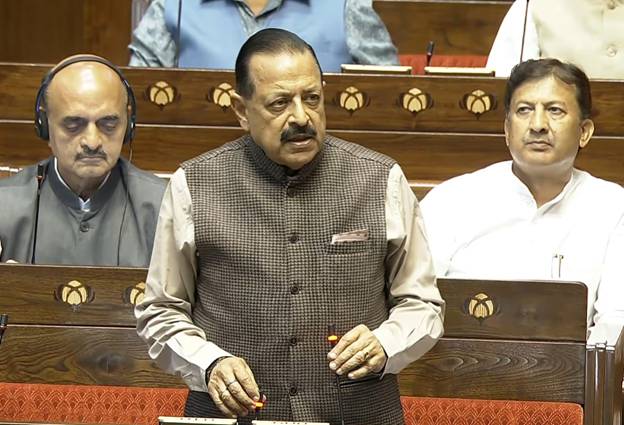
India is leveraging advanced space technology to transform agriculture and strengthen disaster monitoring systems, Union Minister of State Independent Charge for Science and Technology and Earth Sciences and Minister of State in the Prime Minister Office Personnel Public Grievances and Pensions Atomic Energy and Space Jitendra Singh informed the Lok Sabha.
Detailing the initiatives undertaken by the Indian Space Research Organisation and the Department of Space, Jitendra Singh said a wide range of satellite based programmes are now being operationally deployed to improve agricultural productivity, enhance risk management and enable timely disaster response across the country.
Space Technology Driving Agricultural Transformation
The government has implemented multiple space based programmes to support agriculture, including Forecasting Agricultural Output using Space Agrometeorology and Land based observations, National Agricultural Drought Assessment and Monitoring System, Coordinated Horticulture Assessment and Management using Geoinformatics, and Space Technology Utilization for Food Security Agricultural Assessment and Monitoring.
These programmes are complemented by collaborations with state governments and central agencies to strengthen decision making, crop planning and resource management.
A key development is the introduction of artificial intelligence driven crop monitoring tools. The SASYA platform, developed using C band Synthetic Aperture Radar data from EOS 04 satellite, has been integrated into the Bhoonidhi geoportal of the National Remote Sensing Centre. The tool enables accurate crop mapping and has been made available to operational agencies including Mahalanobis National Crop Forecast Centre and the Department of Agriculture and Farmers Welfare.
In the area of yield estimation, ISRO has developed smart sampling techniques under the YES TECH initiative of the Pradhan Mantri Fasal Bima Yojana. These techniques improve the accuracy of Crop Cutting Experiments and reduce dependence on manual sampling. Machine learning based crop simulation models have also been introduced to support faster and more reliable insurance claim assessments.
An automated geospatial system named GeoCrEST has been operationalised on the VEDAS geoportal to estimate crop yields, while satellite based drought monitoring under the NADAMS programme provides timely assessment and reporting of agricultural stress conditions.
Remote sensing data from Indian satellite missions has been made freely available to government users under the Indian Space Policy 2023, with data of coarser than 5 metre resolution open to all users. High resolution imagery has been provided for 13 states under the Agri Stack project to strengthen digital agriculture infrastructure.
The space based systems have delivered measurable outcomes in agriculture.
Impact of Space Based Agriculture Systems
Parameter Outcome
Crop acreage estimation Improved accuracy
Crop production estimation Enhanced reliability
Drought monitoring Timely identification
Crop insurance Faster and transparent claim settlement
Premium rates under PMFBY Reduced from 17 percent to 12 percent
Socio economic studies have also demonstrated tangible benefits. A survey conducted in Parbhani Maharashtra during the Kharif season of 2022 to 2023 showed that use of satellite based advisories increased productivity of soybean and cotton farms by 2 to 5 percent while reducing input costs by 5 to 10 percent.
Strengthening Natural Resource Management
Satellite data is also being used for national level land use mapping. Annual, five year and decadal datasets are generated to support land use planning, food security and environmental assessments. Agro meteorological products are disseminated through the VEDAS geoportal to field units covering more than 85 districts and 500 blocks under the Gramin Krishi Mausam Seva.
Satellite Based Disaster Monitoring Systems
Jitendra Singh said ISRO has established a robust satellite based disaster monitoring mechanism capable of providing near real time data for disaster management agencies.
Earth observation satellites are tasked to capture data over disaster affected or vulnerable regions. In cases of major disasters, India activates the International Charter for Space and Major Disasters, enabling access to satellite data from multiple global agencies.
For cyclones, the India Meteorological Department utilises rapid scan data from INSAT 3DR, along with inputs from INSAT 3DS and Oceansat 3 satellites, for cyclone detection, tracking, intensity assessment and landfall prediction.
Flood monitoring is supported through near real time inundation mapping, which is shared with the Ministry of Home Affairs, National Disaster Management Authority and state agencies. Satellite based drought indicators are generated through the National Geospatial Drought portal hosted on the VEDAS platform.
Rapid damage assessments are also conducted using satellite data for events such as earthquakes and landslides, enabling quicker response and resource mobilisation.
Data and analytical products are disseminated through multiple geoportals including Bhoonidhi, MOSDAC, Bhuvan and National Database for Emergency Management, ensuring accessibility to stakeholders in line with the Indian Space Policy 2023 and National Geospatial Policy.
Institutional Framework And Future Expansion
The government has implemented the Space Application Management System in 2021 to assess user requirements for earth observation satellites, facilitate cost sharing and ensure optimal utilisation of satellite data across sectors such as agriculture, water and forestry.
A series of new satellites and ground systems have been approved for deployment over the next five years to further strengthen disaster monitoring, resource management and national security capabilities, including enhanced surveillance of borders and maritime regions.
Jitendra Singh said the integration of space technology into agriculture and disaster management is playing a critical role in improving productivity, reducing risks and enhancing resilience, positioning India at the forefront of technology driven development.