
Scientists have reconstructed the geological evolution of the Ladakh Magmatic Arc in the northwest Himalaya, uncovering a detailed 130 million year record of plate tectonic processes that led to the formation of the Himalayan mountain range.
The study, conducted by researchers from the Wadia Institute of Himalayan Geology under the Department of Science and Technology, provides new insights into the subduction, magmatic evolution and eventual collision between the Indian and Eurasian plates that shaped one of the world’s most prominent mountain systems.
According to the findings, the Ladakh Magmatic Arc represents a long extinct volcanic system formed during the Jurassic to Eocene period, spanning approximately 201.3 million to 33.9 million years ago. This arc originated beneath the ancient Neo Tethys Ocean, where oceanic crust was gradually forced beneath the Eurasian continental margin in a process known as subduction.
The scientists established that the arc developed due to the northward subduction of the Neo Tethyan oceanic plate beneath Eurasia. By analysing the geochemical and isotopic composition of rock samples, the researchers were able to trace the evolution of magmatic activity over tens of millions of years.
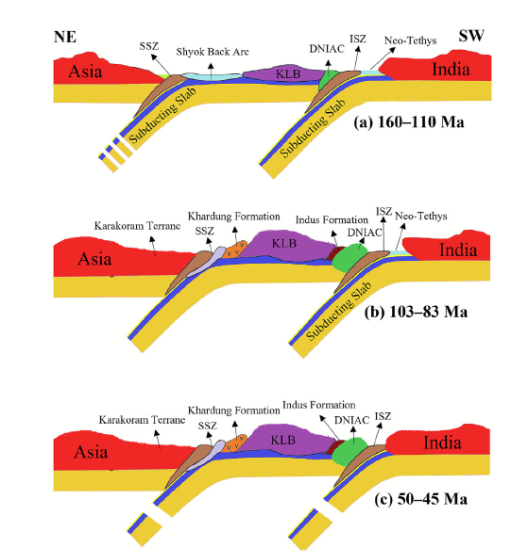
The study involved detailed comparison of geological formations from three distinct phases of tectonic activity. These included the pre collisional Dras Nidar Island Arc Complex, the pre to syn collisional Ladakh Batholith forming part of the Kohistan Ladakh Batholith, and post collisional mafic dykes. Each of these components provided crucial evidence about the changing nature of magma sources and tectonic conditions over time.
The researchers identified three major magmatic phases in the evolution of the Ladakh Magmatic Arc, corresponding to time intervals of 160 to 110 million years, 103 to 45 million years and less than 45 million years. Each phase displayed distinct geochemical signatures linked to the dynamics of the subducting slab, the mantle wedge above it and interactions with the continental crust.
During the earliest phase, the region resembled a volcanic island arc system rising from the Neo Tethys Ocean. Rocks from the Dras Nidar Island Arc Complex indicate that magma during this stage was primarily derived from the mantle, with limited contribution from subducted sediments.
As tectonic convergence progressed, the system evolved significantly. The formation of the Ladakh Batholith marked a major phase of magmatic development deep within the crust. These granitic bodies exhibit stronger chemical signatures of continental material, indicating increased recycling of sediments and crustal fragments into the magma. This shift reflects the intensifying interaction between the converging Indian and Eurasian plates.
The study highlights that as the plates moved closer, greater volumes of sediment were carried into the subduction zone, enriching the magma and altering its composition. This transitional phase captures the gradual transformation from oceanic subduction to continental collision.
The final stage of evolution occurred after the closure of the Neo Tethys Ocean and the collision of the Indian and Eurasian plates, which ultimately led to the uplift of the Himalaya. Even after this major tectonic event, magmatic activity continued in the form of mafic dykes, which are narrow intrusions of dark volcanic rock cutting across older geological formations.
These later magmas originated from mantle sources that had already been chemically modified by earlier tectonic processes, indicating a prolonged and complex evolution of the region’s subsurface dynamics.
To reconstruct this detailed geological history, scientists employed advanced geochemical techniques, including the analysis of rare elements and isotopes such as strontium and neodymium. These isotopic signatures serve as indicators of magma origin, helping differentiate between contributions from deep mantle material, recycled sediments and continental crust. This approach enabled researchers to effectively trace the tectonomagmatic processes that shaped the Ladakh region.
The findings reveal that sediment contribution to magma formation was significantly more pronounced in the Kohistan Ladakh Batholith compared to the earlier Dras Nidar Island Arc Complex, underscoring the progressive enrichment of magmatic sources over time.
The study provides a comprehensive framework for understanding the tectonic and magmatic evolution of the Trans Himalayan region and offers valuable insights into the processes that led to the formation of the Himalaya. It also enhances scientific understanding of subduction dynamics, crustal recycling and long term geological transformations associated with major plate collisions.