

Union Minister for Rural Development and Agriculture and Farmers Welfare Shivraj Singh Chouhan conducted a comprehensive review of key schemes under the Department of Rural Development and the Department of Land Resources, reiterating that no eligible worker under MGNREGA should face any difficulty in accessing work and that there must be no shortage of budget under any component of the programme.
The high-level meeting assessed the progress of flagship rural development initiatives including the Mahatma Gandhi National Rural Employment Guarantee Act, Deen Dayal Upadhyaya Grameen Kaushalya Yojana, Rural Self Employment Training Institutes, Pradhan Mantri Krishi Sinchayee Yojana, and land digitisation reforms under the Digital India Land Records Modernisation Programme.
Reviewing MGNREGA performance for the financial year 2025–26, officials informed that a labour budget of 244 crore agreed man-days had been allocated to states, of which 204 crore man-days have already been generated. Up to January 2026, 198 crore man-days were created, reflecting sustained demand for wage employment across rural areas. During the same period, 64.70 lakh works were completed under the scheme.
Under the wage component alone, Rs 65,506 crore has been released in the current financial year, ensuring timely payment to workers. The meeting also discussed state-wise progress and examined the pending labour budget issue concerning West Bengal.
A significant portion of the review focused on technology integration and transparency measures. The Minister was informed that e-KYC of approximately 80 percent of MGNREGA workers has been completed. Face authentication technology is currently operational in one district of every state and can function even in low or no internet conditions. The system is scheduled for nationwide rollout shortly. Chouhan appreciated the adoption of face authentication as a measure to curb duplication and ensure accountability, while directing that technological reforms must not create barriers for genuine beneficiaries.
He emphasised that every eligible worker seeking employment under MGNREGA must receive work without delay and that adequate financial provisioning should be ensured in all components of the scheme.
The meeting also undertook a detailed review of the Deen Dayal Upadhyaya Grameen Kaushalya Yojana, which focuses on skill development and employment for rural youth. Officials reported that up to January 2026, training has been imparted to 18.29 lakh candidates, of whom 11.78 lakh have been successfully placed in employment.
Under both DDU-GKY and related schemes, 100 percent registration of beneficiaries has been achieved through the Kaushel Panji App, with e-KYC of women and youth completed to eliminate duplication. The Minister expressed satisfaction with this milestone and welcomed the reforms undertaken to streamline processes.
The review also highlighted the role of Rural Self Employment Training Institutes. A target has been set to expand RSETI coverage across 619 rural districts. Construction of 407 buildings has already been approved. Chouhan directed that state-level monitoring mechanisms be strengthened to ensure timely completion of pending infrastructure and achievement of coverage targets.
Officials informed that earlier operational arrangements through a private agency have now been streamlined. With the assistance of the National Informatics Centre, an integrated digital platform, kausal.rural.gov.in, has been developed to consolidate training, monitoring, and reporting functions across skill development schemes.
The Minister further reviewed progress under the Pradhan Mantri Krishi Sinchayee Yojana and land reform initiatives of the Department of Land Resources. Under the Digital India Land Records Modernisation Programme, digitisation of 99.81 percent of land records has been completed nationwide. Standardisation of 66.53 percent of land parcels under the Unique Land Parcel Identification Number system has been achieved, marking substantial progress toward transparent and tamper-proof land ownership records.
The LandStack pilot project is currently operational in identified locations in Tamil Nadu and Chandigarh. The system aims to create an integrated digital land governance architecture and is planned for nationwide implementation over the next five years.
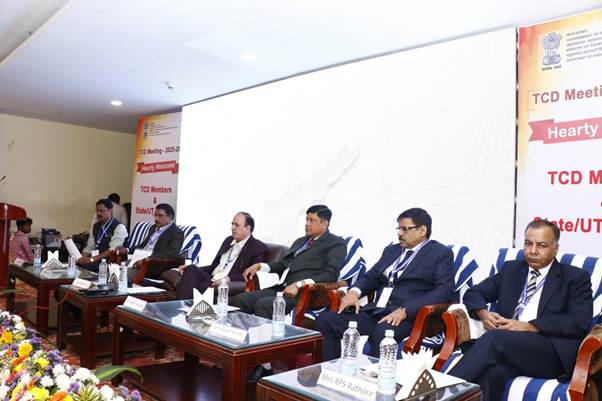
Secretary of the Ministry of Rural Development and Department of Land Resources Shailesh Kumar Singh and Joint Secretaries from both departments were present during the review.
The meeting concluded with the Minister reiterating that rural development programmes must combine financial adequacy, technology-enabled transparency, and strong monitoring to ensure inclusive growth and sustainable livelihoods across India’s villages.