
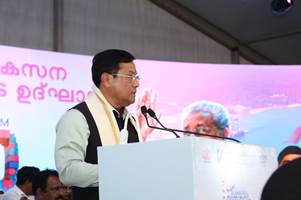
Union Minister for Ports, Shipping and Waterways Shri Sarbananda Sonowal on Saturday inaugurated the capacity augmentation works of Vizhinjam International Seaport in Kerala, marking a significant step in India’s efforts to strengthen its transshipment capability and global maritime competitiveness. The event was held in the presence of Chief Minister of Kerala Shri Pinarayi Vijayan, senior officials of the State and Central governments, and representatives of the concessionaire.
The inauguration formally marked the commencement of construction activities for Phases II, III and IV of the Vizhinjam International Seaport under a fast-tracked and integrated development programme. The expansion is aimed at substantially enhancing India’s container transshipment capacity, reducing dependence on foreign ports and reinforcing the country’s maritime infrastructure ecosystem.
Vizhinjam International Seaport began commercial operations of Phase I on 3 December 2024 with a designed capacity of one million TEUs. In a short span, the port has recorded strong performance, handling more than 1.43 million TEUs and operating at over 130 percent capacity utilisation. The port has already established direct connectivity with major global shipping routes across Europe, the Americas, Africa and the Far East, positioning itself as a key national transshipment terminal.
Addressing the gathering, Shri Sarbananda Sonowal said that the rapid operationalisation and expansion of Vizhinjam International Seaport is a result of the grand maritime vision of Prime Minister Shri Narendra Modi. He said the capacity augmentation will play a critical role in reducing India’s reliance on overseas transshipment hubs, improving logistics efficiency and supporting the growth of India’s external trade. He added that with strong port infrastructure and efficient waterways, Kerala is well positioned to play a vital role in shaping India’s maritime future.
Under the expansion programme, the existing container berth will be extended to form a continuous two kilometre long container berth, the longest in the country. The breakwater will be extended to 3.88 kilometres, while additional container yards will be developed through sea reclamation. Cargo handling capacity will be significantly strengthened through the addition of advanced ship to shore and yard cranes, enabling the port to handle next generation container vessels of up to 28,000 TEUs. Once completed, Vizhinjam will be capable of handling up to five mother vessels simultaneously, with an annual operational throughput capacity of up to 5.7 million TEUs.
The capacity augmentation works are being undertaken in accordance with a Supplementary Concession Agreement signed in November 2024 between the Government of Kerala and Adani Vizhinjam Port Private Limited. The agreement advances the project timeline by nearly 17 years, with completion of the expansion targeted by December 2028. The total investment envisaged for the Vizhinjam International Seaport project is approximately ₹16,000 crore, including about ₹7,398 crore for the ongoing expansion phases.
Shri Sonowal noted that the development of Vizhinjam International Seaport is aligned with national objectives under Maritime Vision 2030 and the Amrit Kaal Vision 2047, and will contribute to building a resilient, efficient and globally competitive maritime sector.
Speaking on the occasion, Chief Minister Shri Pinarayi Vijayan said that Vizhinjam is currently serving mainly Indian container ports as a transshipment port. He added that with the completion of Phase II development, Vizhinjam will emerge as a global transshipment hub connecting Asia, Europe, America and Africa.
With the launch of the capacity augmentation works, Vizhinjam International Seaport is set to advance towards becoming a major regional transshipment hub, strengthening India’s position in global maritime trade and supporting long term economic growth.