
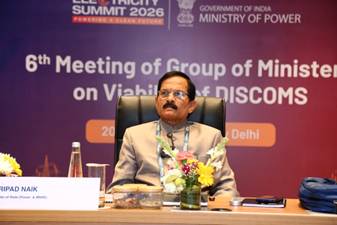
Union Minister of State for Power and New and Renewable Energy Shripad Yesso Naik chaired the sixth meeting of the Group of Ministers on improving the financial viability of electricity distribution utilities during the Bharat Electricity Summit 2026 in New Delhi, with States broadly endorsing a new phase of reforms aimed at strengthening the sector.
The meeting was attended by A. K. Sharma, Energy Minister of Uttar Pradesh, Pradyuman Singh Tomar, Energy Minister of Madhya Pradesh, Hiralal Nagar, Minister of State for Energy of Rajasthan, Meghana Bordikar, Minister of State for Energy, along with senior officials from the Central Government, State Governments, State power utilities and Power Finance Corporation Limited.
In the opening remarks, the Chairperson and Managing Director of Power Finance Corporation Limited highlighted that distribution companies continue to face deep-rooted structural, financial and operational challenges that undermine sustainable and quality power supply. While improvements have been recorded in certain areas, persistent inefficiencies and accumulated losses continue to weigh on the sector. It was noted that sustainable performance across generation and transmission segments depends critically on a financially stable and operationally efficient distribution sector.
Shripad Yesso Naik, in his address, stated that India’s power distribution utilities have, for the first time, recorded a sector-wide profit, supported by reductions in Aggregate Technical and Commercial losses and the gap between Average Cost of Supply and Average Revenue Realised. However, he cautioned that these gains remain uneven and fragile, with nearly half of the distribution utilities still incurring losses and carrying substantial debt burdens.
He pointed out that non cost reflective tariffs and delays in subsidy payments are forcing distribution companies into costly short term borrowing, weakening their financial position. Additionally, imbalanced cross subsidies are driving industrial and commercial consumers towards open access, thereby eroding the revenue base of distribution utilities and affecting long term sustainability.
The Minister emphasised that reforms must be anchored on three core pillars. The first is regulatory discipline, including timely and cost reflective tariffs, automatic fuel and power purchase cost adjustment mechanisms, and a clear reduction pathway for cross subsidies. The second pillar is decisive government intervention through comprehensive debt restructuring and professional management of utilities. The third pillar focuses on operational excellence driven by smart metering, digitalisation and data based efficiency improvements.
He stressed that ensuring financial viability of distribution utilities is fundamental to achieving India’s energy transition goals and the broader vision of Viksit Bharat. He urged States to adopt time bound commitments and treat distribution sector reform as a shared national priority.
During the meeting, a presentation by the Joint Secretary Distribution, Ministry of Power, outlined the current financial status of State distribution companies and key issues affecting their performance. The presentation also incorporated recommendations from the Sixteenth Finance Commission aimed at strengthening the sector’s financial health.
Discussions reflected broad consensus among States on advancing the reform agenda. States called for stronger policy frameworks to ensure cost reflective tariffs and sought central support for reform linked debt restructuring of distribution utilities. It was acknowledged that inefficiencies in the distribution segment continue to impose a significant economic burden, with cumulative losses amounting to multiple lakh crore rupees in recent years.
States also proposed convening a follow up meeting to define clear action points and establish time bound implementation strategies for all stakeholders.
In his concluding remarks, Shripad Yesso Naik appreciated the active participation of State Ministers and officials, noting that the Group of Ministers has worked with a strong sense of purpose and that its recommendations will play a key role in shaping future reforms in the distribution sector. He urged States to move decisively towards structural improvements and position themselves as leaders in driving sectoral transformation.
The Group of Ministers reaffirmed its commitment to undertake necessary measures to improve the financial viability and operational efficiency of electricity distribution utilities across the country.