

The Telecom Regulatory Authority of India has released the Indian Telecom Services Performance Indicator Report for the quarter ending 31 December 2025, presenting a comprehensive overview of trends across telecom, internet, broadband, broadcasting and related services. The report, based on data furnished by service providers, reflects significant expansion in subscriber base, steady revenue growth and continued compliance with quality of service benchmarks.
Total telephone subscribers in the country increased from 1,228.94 million at the end of September 2025 to 1,306.14 million at the end of December 2025, registering a quarterly growth rate of 6.28 percent. On a year on year basis, the subscriber base grew by 9.77 percent. Overall tele density rose from 86.65 percent to 91.74 percent during the quarter, indicating deeper penetration of telecom services.
Urban telephone subscribers rose from 689.11 million to 762.44 million, with urban tele density increasing from 134.76 percent to 148.92 percent. Rural subscribers increased from 539.83 million to 543.70 million, with rural tele density marginally rising from 59.52 percent to 59.63 percent. The share of rural subscriptions declined from 43.93 percent to 41.63 percent during the quarter.
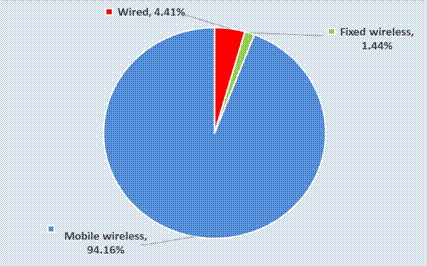
Wireless subscribers, including mobile and fixed wireless access, recorded robust growth. The total wireless base increased by 76.45 million to reach 1,258.77 million, reflecting a quarterly growth rate of 6.47 percent and an annual growth rate of 9.40 percent. Wireless tele density rose from 83.36 percent to 88.41 percent. Mobile subscribers alone increased from 1,170.44 million to 1,244.20 million during the quarter. Wireless data usage remained strong, with average consumption per subscriber at 25.70 GB per month and average revenue realization per GB at Rs 7.87.
Wireline subscriptions grew from 46.61 million to 47.37 million, reflecting quarterly growth of 1.62 percent and year on year growth of 20.63 percent. Wireline tele density increased from 3.29 percent to 3.33 percent. Urban wireline subscribers stood at 42.29 million, while rural subscribers accounted for 5.08 million.
Internet subscribers increased from 1,017.81 million at the end of September 2025 to 1,028.61 million at the end of December 2025, registering quarterly growth of 1.06 percent. Broadband subscribers rose by 1.18 percent to 1,007.35 million, while narrowband subscribers declined to 21.25 million. Wireless internet subscribers numbered 983.29 million, while wired internet subscribers stood at 45.32 million. Internet penetration reached 72.24 subscribers per 100 population, with urban penetration at 116.09 and rural at 47.63.
Financial indicators reflected steady growth. Gross Revenue of the telecom sector for the quarter stood at Rs 1,02,475 crore, up 2.65 percent over the previous quarter. Applicable Gross Revenue rose to Rs 96,456 crore and Adjusted Gross Revenue to Rs 84,270 crore, registering quarterly increases of 2.28 percent and 2.33 percent respectively. On a year on year basis, Gross Revenue grew by 6.31 percent, Applicable Gross Revenue by 4.46 percent and Adjusted Gross Revenue by 8.13 percent. License Fee collections rose to Rs 6,733 crore during the quarter. Pass Through Charges declined by 1.13 percent compared to the previous quarter.
Access services contributed 84.54 percent of total Adjusted Gross Revenue. In this segment, Adjusted Gross Revenue rose by 2.91 percent during the quarter, while Spectrum Usage Charges increased by 2.46 percent.
Monthly Average Revenue per User for wireless services increased from Rs 190.99 in the September 2025 quarter to Rs 194.57 in the December 2025 quarter, marking a quarterly rise of 1.87 percent and year on year growth of 7.03 percent. Prepaid ARPU stood at Rs 194.12 and postpaid ARPU at Rs 199.05. Average Minutes of Usage per subscriber per month increased to 1,012 from 1,005 in the previous quarter.
Quality of Service benchmarks were fully complied with by wireline service providers across all licensed service areas. Parameters such as service provisioning within seven working days, low fault incidence, minimal Point of Interconnection congestion, timely resolution of billing complaints, call centre accessibility and timely closure of services met prescribed standards. Access service providers also complied fully with benchmarks related to network availability, call setup success rates, latency, packet drop rates and complaint resolution timelines. Broadband wireline providers met standards for latency, packet drop rate, speed compliance and customer care accessibility.
In broadcasting and related services, 920 private satellite television channels had been permitted for uplinking and downlinking. Of 911 channels available for downlinking, 335 were pay channels and 576 were Free to Air. The pay DTH segment, with four operators, reported 50.99 million active subscribers as on 31 December 2025, compared to 52.78 million in the previous quarter. There were 385 operational private FM radio channels across 113 cities, operated by 31 private operators. Advertisement revenue from private FM radio channels during the quarter stood at Rs 419.29 crore. Community Radio stations in operation numbered 557.
The report also noted that from December 2025, Bharti Airtel Limited began including its machine to machine cellular subscriber base in its wireless mobile subscriber base, contributing to the significant increase in total and wireless mobile subscriptions during the month.
The December 2025 quarter reflects continued expansion in telecom penetration, steady revenue performance and sustained compliance with regulatory quality benchmarks, underscoring the sector’s critical role in India’s digital and economic landscape.