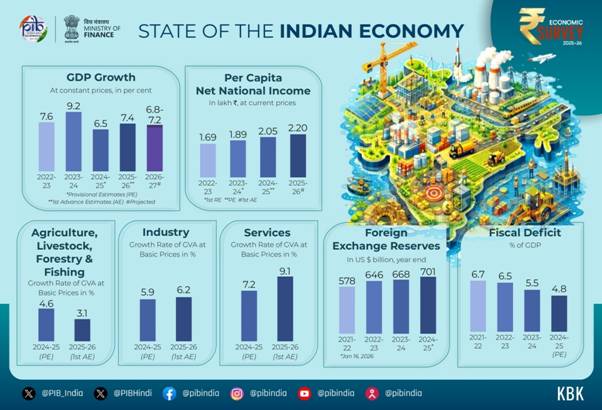

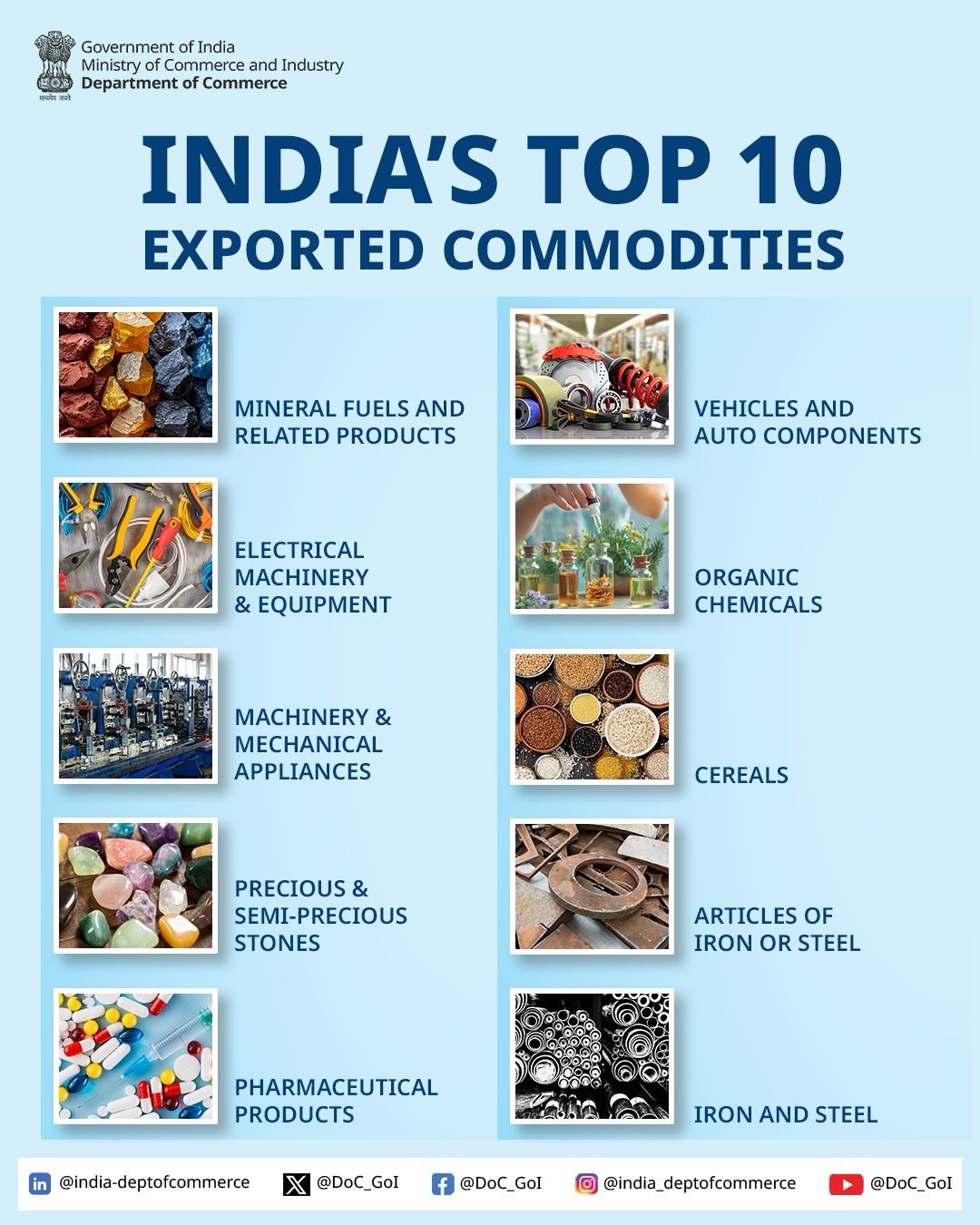
The Union Budget 2026–27 places exports and international trade at the core of India’s economic strategy, signalling a determined push to strengthen manufacturing, generate employment, deepen global value chain integration and position India as a competitive and reliable trading partner. Anchored in macroeconomic stability, sustained public investment and structural reforms, the Budget advances a comprehensive agenda aligned with the vision of Viksit Bharat.
Recognising exports as a key driver of jobs, productivity, foreign exchange earnings and technology absorption, the Budget announces a wide-ranging package of measures covering strategic manufacturing sectors, labour-intensive industries, services, Special Economic Zones, logistics infrastructure and ease of doing business in trade.
A central pillar of the export strategy is the scaling up of domestic manufacturing across both strategic and employment-intensive sectors. Major initiatives include the launch of Biopharma SHAKTI to take India beyond conventional pharmaceuticals into advanced biomanufacturing, India Semiconductor Mission 2.0 to build domestic intellectual property and secure supply chains, expansion of the Electronics Components Manufacturing Scheme, establishment of Rare Earth Corridors, support for dedicated Chemical Parks, and targeted schemes for capital goods and container manufacturing. These measures aim to reduce import dependence while enhancing export competitiveness in high-value sectors.
Labour-intensive sectors such as textiles, footwear, handlooms, handicrafts and sports goods receive renewed policy focus through integrated programmes, cluster modernisation, technology upgradation, skilling initiatives and sustainability-linked interventions. The revival of 200 legacy industrial clusters through infrastructure and technology support is expected to lower costs, improve productivity and strengthen the global competitiveness of traditional export hubs.
The services sector receives a strong policy thrust as part of India’s export ambitions. A High-Powered Education to Employment and Enterprise Standing Committee has been proposed to guide reforms and support the goal of achieving a 10 per cent share in global services exports by 2047. Tax and regulatory reforms for IT and IT-enabled services include unified classification of IT services, higher safe harbour thresholds, automated approvals, faster Advance Pricing Agreements and longer policy certainty, strengthening India’s appeal for Global Capability Centres and international service providers.
To attract global digital investment, the Budget proposes tax holidays until 2047 for foreign companies providing global cloud services through India-based data centres, along with safe harbour norms for related-party services. These measures are expected to deepen digital infrastructure, boost exports of digital services and reinforce India’s position as a global data and technology hub.
Reforms in Special Economic Zones are designed to enhance capacity utilisation and economies of scale while preserving export orientation. One-time facilitation for limited Domestic Tariff Area sales at concessional duties and targeted incentives for technology- and data-driven operations are expected to improve SEZ viability and attract global investors.
Infrastructure and logistics form the backbone of the export push. Higher public capital expenditure, new Dedicated Freight Corridors, operationalisation of additional National Waterways, promotion of coastal shipping, container manufacturing support and improved port connectivity are aimed at reducing logistics costs and improving supply-chain reliability. These measures are expected to particularly benefit exporters in tier-two and tier-three cities.
The Budget advances a trust-based, technology-driven trade facilitation framework. Key measures include expanded non-intrusive scanning, electronic sealing of export cargo, enhanced duty deferment for Authorised Economic Operators, longer validity of advance rulings and removal of the value cap on courier exports. Together, these reforms are intended to reduce transaction costs, improve predictability and strengthen India’s standing on global trade facilitation indices.
Micro, small and medium enterprises, which form the backbone of India’s export ecosystem, receive focused support through a ₹10,000 crore SME Growth Fund, enhanced credit guarantee mechanisms, mandatory use of TReDS by CPSEs and integration of GeM with TReDS to ease access to affordable working capital. These steps directly address liquidity constraints and enable MSMEs to scale up exports.
Sector-specific measures across agriculture, marine products, pharmaceuticals, tourism, AVGC and allied health services further diversify India’s export base and open new global market opportunities.
Overall, the Union Budget 2026–27 presents a coherent and forward-looking export strategy that combines manufacturing scale, services excellence, logistics modernisation and regulatory simplification. By aligning investment, reform and infrastructure with global trade dynamics, the Budget lays a strong foundation for sustained export growth, employment generation and long-term economic resilience.