
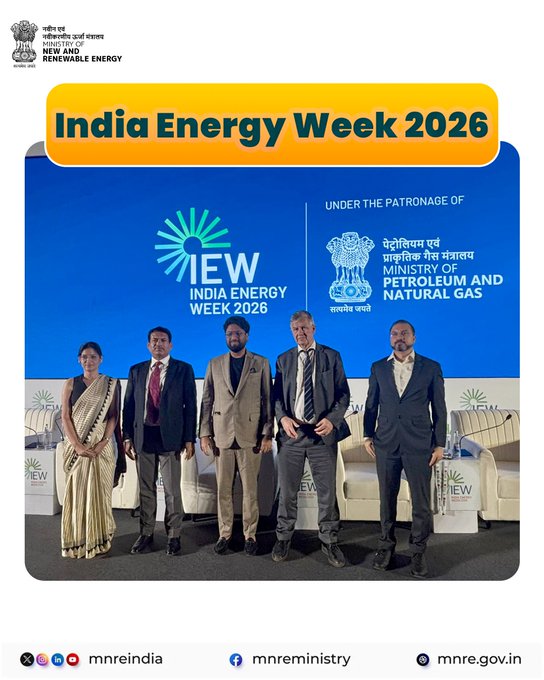
Domestic manufacturing strength, grid integration and technology adoption must move in step with capacity expansion if India is to achieve a smooth and sustainable clean energy transition, Santosh Kumar Sarangi, Secretary, Ministry of New and Renewable Energy, said at India Energy Week 2026 in Goa.
Addressing the Leadership Spotlight Session on the third day of the global energy forum, Santosh Kumar Sarangi said India’s renewable energy journey has reached a critical phase where integration and resilience are as important as scale. Speaking during the session titled The Solar and Wind Opportunity Realising the Dual Potential of Scaling Indias Renewables Outlook, he said India’s non fossil fuel installed capacity has reached around 267 gigawatts and the country is firmly on track to cross 600 gigawatts by financial year 2030.
He said future policy focus will increasingly shift toward grid integration, management of distributed renewable energy and strengthening domestic manufacturing across the solar and wind value chains. Reducing import dependence and building resilient supply chains, he noted, are central to sustaining India’s long term clean energy ambitions.
From the industry perspective, Gyanesh Chaudhary, Chairman and Managing Director, Vikram Solar, said India’s early push into renewable energy created both rapid scale and valuable learning. He said initial expansion exposed gaps in domestic manufacturing and supply chains, but consistent policy direction and market creation have enabled India to emerge as one of the world’s leading renewable energy deployment markets.
Chaudhary said the next phase of growth will require deeper vertical integration, access to advanced technologies and stronger engagement with global markets if India is to establish itself as a long term renewable manufacturing hub.
Offering a global policy perspective, Erik Solheim, President, International Advisory Board, GH2 India, said solar energy has become one of the cheapest sources of power worldwide. He noted that the clean energy transition is no longer driven only by environmental considerations but is increasingly an economic imperative for countries seeking affordable and secure energy.
Aditya Pyasi, Chief Executive Officer, Indian Wind Turbine Manufacturers Association, highlighted the evolution of India’s wind sector from early deployment to deeper manufacturing and global integration. He said Indian wind equipment manufacturers are now catering to both domestic and international markets, and future growth will depend on policy stability, component level indigenisation and sustained focus on employment and manufacturing in a geopolitically uncertain global environment.
India Energy Week is the country’s flagship global energy platform that brings together government leaders, industry executives and innovators to advance a secure, sustainable and affordable energy future through policy alignment, investment and technological collaboration.