
Union Minister of Agriculture and Farmers’ Welfare and Rural Development Shivraj Singh Chouhan on Monday said in Erode, Tamil Nadu, that the Viksit Bharat G Ram G Act lays a strong and durable foundation for building self reliant villages across the country. Addressing farmers, workers and labourers, the Minister described the new law as a decisive step to strengthen employment generation, expand basic facilities and empower village institutions through direct public participation.
Explaining the intent behind the reform, the Union Minister said that while the earlier employment guarantee framework assured 100 days of work, many regions faced persistent problems such as delayed availability of work and irregular wage payments. He termed these shortcomings unacceptable and said the new law was introduced to remove systemic inefficiencies, eliminate corruption and restore trust among rural workers.
Under the Viksit Bharat G Ram G Act, the guaranteed employment period has been enhanced from 100 days to 125 days. The Minister said that if work is not provided within the stipulated timeframe, workers will now be entitled to unemployment allowance. He further stated that wage payments have been legally strengthened, with interest payable if wages are delayed beyond 15 days. To support efficient implementation, administrative expenditure has been raised from 6 percent to 9 percent, ensuring timely payments to field level staff and smoother functioning of the system.
Shri Chouhan emphasised that the new law places Gram Sabhas at the centre of decision making. Village assemblies will now determine the development works required in their own areas, ensuring that priorities reflect local needs rather than decisions taken at distant administrative centres. He said development planning would no longer be driven from state capitals or Delhi, but shaped directly by villagers themselves.
Addressing concerns raised by some sections, the Union Minister said misinformation was being deliberately spread about the scheme. He reiterated that reforms introduced under the leadership of Prime Minister Narendra Modi ensure that funds meant for labourers and workers are transferred directly into their bank accounts, leaving no scope for siphoning or misuse. He asserted that no individual would be allowed to divert money meant for workers under the new system.
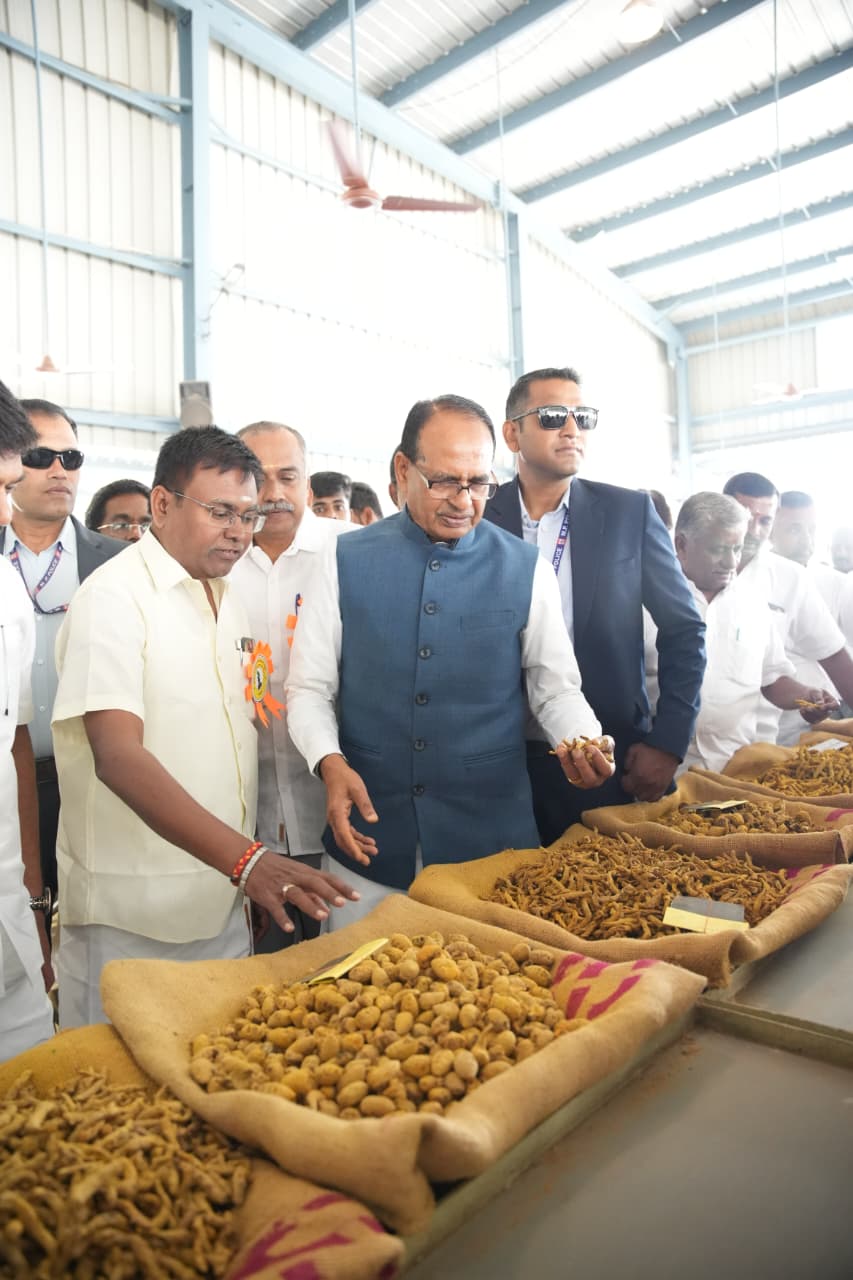
During his visit to Erode, known nationally as a major turmeric trading hub, the Union Minister interacted with turmeric farmers and traders at the local market. He announced the establishment of a dedicated turmeric testing laboratory in Erode and issued directions to the Indian Council of Agricultural Research to set up the facility. The laboratory is expected to support farmers through quality testing, certification and improved market access.
Shri Chouhan also assured that a regional office of the Turmeric Board would be established in Erode. While the subject falls under the Ministry of Commerce, he said he would personally pursue the matter to ensure policy support, better marketing opportunities and enhanced export prospects for turmeric farmers.
Highlighting infrastructure needs in the region, the Union Minister said cold storage facilities are critical for safeguarding produce and improving farmer incomes. He noted that such facilities can be created under various central government schemes and that the Tamil Nadu government would be requested to utilise Rashtriya Krishi Vikas Yojana funds for this purpose. He also assured strict action to curb the inflow of smuggled turmeric and said a meeting would be convened in Delhi to arrive at concrete solutions. Stressing that quality seed is the foundation of agriculture, he underlined the need for focused seed development through ICAR.
As part of his visit, Shri Chouhan reviewed agricultural innovations showcased at more than 100 stalls, interacting with farmers and entrepreneurs on product quality and future potential. He held discussions with over 1,000 women farmers, met representatives of farmer organisations and progressive cultivators, and participated in cultural programmes organised on the occasion. The Minister said such direct engagement with farmers and workers is essential to ensure that policies translate into tangible improvements in rural livelihoods.