
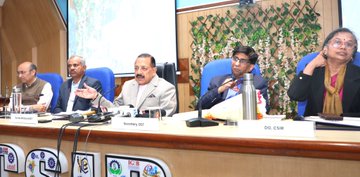
Union Minister of State Independent Charge for Science and Technology and Earth Sciences, and Minister of State for PMO, Department of Atomic Energy, Department of Space, Personnel, Public Grievances and Pensions, Dr Jitendra Singh on Monday said that the Union Budget 2026–27 marks a decisive shift towards technology-driven, AI-integrated structural reforms that will shape India’s development trajectory for the next 25 years.
Addressing the media at a post-Budget interaction organised by the Ministry of Science and Technology, Dr Jitendra Singh described the Budget as a generational roadmap rather than a one-year financial exercise. He said the Budget reflects a clear and sequential vision in which structural reforms are enabled by cutting-edge technologies, with artificial intelligence increasingly acting as the central driver. According to the Minister, this approach positions India firmly for a future defined by innovation, resilience and inclusive growth.
Responding to concerns about immediate benefits for the middle class, Dr Jitendra Singh said the Budget’s real impact lies in long-term relief from rising healthcare and living costs. He emphasised that sustained investments in biopharma, diagnostics, vaccines and gene-based therapies will significantly reduce the financial burden on families affected by chronic diseases such as cancer, diabetes and metabolic disorders. He noted that India currently has more than 11 to 12 crore diabetics, nearly 14 crore pre-diabetics, and a rapidly rising cancer burden that could reach two million cases annually by 2030.
Highlighting the ₹10,000 crore Biopharma Shakti initiative, the Minister said India has already emerged as a leading global bio-manufacturing hub and that the new outlay will further strengthen capabilities in biologics, biosimilars, vaccines, medical devices and gene-based technologies. He described biotechnology as the next major industrial engine, comparable to the role played by information technology in earlier decades, and said the coming industrial transformation would be a bio-revolution centred on recycling, regeneration and the circular economy.
Dr Jitendra Singh said the Budget also addresses non-communicable diseases and mental health, areas that received limited attention in the past. He announced the establishment of new super-speciality academic and clinical institutes for mental health in North India to ensure wider and more equitable access to care. He also highlighted proposals to set up new institutes of Ayurveda and pharmaceutical education, aimed at strengthening traditional medicine while integrating it with modern research and healthcare delivery systems.
On energy and strategic sectors, the Minister said the extension of customs duty exemptions on imported components for nuclear power plants until 2035 will enhance project efficiency and attract credible domestic and international investment, in line with reforms to expand private sector participation in the nuclear ecosystem. He also referred to the development of rare earth corridors and critical mineral initiatives, which are expected to support clean energy technologies, electronics manufacturing and strategic industries while reducing import dependence.
Describing the National Geospatial Mission as a foundational reform, Dr Jitendra Singh said it will play a critical role in planned urbanisation, infrastructure design and land management, particularly as India experiences rapid rural-to-urban migration. Implemented through the PM Gati Shakti platform, the Mission will enable evidence-based planning using satellite imagery, drones and advanced mapping technologies.
The Minister highlighted the ₹20,000 crore allocation over five years for Carbon Capture, Utilisation and Storage as a key step towards industrial decarbonisation and environmental sustainability. He also said the structured deployment of artificial intelligence in agriculture will empower farmers through better decision-making while safeguarding them from potential risks associated with emerging technologies.
Secretary, Department of Science and Technology, Prof Abhay Karandikar said the Budget places strong emphasis on science, technology and innovation, with repeated references to technology in the Finance Minister’s speech. He announced the creation of two mega science research infrastructure facilities, including a 30-metre National Large Optical Telescope and a National Large Solar Telescope near Pangong Lake, which will significantly enhance India’s global scientific standing.
Secretary, Department of Biotechnology, Dr Rajesh S Gokhale said the Biopharma Shakti programme builds on the National Biopharma Mission and will accelerate the translation of research into manufacturing by strengthening industry-academia partnerships, shared infrastructure and clinical trial networks. He also noted the integration of biotechnology-based carbon utilisation technologies within the programme.
Secretary, Ministry of Earth Sciences, Dr M Ravichandran outlined initiatives under the Blue Economy, including expansion of national waterways, coastal tourism, offshore and deep-sea fisheries and sustainable shipping. He said new policies permitting fishing beyond territorial waters and in the high seas would open significant economic opportunities while ensuring environmental responsibility.
Director General of CSIR and Secretary, Department of Scientific and Industrial Research, Dr N Kalaiselvi said CSIR will play a central role across multiple Budget initiatives, including carbon capture, semiconductors, critical minerals, rare earth magnets, clean energy and advanced manufacturing. She added that CSIR laboratories have been designated as centres of excellence for critical metals and minerals, aligning national research capabilities with industrial and strategic needs.
Concluding the interaction, Dr Jitendra Singh said the Budget reflects a mission-oriented approach in which research, manufacturing and deployment progress together. He said science-led reforms outlined in the Budget demonstrate India’s readiness to compete in technology-intensive global sectors while ensuring that growth remains inclusive, sustainable and citizen-centric.