
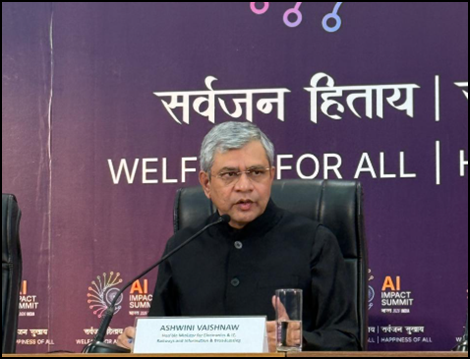
India signalled a decisive escalation of its artificial intelligence ambitions on the second day of the India AI Impact Summit 2026, with Union Minister for Electronics and Information Technology Ashwini Vaishnaw announcing the addition of 20,000 more Graphics Processing Units to the country’s existing compute base of over 38,000 GPUs.
The expansion, unveiled at Bharat Mandapam during the Summit being held from 16 to 20 February, will take India’s total available high end GPU capacity to more than 58,000 units in the coming weeks. The announcement marks a significant strategic step in strengthening the nation’s AI infrastructure and reinforcing its positioning among leading global AI powers.
The Minister described the move as part of India’s next phase of AI growth, combining scale with responsible deployment. The Summit, themed Sarvajan Hitaya, Sarvajan Sukhaya meaning Welfare for All, Happiness of All, has drawn unprecedented participation and is being described as one of the largest AI gatherings globally.
Democratising Access To Compute
India’s AI expansion is anchored in the ₹10,300 plus crore IndiaAI Mission, which seeks to broaden access to compute infrastructure for startups, researchers, students and public institutions. Under the Mission, more than 38,000 GPUs have already been made available at ₹65 per hour, significantly lowering entry barriers for innovation.
The addition of 20,000 GPUs further strengthens this democratised model, contrasting with global trends where advanced AI infrastructure remains concentrated within a handful of private corporations. India’s framework emphasises access, affordability and public good, positioning technology as an enabling resource rather than an exclusive asset.
Artificial intelligence, the Minister observed, represents what he termed the fifth industrial revolution, with transformative implications across agriculture, healthcare, education, manufacturing, governance and climate action. The expansion of compute capacity reflects a deliberate effort to match national ambition with foundational infrastructure.
Global Leadership And Participation
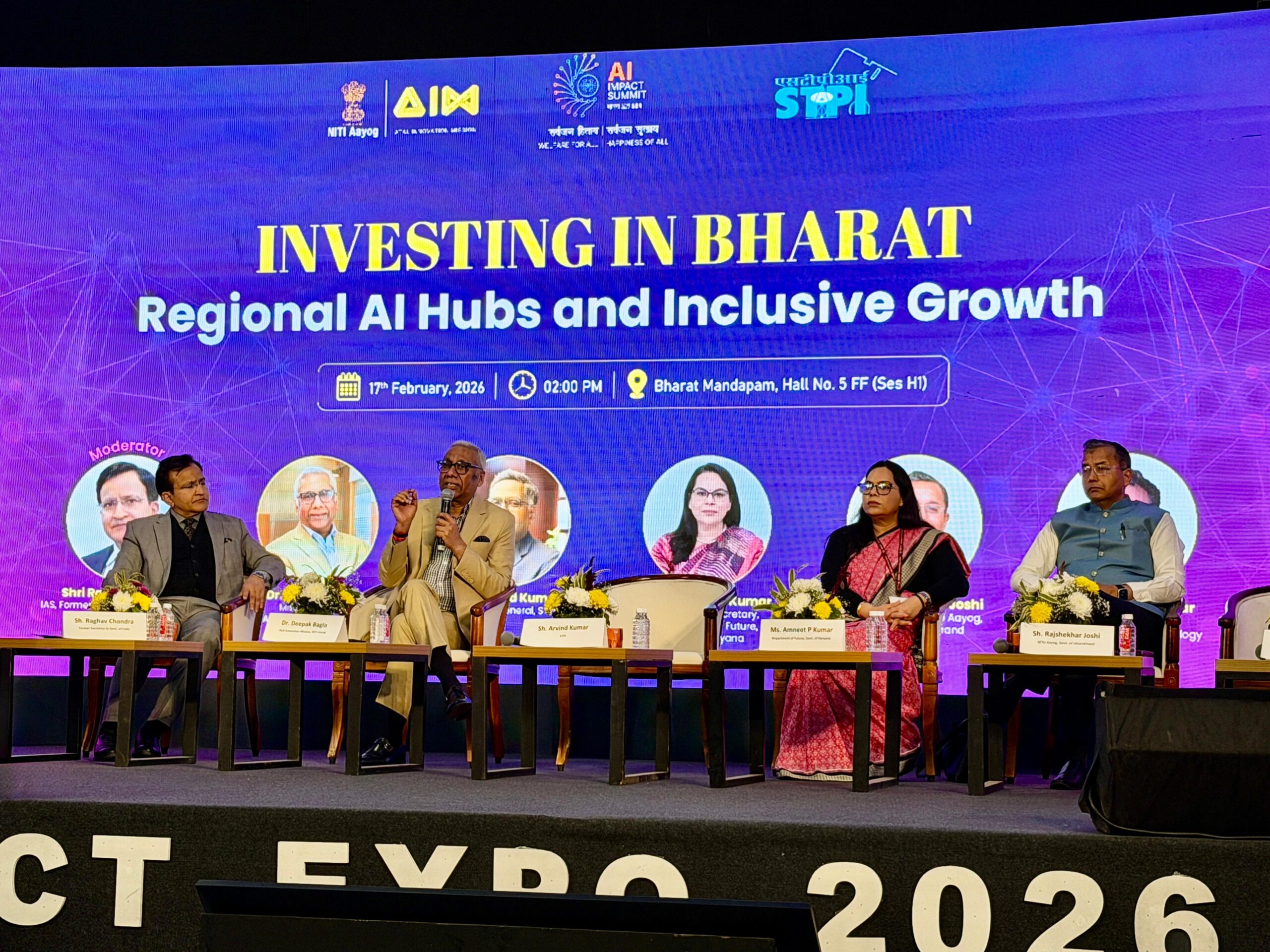
The Summit opened on 16 February 2026 with Prime Minister Narendra Modi inaugurating the India AI Impact Expo at Bharat Mandapam. The event has brought together over 20 Heads of State, 60 Ministers and 500 global AI leaders, alongside policymakers, technologists, academics and investors.
On the first day alone, more than 2.5 lakh students across India took a pledge to use AI responsibly for innovation and social good, an initiative submitted for recognition by Guinness World Records. The participation underscored the scale of youth engagement in the country’s AI journey.
Investment momentum is building in parallel. Ashwini Vaishnaw expressed optimism that more than USD 200 billion in investments could flow into India’s AI ecosystem over the next two years. Venture capital interest is rising across all five layers of the AI stack, from foundational models to large scale applications.
India’s sovereign AI models have also drawn attention at the Summit. Several models launched and benchmarked during the event have performed competitively against leading international systems across multiple parameters, signalling original capability rather than incremental progress.
Global recognition has further reinforced India’s position. Stanford has ranked India among the top three AI nations in the world, reflecting the convergence of talent, policy design and infrastructure development.
Framework Rooted In Responsibility
The Summit’s intellectual architecture rests on three foundational Sutras: People, Planet and Progress. The People Sutra emphasises inclusivity and dignity in AI deployment. The Planet Sutra aligns innovation with environmental sustainability. The Progress Sutra calls for equitable distribution of AI’s benefits across societies.
Deliberations are structured around seven Chakras translating these principles into action. These include Human Capital, Inclusion for Social Empowerment, Safe and Trusted AI, Resilience Innovation and Efficiency, Science, Democratizing AI Resources, and AI for Economic Growth and Social Good.
The Government launched six sectoral AI Impact Casebooks during the Summit, documenting more than 170 deployed and scalable AI innovations across Health, Energy, Gender Empowerment, Education, Agriculture and Accessibility. These casebooks highlight real world applications already delivering measurable outcomes.
RailTel Corporation of India Ltd curated two sessions focused on AI powered public health and inclusive healthcare delivery. Another key session titled AI in Governance Revolutionising Government Efficiency examined how AI can strengthen public service delivery through measurable impact and accountable deployment.
Discussions on employability highlighted the shift towards human centred capabilities in the AI era, with India’s demographic profile identified as a significant advantage. Sessions such as From Algorithms to Outcomes and Scaling Impact from India’s Sovereign AI and Data stressed the transition from experimental models to deployable systems with global relevance.
Infrastructure As The Foundation
Across policy debates and technical sessions, one theme remained constant: ambition at scale requires infrastructure at scale. The addition of 20,000 GPUs represents more than a hardware upgrade. It signals intent, access and long term capacity building.
By expanding compute power, encouraging global collaboration and embedding ethical frameworks, India is positioning itself not merely as a consumer of AI technologies but as a creator of scalable, responsible and globally relevant AI systems.
With more than 58,000 GPUs soon operational, India’s AI moment is being defined not by rhetoric but by infrastructure, investment and institutional alignment, shaping a future in which artificial intelligence drives welfare, prosperity and shared progress.