

Artificial Intelligence is entering a decisive new phase where inclusion, opportunity and human potential will define its impact, industry leaders asserted at the AI Summit, positioning India at the forefront of the next wave of AI-driven transformation.
Three keynote addresses brought together voices from fintech, advanced research and global technology, outlining how AI is rapidly moving beyond experimental applications into large-scale deployment across finance, enterprise systems, agriculture and industrial ecosystems.
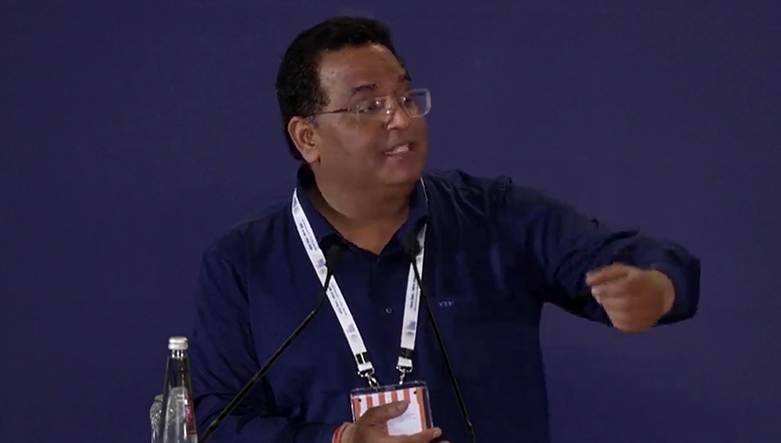
Opening the session, Vijay Shekhar Sharma, Founder and CEO of Paytm, described the gathering of global AI leaders in India as a moment of national significance. He said that just as the Startup India movement ignited a new entrepreneurial wave, the country is now witnessing the emergence of an AI India revolution.
Sharma stressed that AI is transitioning from novelty tools to real-world economic engines. He noted that the technology is no longer confined to conversational interfaces or image processing, but is increasingly solving practical problems across business operations, financial services, agriculture and industry. In financial inclusion, he explained, AI-driven analytics can expand credit access, improve risk assessment and deliver tailored financial products to underserved populations. He asserted that AI represents abundance rather than displacement and said India has the scale, digital infrastructure and entrepreneurial ecosystem to lead this transformation.
Offering a research and enterprise perspective, Ananya Birla of Birla AI Labs outlined a dual strategy focused on building applied AI systems for industry while advancing foundational research. She said the goal is not merely to replicate pattern recognition, but to develop structured foundational models that better understand the structure of the world.
Birla emphasised that AI deployment must remain grounded in responsibility, especially as it influences cognition, decision-making and human agency. She pointed to microfinance as an area where AI can deliver profound human impact by optimising risk assessment, improving operational efficiency and expanding access to credit for marginalised communities. According to her, embedding AI across enterprise workflows can unlock productivity gains that ultimately translate into deeper financial inclusion.
From a global technology standpoint, Takahito Tokita, President and CEO of Fujitsu, framed AI within a broader mission of societal sustainability and trust. He stated that innovation must be aligned with building confidence in digital systems. Tokita emphasised that AI should augment rather than replace human capability. He argued that the core function of AI must be to enhance uniquely human strengths such as creativity, complex reasoning and critical judgment, while preserving autonomy and ethical integrity.
Across the three addresses, a consistent theme emerged: the next chapter of AI will be measured not only by computational power or model sophistication, but by its capacity to widen opportunity, reduce inequality and support human development.
Speakers highlighted that India’s digital public infrastructure, entrepreneurial momentum and youthful talent base position the country to become a central hub in shaping responsible AI adoption. They emphasised that AI deployment must remain aligned with inclusive growth, enterprise transformation and sustainable development objectives.
The discussions underscored that as AI integrates deeper into finance, agriculture, manufacturing and governance, its governance frameworks must evolve in parallel to ensure accountability, transparency and equitable access.
The Summit session concluded with a strong message that AI’s trajectory must be anchored in human progress. By aligning technological advancement with inclusive economic models and ethical safeguards, India and global industry leaders aim to define an AI-driven future that expands opportunity while strengthening human potential.