
India’s energy landscape is undergoing a structural transformation as the country expands renewable capacity, accelerates green hydrogen deployment, modernises nuclear power laws, strengthens energy efficiency frameworks and digitises its power distribution architecture. The evolving spectrum of energy sources reflects a calibrated transition designed to ensure reliability, affordability, sustainability and long term energy security while supporting economic growth.
Electricity availability has improved significantly over the past decade. Average daily power supply in rural areas has risen from 12.5 hours in 2014 to 22.6 hours, while urban areas now receive about 23.4 hours of supply compared to 22.1 hours in 2014. These improvements underscore progress in generation capacity, transmission strengthening and distribution reforms.
India is now among the world’s top three energy consumers, with electricity demand rising annually in tandem with industrial expansion, urbanisation and digital growth. Total electricity generation increased from 1,739.09 Billion Units in 2023–24 to 1,829.69 Billion Units in 2024–25, marking a growth of 5.21 percent. The generation target for 2025–26 has been set at 2,000.4 Billion Units, reflecting continued demand momentum.
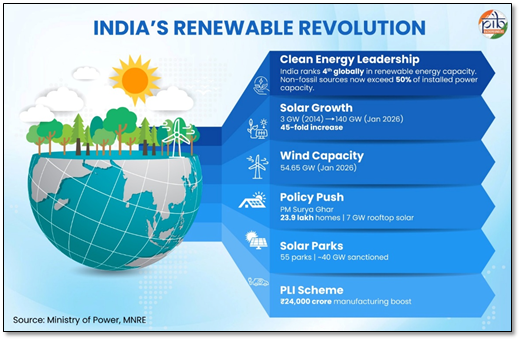
Renewable energy has emerged as a central pillar of India’s transition strategy. According to Renewable Energy Statistics 2025 by the International Renewable Energy Agency, India ranks fourth globally in total installed renewable energy capacity. Solar capacity has expanded from 3 GW in 2014 to 140 GW as of January 2026. Wind energy capacity has reached approximately 54.65 GW. Together, these sources have helped push non fossil fuel based capacity beyond 50 percent of total installed electricity capacity.
Government programmes have supported expansion across sectors. The PM Surya Ghar initiative has enabled 23.9 lakh households to install rooftop solar systems, adding 7 GW of distributed capacity. The PM KUSUM scheme promotes solarisation of agriculture, aiming to install 14 lakh standalone solar pumps by March 31, 2026, thereby reducing diesel dependence and stabilising rural power supply. Fifty five solar parks across 13 states have been approved with a sanctioned capacity of nearly 40 GW. A Production Linked Incentive scheme with an outlay of ₹24,000 crore is strengthening domestic solar manufacturing and reducing import reliance.
Green hydrogen has been positioned as the next frontier of clean energy transition, particularly for hard to abate sectors such as steel, fertilisers, refining, shipping and heavy transport. Green hydrogen is produced by splitting water using renewable electricity, ensuring lifecycle emissions do not exceed 2 kilograms of carbon dioxide equivalent per kilogram of hydrogen, averaged over 12 months. It can also be generated from biomass, provided emission thresholds are met.
Under the National Green Hydrogen Mission launched in 2023, India has set a target of producing 5 million metric tonnes of green hydrogen annually by 2030. The mission is expected to attract over ₹8 lakh crore in investment, reduce fossil fuel imports by more than ₹1 lakh crore and avoid nearly 50 million metric tonnes of greenhouse gas emissions annually by 2030. The government has approved an outlay of ₹19,744 crore till 2029–30, including ₹17,490 crore under the SIGHT programme to incentivise electrolyser manufacturing and hydrogen production. Pilot projects are operational, including India’s first port based green hydrogen initiative and hydrogen mobility trials across 10 routes involving buses and trucks. The Green Hydrogen Certification Scheme 2025 provides emission verification standards for domestic and export markets.
Nuclear energy continues to provide reliable baseload power with minimal greenhouse gas emissions. India’s present nuclear capacity stands at 8.78 GW and is projected to increase to 22.38 GW by 2031–32. A long term Nuclear Energy Mission envisions achieving 100 GW by 2047. The Sustainable Harnessing and Advancement of Nuclear Energy for Transforming India Act 2025 modernises the legal framework by enabling limited private participation under regulatory oversight, granting statutory recognition to the Atomic Energy Regulatory Board, introducing a graded liability framework and reinforcing safety safeguards while retaining sovereign control over sensitive fuel cycle activities. Additionally, ₹20,000 crore has been allocated for development of at least five indigenously designed Small Modular Reactors by 2033.
Energy efficiency remains integral to managing demand growth. The transition from the Perform Achieve and Trade scheme to the Carbon Credit Trading Scheme introduces a market based mechanism in which emission intensive industries are assigned greenhouse gas intensity targets and can trade carbon credits for over performance. At the consumer level, the UJALA programme has distributed 36.87 crore LED bulbs, resulting in annual energy savings of 47,883 million kilowatt hours and reduction of 3.88 million tonnes of carbon dioxide emissions. Digital tools such as the Urja Dakshata Information Tool enhance monitoring and compliance.
Distribution reforms have focused on infrastructure strengthening and financial sustainability of DISCOMs. Under Deen Dayal Upadhyaya Gram Jyoti Yojana, Integrated Power Development Scheme and Pradhan Mantri Sahaj Bijli Har Ghar Yojana, approximately ₹1.85 lakh crore was invested, electrifying 18,374 villages and providing connections to 2.86 crore households. The Revamped Distribution Sector Scheme launched in 2021 with an outlay of ₹3.03 lakh crore has approved projects worth ₹2.8 lakh crore, emphasising smart metering and system modernisation. So far, 5.62 crore smart meters have been installed, enhancing billing accuracy and reducing losses. The draft Electricity Amendment Bill 2026 seeks to improve financial viability, competitiveness and regulatory accountability, while the Draft National Electricity Policy 2026 outlines strategies for reliable and environmentally sustainable 24 by 7 power supply.
The India Energy Stack represents a digital public infrastructure initiative to standardise energy data exchange through open standards and consent based frameworks. It aims to enable portable onboarding across utilities, facilitate monetisation of distributed assets such as rooftop solar and electric vehicle chargers, and embed policy as code for near real time settlement. This architecture seeks to transform consumers into active energy participants.
On the global stage, India has expanded engagement through the G20 Energy Transitions Working Group and launched the Global Biofuels Alliance during its G20 Presidency, bringing together 25 countries and 12 international organisations. India joined the International Energy Efficiency Hub in 2024 and remains committed under the UNFCCC to achieving Net Zero by 2070 and reducing emissions intensity of GDP by 45 percent by 2030. The International Solar Alliance, co founded by India, now includes over 125 member and signatory countries. India Energy Week serves as a global platform for energy dialogue and collaboration.
India’s evolving energy spectrum reflects a layered transition rather than abrupt replacement. Solar parks, wind farms, rooftop installations, hydrogen pilots, nuclear expansion, carbon markets, smart meters and digital platforms together represent a comprehensive redesign of the energy system. The approach integrates policy reform, infrastructure investment, technological innovation and international cooperation.
As the country moves toward its Net Zero 2070 commitment, the energy transition is structured to align economic growth with climate responsibility. The objective is not merely to generate more power but to redesign how energy is produced, transmitted, consumed and monetised. The result is an energy system intended to be resilient, inclusive and future ready, supporting homes, farms, factories and digital infrastructure in a manner that balances development with sustainability.