
The Ayush Pavilion at the India AI Impact Summit 2026 witnessed sustained engagement from visitors, innovators and international delegates, highlighting growing public and institutional interest in citizen-centric digital solutions for traditional medicine systems.
The Pavilion, set up by the Union Ministry of Ayush as part of the Summit exhibition, showcased AI-enabled initiatives designed to modernise and strengthen service delivery across Ayurveda, Yoga, Unani, Siddha and Homoeopathy systems. Key attractions included AI-powered chatbots and Yoga Posture AI, a computer vision-based tool that enables users to assess and correct yoga asanas in real time, enhancing safety, precision and accessibility.
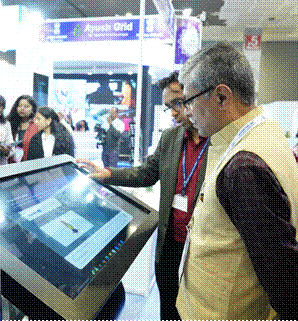
Vaidya Rajesh Kotecha, Secretary, Ministry of Ayush, reviewed the Pavilion along with Vaidya Rabinarayan Acharya, Director General, Central Council for Research in Ayurvedic Sciences, and senior officials. The Secretary commended the Ayush Grid team for presenting a structured demonstration of technology-driven interventions aimed at strengthening healthcare services, education, research and governance in the Ayush sector.
During the visit, Rajesh Kotecha also interacted with representatives at other key pavilions, including Sarvam AI, MeitY, Meta, Google and other leading technology organisations, reflecting cross-sector dialogue on the integration of artificial intelligence with public health frameworks.
Emphasising the importance of indigenous AI capability, he stated that India’s Sovereign AI Models must be leveraged to strengthen the Ayush digital ecosystem while maintaining data integrity, inclusivity and global interoperability. He underscored that artificial intelligence should be integrated responsibly with traditional knowledge systems to create scalable, people-centric healthcare solutions.
At the core of the Pavilion was the Ayush Grid, India’s digital public health infrastructure for traditional medicine. The Ayush Grid architecture integrates healthcare services, research, education, medicinal plant databases, drug administration and public outreach through a unified digital backbone. The My Ayush Integrated Services Portal serves as a central gateway, enabling citizens and institutions to access authentic Ayush services through a single platform.
Live demonstrations attracted significant visitor interaction. AI-enabled chatbots offered personalised wellness guidance, service navigation and information on Ayush therapies. The Yoga Posture AI system demonstrated real-time posture analysis using computer vision technology, illustrating how AI can improve alignment accuracy and reduce injury risk during practice.
The Pavilion also displayed AI tools currently under development to support clinical decision-making, standardisation protocols, research analytics and public health outreach within Ayush disciplines. These tools aim to improve evidence generation, practitioner support and citizen engagement while maintaining adherence to traditional principles.
The IIT Jodhpur Centre of Excellence presented research initiatives at the intersection of digital health, artificial intelligence and traditional medicine. Interactive displays highlighted collaborative projects and ongoing studies exploring data-driven approaches within Ayush systems.
In addition, the IndiaAI–Ministry of Ayush Innovation Challenge generated notable interest from startups and researchers. The initiative seeks to encourage development of AI-driven public health applications tailored to traditional medicine, reflecting a broader effort to create an innovation ecosystem aligned with national health priorities.
Through its participation in the India AI Impact Summit 2026, the Ministry of Ayush demonstrated how advanced technologies can reinforce traditional health knowledge systems. The Pavilion underscored a vision in which artificial intelligence enhances accessibility, transparency and service quality, contributing to inclusive and citizen-focused healthcare transformation.