

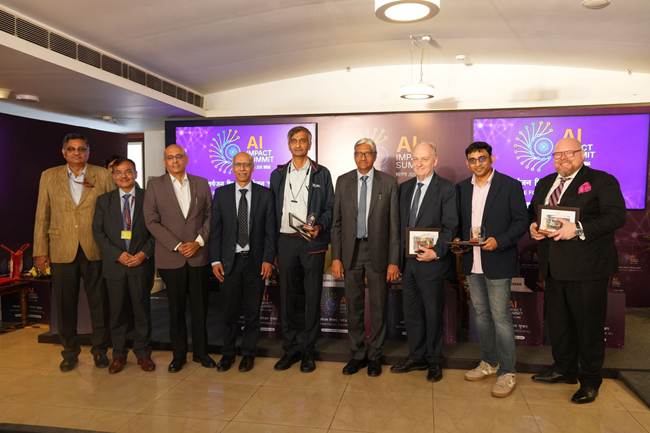
The Telecom Regulatory Authority of India hosted a high-level session on Responsible AI in Telecom at the India AI Impact Summit 2026, focusing on digital resilience, governance frameworks and the transformation of network operations in an AI-driven era. The session was held at Sushma Swaraj Bhawan, New Delhi, and brought together senior representatives from telecom service providers, global technology companies, industry associations, government institutions and international bodies.
The discussion formed part of the broader summit agenda and served as a platform to examine policy, operational and technological approaches to integrating artificial intelligence into telecom networks and consumer-facing services. Participants deliberated on governance priorities including trust, accountability, transparency and safety, alongside pathways to scale AI responsibly in network management, consumer protection and service delivery.
In his inaugural address, Anil Kumar Lahoti, Chairman, TRAI, underlined that artificial intelligence is no longer a peripheral technology for the telecom sector but is becoming integral to how networks are designed, managed and experienced. He stated that as AI systems increasingly influence decisions at population scale, trust must be central to their rollout. Efficiency gains, he observed, must be accompanied by transparency, accountability, human oversight and clearly defined guardrails to ensure fairness and unbiased outcomes.
He noted that telecom networks constitute a core pillar of India’s AI infrastructure and, given the scale of the country’s subscriber base, AI-driven automation is becoming indispensable. AI is already being deployed to optimise network performance, predict system faults, enhance energy efficiency, improve customer experience and combat fraud and spam communications. Strengthened enforcement and AI-driven filtering mechanisms have enabled action against spam-linked connections, and work is underway to implement digital consent frameworks to ensure verifiable consumer consent in commercial communications. He reiterated TRAI’s commitment to a risk-based regulatory approach and the use of regulatory sandboxes to encourage innovation while safeguarding consumer rights and public interest.
The first panel discussion, titled Preparing Telecom Networks for the AI Era, was chaired by Ritu Ranjan Mittar, Member, TRAI. The panel included Magnus Ewerbring, Chief Technology Officer, Ericsson; Vinesh Sukumar, Vice President Product Management, Qualcomm; Pasi Toivanen, Senior Vice President Strategic Government and Industry Initiatives, Nokia; and Shantigram Jagannath, Senior Vice President and Head NMS, Tejas.
The panel examined how telecom networks must evolve to incorporate AI capabilities responsibly. Discussions focused on AI-native architectures, intelligent automation, and the transformation of network management across expanding 5G ecosystems. Speakers emphasised embedding responsibility by design, strengthening transparency and explainability in AI-driven systems, and ensuring environmental sustainability, safety and security in large-scale AI deployment.
The second panel discussion, titled Building Customer Trust through AI Driven Operations, was chaired by M. P. Tangirala, Member, TRAI. The panel featured Julian Gorman, Head of APAC, GSMA; Rajkumar Upadhyay, Chief Executive Officer and Chairman Board, C-DOT; Mathan Babu Kasilingam, Chief Technology and Security Officer and Data Privacy Officer, Vodafone India Ltd.; and Syed Tausif Abbas, Senior Deputy Director General and Head, TEC, Department of Telecommunications.
This session focused on accountability in automated network decisions, transparency in AI-driven customer engagement and the ethical governance of AI systems within telecom operations. Participants discussed mechanisms for responsible AI use in spam prevention, the development of standards for an AI incident database to analyse failures in telecommunications and critical digital infrastructure, and the scaling of AI responsibly in emerging 5G and future 6G environments. Fraud detection systems and customer-facing analytics were highlighted as priority areas requiring robust safeguards and oversight.
Speakers across both panels underscored that trusted AI adoption will depend on sustained collaboration among regulators, telecom operators, equipment manufacturers and technology providers. The convergence of AI and telecommunications, they noted, is reshaping network design, operations and customer experience, making digital resilience and governance central to long-term sectoral growth.
The session concluded with a consensus that responsible AI integration in telecom must balance innovation with consumer protection, security and public interest. The deliberations are expected to contribute to the broader objectives of the India AI Impact Summit 2026 and to support India’s vision of inclusive, secure and development-oriented AI adoption in the telecom sector.