

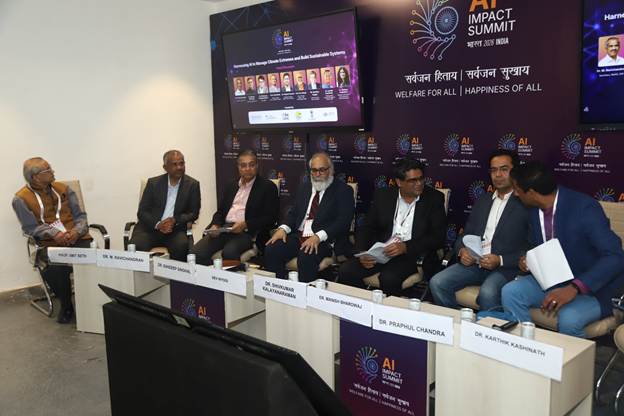
Blending physics-based meteorology with artificial intelligence is the future of weather prediction, said M. Ravichandran, Secretary, Ministry of Earth Sciences, outlining a roadmap for tackling increasingly unpredictable climate extremes.
Addressing the high-level panel discussion titled Harnessing AI to Manage Climate Extremes and Build Sustainable Systems on the final day of the India AI Impact Summit 2026 at Bharat Mandapam, he called for a paradigm shift in forecasting science. He stressed that while traditional numerical models remain indispensable for large-scale spatial forecasting, artificial intelligence is critical for mastering hyper-local and time-sensitive weather dynamics.
Using a vivid metaphor, M. Ravichandran explained the emerging challenge. In earlier decades, he said, scientists primarily tracked large-scale weather systems, but climate change now demands attention to far more granular patterns. Traditional models capture the broader spatial movement, yet extreme and localized events require sharper time-series analysis, an area where AI demonstrates distinct strengths.
He pointed out that numerical weather prediction models are built on multiple assumptions, which can amplify forecast errors over time. Artificial intelligence, he said, can be deployed to reduce these errors, particularly by improving the quality of initial conditions fed into forecasting systems. Enhancing these inputs would significantly increase predictive accuracy for high-impact events such as cloudbursts and extreme rainfall episodes that remain difficult to forecast reliably.
A major opportunity, he noted, lies in unlocking India’s extensive meteorological archives. The India Meteorological Department possesses over 150 years of historical data. He urged that this legacy data be made more accessible to young researchers and interdisciplinary experts to accelerate AI-driven analysis and innovation in climate science.
Highlighting AI’s transformative potential, he described downscaling as a game-changing capability. Artificial intelligence can refine outputs from large-scale models down to resolutions as fine as one kilometre, enabling more precise localized forecasts. Such granularity is crucial for disaster preparedness, urban planning and protecting vulnerable populations from sudden extreme events.
On the question of ethics and reliability, M. Ravichandran underscored that trust is fundamental to any forecasting system. AI-generated insights must undergo rigorous validation and verification before being operationalised for public advisories. Transparent methodologies and accountability frameworks, he said, are essential to ensure that advanced tools strengthen public confidence rather than undermine it.
He concluded by calling for a multidisciplinary approach to climate science. Breaking departmental silos, he said, is imperative. Collaboration among meteorologists, data scientists, biologists, engineers and social scientists will be critical to interpreting complex datasets and building resilient systems capable of responding to climate variability and long-term change.
The session was organised by Indian AI Research Organisation, Atria University, C-DAC, IITM Ministry of Earth Sciences and LokNeeti. In addition to M. Ravichandran, the panel featured Manish Bhardwaj, Secretary, National Disaster Management Authority; Shivkumar Kalyanaraman, Chief Executive Officer, Anusandhan National Research Foundation; Amit Sheth, Founding Director, Indian AI Research Organisation and Professor, University of South Carolina; Praphul Chandra, Professor and Dean Research, Atria University; Karthik Kashinath, Distinguished Scientist and Engineer, NVIDIA, Santa Clara, USA; Dev Niyogi, William Stamps Farish Chair Professor and UNESCO Chair, University of Texas at Austin, Jackson School of Geosciences; Sandeep Singhal, Senior Adviser and Investment Committee Member, Avaana Capital; and Akshara Kaginalkar, Professor of Practice, Centre for Climate Change, Atria University.
The discussion reinforced the growing consensus that future-ready weather systems must combine the rigour of physics with the adaptability of artificial intelligence to build a climate-resilient India.