
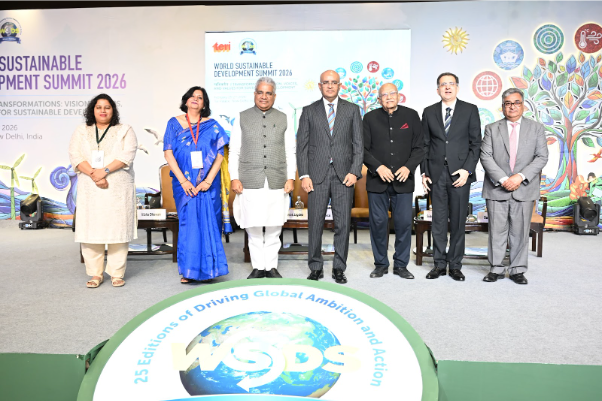
Union Minister for Environment, Forest and Climate Change Bhupender Yadav inaugurated the Silver Jubilee edition of The Energy and Resources Institute World Sustainable Development Summit 2026 and launched Him CONNECT, a dedicated platform of the Ministry of Environment, Forest and Climate Change aimed at translating Himalayan research into scalable solutions.
The inaugural session was attended by Bharrat Jagdeo, Vice President of the Cooperative Republic of Guyana; Nitin Desai, Chairman, TERI; Vibha Dhawan, Director General, TERI; and Siddhartha Sharma, CEO, Tata Trust, among other dignitaries.
In his address, Bhupender Yadav highlighted his long association with TERI and noted that over the past 25 years, the Summit has evolved into a significant forum from the Global South that brings together governments, industry, academia, civil society and communities to convert sustainability science into policy frameworks, partnerships and actionable outcomes.
Referring to Him CONNECT, he described it as a structured platform designed to translate research supported under the National Mission on Himalayan Studies into practical solutions capable of large scale deployment. He expressed appreciation for exhibitors from Himalayan States and Union Territories, stating that their participation reflects the innovation emerging from mountain ecosystems. Him CONNECT, he said, serves as a bridge between science and society by linking researchers with start ups, entrepreneurs, investors, development agencies and policymakers to strengthen real world impact while placing communities at the centre of environmental action.
Addressing the global climate challenge, the Minister noted that the first Global Stocktake under the Paris Agreement has made it clear that the world is not on track to limit warming to 1.5 degrees Celsius. Emission reductions remain inadequate, adaptation finance is insufficient and implementation of Sustainable Development Goals is uneven. He stressed that the climate crisis is no longer a challenge of science but of scale and speed.
He called for structural transformation that goes beyond incremental policy changes and encompasses energy systems, economic models, consumption patterns and global governance frameworks. Referring to the Summit theme Transformations Vision Voices and Values for Sustainable Development, he described it as a strategic necessity at a defining moment for humanity and the planet.
Explaining the concept of transformation, Bhupender Yadav observed that while it denotes structural change in English, the Indian concept of parivartan reflects a deeper evolution of consciousness. For India, he said, sustainability is a civilisational ethic. Transformation does not imply halting development but redefining it within ecological limits while ensuring social justice and inter generational equity.
Outlining India’s climate vision, he reiterated the target of achieving 500 gigawatts of non fossil fuel energy capacity by 2030, reducing emissions intensity of GDP by 45 percent from 2005 levels by 2030 and attaining net zero by 2070. He highlighted progress under the National Green Hydrogen Mission and efforts to build climate resilient infrastructure. At the global level, he emphasised the need to triple renewable energy capacity, double energy efficiency, scale up adaptation finance and reform multilateral development banks to unlock climate finance, asserting that climate ambition and climate finance must advance together.
On the theme of voices, he stated that the Global South remains at the frontline of climate impacts while pursuing development. India continues to uphold the principles of Common but Differentiated Responsibilities, climate justice, equitable carbon space and inclusive carbon markets. He stressed that the voices of small island states, least developed countries, indigenous communities and youth must shape global frameworks.
Speaking on values, the Minister said that while technology can accelerate transformation and finance can enable it, values determine fairness. Referring to the G20 Presidency theme Vasudhaiva Kutumbakam One Earth One Family One Future, he emphasised that sustainability frameworks must be transparent, equitable and reflective of diverse development realities.
He stated that India’s pathway to becoming a Viksit Bharat rests on four pillars: energy transformation, circular economy transition, nature based solutions and digital environmental governance. The next 25 years, he said, must shift the focus from pledges to performance, from targets to trajectories and from ambition to accountability.
On the occasion, Bhupender Yadav inaugurated the Him CONNECT exhibition and reviewed innovations and exhibits presented by scientists and researchers from Himalayan States and Union Territories, reinforcing the commitment to align research, policy and community action for sustainable development.