
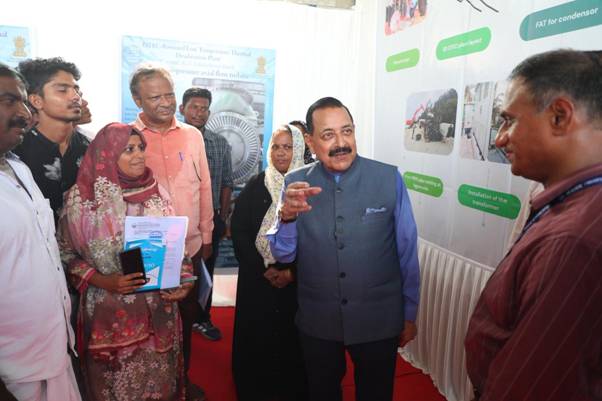
Access to clean drinking water has significantly improved in Lakshadweep with the introduction of desalination technology, residents told Jitendra Singh during his visit to the Low Temperature Thermal Desalination plant in Kavaratti on 7 March 2026.
The visit was aimed at reviewing the functioning of desalination facilities established across the Lakshadweep archipelago by the Ministry of Earth Sciences to address chronic drinking water shortages in the island territory.
During the interaction, several residents shared how the availability of desalinated water has transformed daily life in communities that earlier depended on saline groundwater and small household wells.
Abdul Rehman, a resident of Kavaratti, said that people in the area previously relied on well water that was often salty due to the island’s proximity to the sea. He explained that households had limited options for obtaining potable water and frequently consumed brackish water drawn from shallow wells.
He said the introduction of desalination plants has brought a major change, with clean drinking water now supplied through taps in homes and communities. According to him, residents who earlier depended on saline water sources are now able to use desalinated water for drinking and household needs.
Another resident, Valiya B, described how fetching water used to be a daily challenge for many families. He said residents earlier had to collect water from wells and carry it home multiple times a day.
With the commissioning of desalination plants, he said, households now have direct access to water supply near their homes, reducing the burden of water collection and improving convenience for residents.
Officials accompanying the minister explained that the Low Temperature Thermal Desalination technology converts seawater into potable water by using the temperature difference between warm surface seawater and cold deep sea water. This natural temperature gradient is harnessed to produce freshwater without the need for large energy inputs.
The desalination plants have been installed in several islands of Lakshadweep to create a reliable and sustainable source of drinking water in a region where freshwater resources are extremely limited.
Speaking during the visit, Jitendra Singh said the desalination initiative first began in Kavaratti and has gradually been expanded to other islands in the Lakshadweep archipelago.
He also reviewed the progress of the upcoming Ocean Thermal Energy Conversion project, which is designed to generate clean electricity while simultaneously producing freshwater from seawater.
According to officials, the Ocean Thermal Energy Conversion system uses the natural temperature difference between warm surface waters and cold deep ocean waters to produce electricity. The technology can also support desalination processes, offering a combined solution for power generation and freshwater production.
Jitendra Singh said such technologies are particularly suitable for island regions where freshwater resources are scarce but seawater is abundant. By using ocean based energy systems, islands can develop sustainable solutions for both water and energy needs.
He added that the adoption of desalination and ocean energy technologies could reduce dependence on diesel based power supplies and water transport systems that often face logistical disruptions during the monsoon season.
Lakshadweep has historically faced challenges in ensuring reliable drinking water supply due to limited freshwater reserves, salinity intrusion and dependence on seasonal rainfall. Groundwater sources on coral islands are often vulnerable to contamination and seawater intrusion.
Officials said the expansion of desalination facilities across the islands is expected to significantly improve water security and ensure a stable supply of potable water for residents in the coming years.
The projects are part of broader efforts to deploy ocean based technologies that support sustainable development in coastal and island regions while addressing critical infrastructure challenges.