
India is expanding opportunities for student participation in space missions while strengthening the country’s geospatial science ecosystem as part of a broader effort to promote scientific innovation and technological self reliance.
Union Minister of State Independent Charge for Science and Technology and Earth Sciences, Minister of State in the Prime Ministers Office, Personnel Public Grievances Pensions, Atomic Energy and Space Jitendra Singh informed Parliament that the Indian Space Research Organisation has launched a range of initiatives to actively involve students and young researchers in satellite development, payload experiments and space missions.
Speaking separately at the inaugural session of the first National Conference on Geodesy GeodCon 26 in New Delhi, Jitendra Singh also highlighted the strategic importance of geospatial science and the reforms introduced under the National Geospatial Policy 2022 to democratise access to geospatial data and strengthen the sector.
Student Participation In Space Missions Expanding
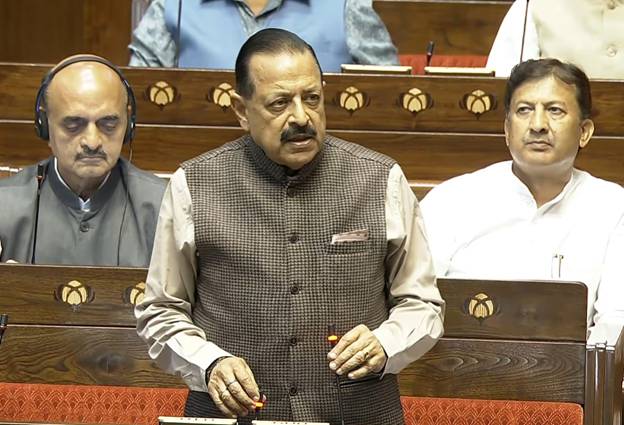
Replying to an unstarred question raised by Member of Parliament Sumitra Balmik in the Rajya Sabha, Jitendra Singh said the government is committed to democratising access to space technology and ensuring that students from across the country including institutions in smaller towns gain opportunities to participate in India’s growing space ecosystem.
The minister said structured programmes have been created to allow students to work on real space technology projects including satellite design payload development and mission experiments.
Under the Student Satellite Programme led by the U R Rao Satellite Centre, academic institutions and student teams are encouraged to design and build satellites with technical mentoring from scientists of the Indian Space Research Organisation.
These satellites receive integration support and launch opportunities through missions undertaken by the Indian Space Research Organisation.
Student Satellites Launched With ISRO Support
Jitendra Singh informed the Rajya Sabha that the Indian National Space Promotion and Authorisation Centre has authorised 17 student satellites and payloads so far.
Out of these projects, 11 student satellites have already been successfully launched.
The missions involved participation from institutions including Indian Institute of Astrophysics, Indian Institute of Space Science and Technology, RV College of Engineering, Amity University Maharashtra, MIT World Peace University, Assam Don Bosco University and CV Raman Global University.
Officials said the participation of institutions from different parts of the country reflects the growing national engagement in student led space missions.
Competitions Encourage Space Innovation
Jitendra Singh also highlighted that the Indian National Space Promotion and Authorisation Centre has organised student competitions focused on designing and developing CAN sized satellites and model rockets.
These competitions have attracted participation from 97 student teams comprising nearly 850 students.
In October 2025 the Model Rocketry and CanSat India Student Competition was jointly organised by the Indian National Space Promotion and Authorisation Centre, the Indian Space Research Organisation and the Astronautical Society of India in Kushinagar in Uttar Pradesh.
During the competition 67 teams comprising nearly 500 students designed fabricated and launched model rockets carrying CanSat payloads to an altitude of about one kilometre.
Mentorship And Research Opportunities
The minister said internship and project trainee schemes are available for undergraduate postgraduate and doctoral students from recognised institutions across the country.
These programmes allow students to work directly with scientists at centres of the Indian Space Research Organisation and gain practical research experience in advanced space technologies.
To strengthen academic participation in the space sector, Space Technology Incubation Centres have been established in different regions of the country.
These centres facilitate collaboration between universities and scientists of the Indian Space Research Organisation and support students in developing indigenous space technologies.
Regional Academic Centres for Space have also been established to ensure that students from tier two and tier three institutions receive exposure to space science and technology programmes.
Jitendra Singh said that the All India Council for Technical Education has approved a Space Technology Minor Course and a National Committee for Adoption of Space Technology Education in India has been formed in accordance with the Indian Space Policy 2023.
The government has also earmarked approximately ten crore rupees annually for student focused educational outreach programmes in space science and technology.
Building A Space Entrepreneurship Ecosystem
Jitendra Singh said the Indian National Space Promotion and Authorisation Centre is also nurturing the next generation of space entrepreneurs.
The centre is providing mentorship from domain experts pre incubation entrepreneurship support programmes and co working facilities at its technical centres to encourage innovation and start up activity in the space sector.
Officials said these initiatives are part of a broader strategy to build an inclusive and vibrant space ecosystem where students startups academic institutions and industry collaborate in advancing India’s role in the global space sector.
National Conference Highlights Geospatial Science
Addressing the inaugural session of GeodCon 26 the first National Conference on Geodesy held at the Indian National Science Academy in New Delhi, Jitendra Singh emphasised the growing importance of geospatial science in national development.
The minister said India is moving towards scientific self reliance under the vision of Aatmanirbhar Bharat and foundational sciences such as geodesy must emerge as strategic national strengths.
Jitendra Singh noted that the National Geospatial Policy 2022 marked a landmark reform that liberalised the geospatial sector and democratized access to geospatial data.
He said the geospatial sector plays an important role in governance infrastructure development national security disaster resilience and economic growth.
Geodesy As Scientific Foundation
The minister explained that geodesy forms the scientific backbone of the geospatial ecosystem by enabling accurate positioning satellite navigation infrastructure planning climate monitoring and disaster response.
Jitendra Singh said that while mapping represents the visible layer of geospatial development geodesy remains the invisible but essential scientific foundation that makes accurate mapping and positioning possible.
He stressed that technologically advanced nations must maintain sovereign capabilities in geodetic reference frames gravity models and positioning systems.
Strengthening Geospatial Infrastructure
Jitendra Singh highlighted that initiatives such as the indigenous satellite navigation system NavIC space missions and Earth observation programmes demonstrate India’s expanding role in the global geospatial ecosystem.
He said the success and accuracy of these technologies depend heavily on strong geodetic infrastructure and reference frameworks.
The minister also appreciated the efforts of the Department of Science and Technology and the Survey of India in strengthening geospatial infrastructure and advancing research in geodesy.
Scientific Collaboration And Capacity Building
Padma Shri V P Dimri, Patron of GeodCon 26, said geodesy has long remained a foundational science that is essential but often overlooked.
He welcomed the establishment of the National Centre for Geodesy at the Indian Institute of Technology Kanpur along with six regional centres to strengthen research and capacity building in geodetic science.
M Mohanty, Head of the National Geospatial Programme Division at the Department of Science and Technology, highlighted research areas being pursued at the centre including GNSS based reference frame development crustal deformation monitoring space geodesy techniques and GeoAI based applications.
The inaugural session also included addresses by Onkar Dikshit, Chairperson GeodCon 26, and Hitesh Kumar S Makwana, Surveyor General of India.
Officials said GeodCon 26 has brought together scientists policymakers industry leaders academic institutions and young researchers to deliberate on advancements in geodesy and its role in national development scientific research and strategic sectors.