
India’s petroleum supply position remains secure despite major disruptions in global energy flows caused by the ongoing conflict in West Asia, Union Minister for Petroleum and Natural Gas Hardeep Singh Puri informed the Lok Sabha on Thursday while outlining the government’s measures to safeguard the country’s energy security.
Making a detailed statement in Parliament, Hardeep Singh Puri said the government has taken comprehensive steps to ensure uninterrupted availability of crude oil, petroleum products, natural gas and cooking gas while protecting consumers from the impact of volatile global energy markets.
Global Energy Disruption Triggered By Strait Of Hormuz Closure
The minister said the current crisis is unprecedented in modern energy history. The disruption began after military operations involving Iran, Israel and the United States led to the closure of the Strait of Hormuz to commercial shipping.
The Strait of Hormuz is one of the most critical maritime energy routes in the world, through which approximately 20 percent of global crude oil, 20 percent of natural gas and 20 percent of liquefied petroleum gas supplies normally transit.
According to the minister, the disruption has created a challenging global energy environment, forcing many countries to impose energy rationing and conservation measures.
Some neighbouring countries have already taken emergency steps including reducing working days, cutting fuel allowances for official vehicles and restricting the use of government transport fleets to manage fuel shortages. Other countries in South Asia and Southeast Asia have also implemented fuel saving measures to deal with supply constraints.
India Diversifies Crude Oil Sources
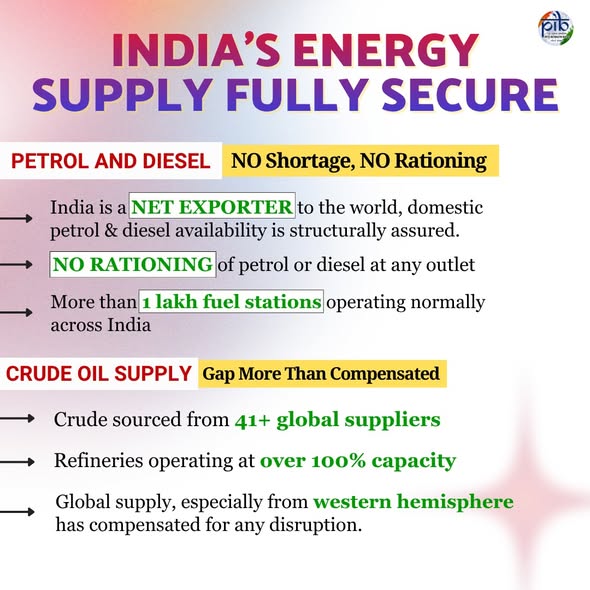
Despite the disruption in global supply routes, India has been able to secure sufficient crude oil supplies through diversified sourcing strategies.
Hardeep Singh Puri told Parliament that before the crisis approximately 45 percent of India’s crude imports transited through the Strait of Hormuz. Following the disruption, India successfully increased sourcing from alternative routes.
Non Hormuz sources now account for approximately 70 percent of India’s crude imports, compared to about 55 percent before the conflict began.
India currently imports crude oil from 40 countries, significantly expanding its supplier base from 27 countries in 2006-07. The minister said this long term diversification strategy has strengthened India’s ability to respond to global supply disruptions.
Indian refineries are currently operating at high capacity utilisation and in several cases are running above 100 percent capacity to maintain adequate fuel supplies.
No Shortage Of Petrol Diesel Or Aviation Fuel
The minister assured Parliament that there is no shortage of petrol, diesel, kerosene, aviation turbine fuel or fuel oil anywhere in the country.
Retail fuel outlets across India remain fully stocked and supply chains are functioning normally.
To support vulnerable households, additional allocations of Public Distribution System kerosene have been issued to all states.
Natural Gas Supply Prioritised For Essential Sectors
Natural gas supply has also been managed through a priority based allocation framework introduced through the Natural Gas Control Order issued on 9 March 2026 under the Essential Commodities Act.
India currently produces about 90 million metric standard cubic metres of natural gas per day domestically. Before the crisis, an additional 30 million metric standard cubic metres per day was imported through Gulf sources that have now been affected by a force majeure declaration from a major processing facility in Qatar.
Under the priority allocation system, piped natural gas to households and compressed natural gas for vehicles are receiving 100 percent supply without any reduction.
Industrial and manufacturing consumers will receive up to 80 percent of their average consumption over the previous six months, while fertiliser plants will receive up to 70 percent of their requirements to protect the agricultural supply chain ahead of the sowing season.
Refineries and petrochemical units are absorbing a managed reduction in gas allocation so that supplies can be redirected to higher priority sectors.
The minister said additional liquefied natural gas cargoes are arriving almost daily through alternative supply routes, ensuring that India has sufficient gas supply even if the crisis continues for an extended period.
LPG Supply Strengthened Through Diversified Imports
India previously imported around 60 percent of its liquefied petroleum gas requirements from Gulf countries including Qatar, the United Arab Emirates, Saudi Arabia and Kuwait, while the remaining 40 percent was produced domestically.
To address potential supply disruptions, the government has diversified LPG procurement sources. Additional cargoes are now being sourced from the United States, Norway, Canada, Algeria and Russia.
A Liquefied Petroleum Gas Control Order issued on 8 March 2026 directed refineries to maximise LPG production and channel all propane and butane streams exclusively to the three oil marketing companies for domestic cooking gas supply.
As a result of these directives, LPG production has increased by 28 percent within five days.
Protecting Domestic LPG Consumers
The minister emphasised that protecting domestic cooking gas supply for India’s more than 33 crore households remains the government’s highest priority.
The average delivery time for domestic LPG cylinders remains unchanged at approximately 2.5 days from booking.
Hospitals and educational institutions have been placed under uninterrupted priority supply to ensure that essential services are not affected.
Authorities have reported instances of panic booking and hoarding in some areas due to consumer anxiety rather than any actual shortage of LPG.
To prevent diversion and black marketing, the Delivery Authentication Code system is being expanded from 50 percent to 90 percent consumer coverage. Under this system, delivery of cylinders is confirmed through a one time code sent to the consumer’s registered mobile number.
The government has also introduced a minimum booking interval of 25 days in urban areas and 45 days in rural and remote regions as a temporary demand management measure.
Regulating Commercial LPG Supply
Commercial LPG, which normally operates in a deregulated market without government controls, has been temporarily regulated to prevent hoarding and diversion during the crisis.
A three member committee comprising executive directors from Indian Oil Corporation Limited, Hindustan Petroleum Corporation Limited and Bharat Petroleum Corporation Limited was constituted on 9 March 2026 to assess genuine demand across sectors and regions.
Based on its recommendations, oil marketing companies will allocate 20 percent of the average monthly commercial LPG requirement through a coordinated system with state governments to ensure fair distribution.
Alternative Fuels Activated
To ease pressure on LPG and natural gas supplies, alternative fuels are being made available for industrial and commercial users.
Kerosene is being distributed through retail outlets and the Public Distribution System while fuel oil is being made available for industrial consumption.
The Ministry of Environment Forest and Climate Change has advised state pollution control boards to temporarily permit the use of biomass fuels, refuse derived fuel pellets, kerosene and coal as alternative fuels for the hospitality and restaurant sector for a period of one month.
Consumer Prices Shielded From Global Volatility
The minister said the government has taken steps to shield consumers from global price volatility.
While the international Saudi contract price for LPG rose by 41 percent between July 2023 and March 2026, the price paid by beneficiaries under the Pradhan Mantri Ujjwala Yojana has fallen by 32 percent over the same period.
Currently the price for Ujjwala scheme beneficiaries stands at ₹613 for a 14.2 kilogram cylinder in Delhi. The price for non subsidised consumers is ₹913 after the recent ₹60 adjustment, compared with a market determined price of approximately ₹987.
Of the ₹134 per cylinder price increase required by global market conditions, the government absorbed ₹74.
Compensation of ₹30,000 crore has been approved for oil marketing companies against losses of approximately ₹40,000 crore in 2024-25.
Coordination With States
The minister said state governments are working closely with the central government to ensure smooth energy distribution.
Senior officials from oil marketing companies held meetings on 11 March 2026 with state administrations across major states including Maharashtra, Madhya Pradesh, Gujarat, Odisha, West Bengal, Bihar, Punjab, Uttar Pradesh, Karnataka, Tamil Nadu, Kerala, Telangana and Andhra Pradesh.
District level monitoring committees have been formed in several states, while anti diversion raids have been conducted and cases registered against illegal fuel activities.
Hardeep Singh Puri said India is navigating one of the most severe global energy disruptions in history but remains well prepared due to diversified sourcing strategies, strong coordination between central and state governments and proactive policy measures.
He urged citizens to avoid spreading rumours and emphasised that the country’s energy supply chain remains stable and fully operational.