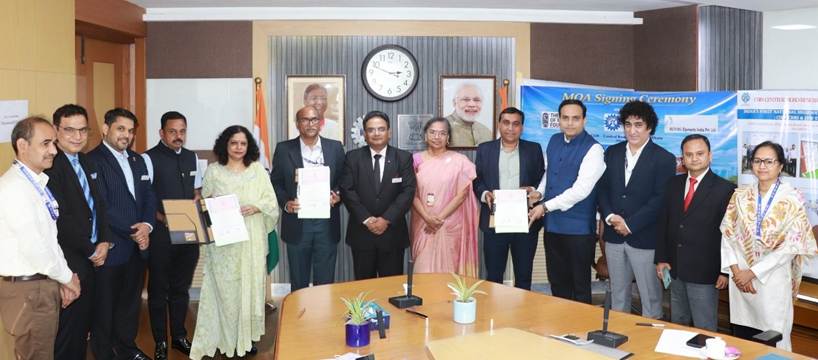

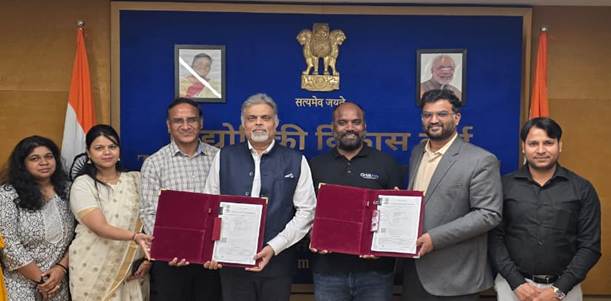
India has taken a major step toward strengthening its emerging private space technology ecosystem with financial support for the development of indigenous satellite servicing capabilities. The Technology Development Board under the Department of Science and Technology has extended financial assistance to OrbitAID Aerospace Private Limited for a project focused on building advanced in orbit satellite docking and refueling systems.
The project titled Development of Docking and Refueling Systems for In Space Life Extension of Satellites aims to establish critical technologies that allow operational satellites to be serviced and refueled while in orbit. The initiative forms part of the Government of India’s broader strategy to expand private sector participation in the space industry and build indigenous capabilities in advanced space technologies.
Advancing India Private Space Ecosystem
OrbitAID Aerospace Private Limited is working on the development of advanced satellite servicing systems that enable in orbit refueling and life extension of operational satellites. These technologies are becoming increasingly important as the number of satellites in Earth orbit continues to grow rapidly.
The expansion of satellite constellations has created new challenges related to orbital congestion, satellite lifecycle management and the long term sustainability of space operations. Technologies that allow satellites to be serviced and refueled in orbit can significantly extend their operational life and reduce the need for frequent replacement launches.
The support provided by the Technology Development Board is intended to accelerate the development and demonstration of these advanced capabilities while strengthening India’s position in the rapidly evolving global commercial space sector.
Development Of Indigenous Docking And Refueling Technology
A key innovation under the project is the Standard Interface Docking and Refueling Port system. This system has reached Technology Readiness Level seven and is designed to enable autonomous docking and propellant transfer between satellites operating in orbit.
The docking system integrates a satellite fill and drain valve with a dual docking interface and has been engineered to function reliably both on the ground and in microgravity environments.
The Standard Interface Docking and Refueling Port incorporates several advanced engineering features including autonomous docking capability, dual docking mechanisms and multiple layers of built in redundancy to ensure safe and reliable fuel transfer operations.
The technology allows a dedicated servicing satellite module to approach a client satellite and dock with it in orbit. Once docked, propellant transfer can take place, enabling the target satellite to replenish its fuel reserves and continue operating for extended periods.
Industry experts note that the ability to refuel satellites in orbit can extend satellite life by several years and significantly reduce operational costs for satellite operators when compared to launching replacement spacecraft.
Autonomous Satellite Servicing System
During servicing operations the OrbitAID Service Module approaches the target satellite using advanced guidance navigation and control systems. These systems are supported by multiple sensor technologies including LiDAR optical sensors and infrared imaging.
Once the service module reaches close proximity to the satellite, the docking interface enables soft capture followed by secure mechanical latching. After the docking sequence is completed safely, propellant transfer systems activate to replenish the satellite fuel supply.
This process allows satellite operators to extend the operational life of their space assets without requiring costly replacement missions.
Testing And Demonstration In Space
With the financial support provided by the Technology Development Board, the project will now focus on further engineering development, ground validation and eventual in orbit demonstration of the Standard Interface Docking and Refueling Port system.
Successful deployment of the technology is expected to help establish an indigenous on orbit satellite servicing ecosystem in India. Such an ecosystem could enable satellite life extension services, improve operational efficiency for space operators and contribute to more sustainable space infrastructure.
The development of in orbit servicing technologies also has strategic significance for future space missions, satellite constellations and long duration space infrastructure.
Government Support For Space Innovation
Rajesh Kumar Pathak, Secretary of the Technology Development Board, said the Indian space sector has entered a transformative phase driven by policy reforms and increased private sector participation.
Rajesh Kumar Pathak noted that emerging technologies such as satellite life extension systems and in orbit servicing represent the next frontier in commercial space activities. He emphasised that supporting innovative startups developing such advanced technologies is essential to strengthening India’s technological self reliance and global competitiveness in the space sector.
He added that the Technology Development Board remains committed to supporting Indian companies developing breakthrough technologies that contribute to the country’s growing space economy.
Startup Contribution To Space Innovation
Promoters of OrbitAID Aerospace Private Limited welcomed the support provided by the Technology Development Board and said the financial assistance will accelerate the development and testing of the docking and refueling system.
The company noted that the project will help position OrbitAID Aerospace Private Limited as an important contributor to India’s rapidly expanding space innovation ecosystem.
Industry observers say that initiatives supporting private space startups are critical to building a vibrant commercial space sector capable of competing in the global market.
The development of indigenous satellite docking and refueling capabilities is expected to open new opportunities for space servicing, satellite lifecycle management and sustainable orbital operations in the coming years.