
Maharashtra has formally joined the reform linked framework of Jal Jeevan Mission 2.0 with the signing of a Memorandum of Understanding with the Centre, marking a significant step towards strengthening rural drinking water service delivery and ensuring long term sustainability of water infrastructure.
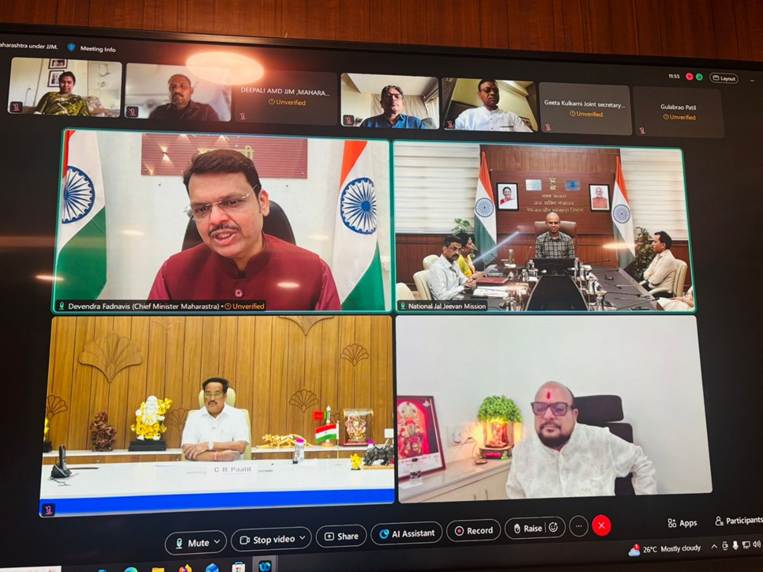
The agreement was signed in the presence of Union Minister of Jal Shakti C R Paatil and Chief Minister of Maharashtra Devendra Fadnavis, along with Gulabrao Patil Minister of Water Supply and Sanitation Department Maharashtra and Meghna Bordikar Sakore State Minister Maharashtra, who participated through video conference.
The MoU was exchanged between Swati Meena Naik Joint Secretary Water Department of Drinking Water and Sanitation Ministry of Jal Shakti and R Vimla Resident Commissioner and Secretary of Maharashtra Sadan. Senior officials including Ashok K K Meena Secretary Department of Drinking Water and Sanitation and Kamal Kishore Soan Additional Secretary and Mission Director National Jal Jeevan Mission attended the event.
Reform Driven Approach Under Jal Jeevan Mission Two
The signing of the MoU marks Maharashtra’s entry into the restructured Jal Jeevan Mission 2.0, approved by the Union Cabinet on March 10, 2026, which shifts focus from infrastructure creation to assured service delivery, accountability and sustainability.
C R Paatil stated that the mission has already brought transformative change in rural India by providing tap water connections to 80 percent of rural households. He emphasised that the next phase will prioritise consistent service delivery, quality assurance and strengthened governance systems at the grassroots level.
He reiterated the government’s zero tolerance policy towards corruption, irregularities and quality lapses in implementation, stressing the need for robust monitoring and accountability mechanisms.
Impact On Women Health And Rural Livelihoods
Highlighting the social impact of the mission, C R Paatil cited findings indicating that nearly 9 crore women have been relieved from the burden of fetching water daily, enabling them to engage in productive activities such as agriculture and livelihoods.
He also referred to estimates that universal access to safe drinking water could save around 5.5 crore hours daily and prevent nearly 4 lakh deaths annually due to water borne diseases, underlining the mission’s role in improving public health and quality of life.
State Commitment To Quality And Timely Implementation
Devendra Fadnavis reaffirmed Maharashtra’s commitment to ensuring reliable, sustainable and quality drinking water supply to every rural household. He said the state will focus on improving quality of works, strengthening systems and adhering to timelines to achieve mission objectives.
Drawing on implementation experience, he said the state is well positioned to deliver on the goals of Jal Jeevan Mission 2.0 through enhanced planning and execution.
Community Participation And Transparency Measures
The MoU introduces key reforms to strengthen community participation and transparency. Jal Seva Aankalan will be conducted at the Gram Panchayat level to capture citizen feedback on water supply services, including quality, regularity and reliability.
The results will be made accessible through the Meri Panchayat application, enabling citizens to track service delivery outcomes and enhancing accountability.
To promote community engagement, a structured Jal Utsav framework has been introduced, comprising Jal Mahotsav at the national level, Rajya Jal Utsav or Nadi Utsav at the state level and Lok Jal Utsav at the village level.
Strengthening Local Ownership And Governance
A key provision mandates the formal handover of completed water supply schemes to Gram Panchayats, Village Water and Sanitation Committees and local communities through the Jal Arpan process. This is aimed at ensuring local ownership, effective operation and long term sustainability of assets.
The MoU also promotes a Gram Panchayat led model of water governance, placing communities at the centre of planning and service delivery.
Digital Planning And Sustainability Focus
The agreement provides for the operationalisation of a Decision Support System developed by the Department of Drinking Water and Sanitation, which will enable data driven planning at district and village levels.
The system will integrate with national water datasets and platforms such as Sujalam Bharat to support evidence based decision making, particularly in areas such as source sustainability and water conservation.
The Union Minister also urged the state to focus on source sustainability and water conservation initiatives to ensure uninterrupted water supply in the long term.
Long Term Vision For Water Security
The extension of Jal Jeevan Mission up to December 2028 with enhanced financial outlay is aimed at building a sustainable rural water supply system focused on functionality, water quality and community ownership.
The reform linked MoU is expected to strengthen implementation on the ground and ensure that every rural household receives adequate and safe drinking water on a regular basis, contributing to improved living standards and long term water security in line with the national vision of Viksit Bharat.