
The government has intensified its public health strategy with a dual focus on accelerating HIV control through district level interventions and overhauling dental education regulation with the establishment of the National Dental Commission, marking significant reforms in healthcare delivery and governance.
District Level Push To Control HIV Epidemic
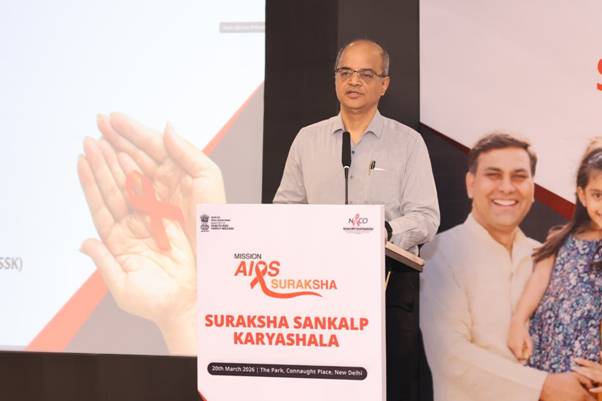
The Ministry of Health and Family Welfare, through the National AIDS Control Organisation, convened the Suraksha Sankalp Karyashala in Delhi to strengthen district level HIV response, with a focused engagement for Haryana and Delhi.
The workshop was chaired by Rakesh Gupta, Additional Secretary and Director General, National AIDS Control Organisation, while S P Bhavsar provided the background address highlighting the need for data driven, district specific strategies based on evolving epidemiological trends.
Rakesh Gupta emphasised that HIV continues to be a major public health challenge requiring sustained coordination across all levels of governance. He reiterated the global 95 95 95 framework, which targets that 95 percent of people living with HIV know their status, 95 percent of those diagnosed receive sustained treatment and 95 percent of those on treatment achieve viral suppression.
He highlighted gaps in Delhi, where only around 70 percent of identified individuals are currently linked to treatment, indicating the need for urgent improvement in treatment coverage and retention. Haryana, on the other hand, has achieved a cascade of approximately 81 83 95, showing progress while underscoring the need to further strengthen diagnosis and treatment linkage.
A total of 219 districts across the country have been identified for intensified HIV interventions, including 11 districts in Haryana and 7 in Delhi.
Priority Districts Identified
Delhi
North
New Delhi
Shahdara
Central
South East
South
North West
Haryana
Panipat
Rohtak
Sirsa
Jhajjar
Gurugram
Faridabad
Bhiwani
Hisar
Sonipat
Kaithal
Fatehabad
Delhi currently reports an adult HIV prevalence of 0.33 percent with an estimated 59079 people living with HIV, while Haryana reports 0.24 percent prevalence with an estimated 59642 people living with HIV.
The workshop focused on improving treatment linkage, enhancing viral suppression and strengthening outreach among vulnerable populations. It also emphasised elimination of mother to child transmission through early testing, counselling and universal access to treatment.
Rakesh Gupta called for a whole of system approach, stressing coordinated action among national, state and district stakeholders to bridge gaps in awareness, testing, treatment and adherence.
India has set a target to bring HIV under control by World AIDS Day 2027 and is working towards an enhanced 95 95 99 milestone to accelerate progress.
National Dental Commission To Reform Education And Regulation
In a parallel major reform, the government has constituted the National Dental Commission, replacing the Dental Council of India, with effect from March 19, 2026, to improve the quality of dental education and strengthen healthcare standards.
The new framework introduces a transparent, accountable and quality driven regulatory system aligned with global benchmarks. It also aims to enhance access to affordable oral healthcare across the country.
Key Appointments
National Dental Commission
Sanjay Tewari Chairperson
Mousumi Goswami Part Time Member
Undergraduate and Postgraduate Dental Education Board
Chandrashekhar Janakiram President
Shailesh Madhav Lele Whole Time Member
Nagaraj M Part Time Member
Dental Assessment and Rating Board
Nanda Kishore Sahoo President
Himanshu Aeran Whole Time Member
Parimala Tyagi Part Time Member
Ethics and Dental Registration Board
Tapas Kumar Bandyopadhyay Whole Time Member
Usha Hegde Whole Time Member
Swarga Jyoti Das Part Time Member
Arindam Modak has been appointed Secretary to the Commission.
The National Dental Commission will regulate dental education, conduct institutional assessments, promote research, frame fee guidelines for private colleges and establish standards for community dental care and professional ethics.
With the implementation of the new framework, the Dentists Act 1948 has been repealed and the Dental Council of India has been dissolved.
Strengthening Public Health And Regulatory Systems
The combined initiatives reflect a comprehensive approach to public health reform, focusing on both disease control and systemic improvements in healthcare education and regulation.
While the Suraksha Sankalp Karyashala strengthens grassroots level HIV interventions through targeted, data driven strategies, the National Dental Commission aims to modernise regulatory oversight and improve quality standards in dental education and services.
These measures underline the government’s commitment to building a responsive, inclusive and high quality healthcare system aligned with long term national development goals.