
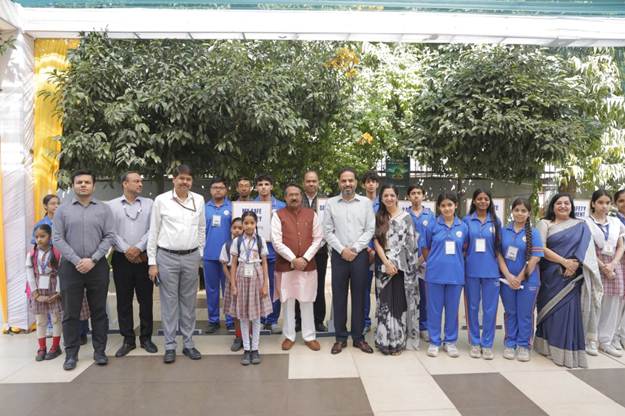
The Road Safety Conclave 2026 held at Vivekanand School in Anand Vihar marked a significant push towards building a nationwide culture of responsible mobility, with a strong focus on youth engagement and behavioural change.
Organised under the Ministry of Road Transport and Highways, the conclave brought together policymakers, educators, students and civil society representatives to translate road safety awareness into sustained action. The event saw participation from nearly 4000 students from Classes 3 to 12 and over 500 teachers representing around 100 schools, reflecting a broad based grassroots commitment to safer roads.
Harsh Malhotra, Minister of State for Road Transport and Highways and Corporate Affairs, attended as Chief Guest. Om Prakash Sharma, Member of Legislative Assembly, along with councillors Monika Pant, Ramesh Garg and Pankaj Luthra, were also present at the event.
A central feature of the conclave was the active involvement of students as change makers. Participants engaged in a wide range of activities including poster making, role play, street theatre, panel discussions, documentary creation and innovation challenges. These initiatives were designed to empower students as Road Safety Ambassadors, enabling them to promote responsible behaviour within their communities.
Addressing the gathering, Harsh Malhotra highlighted the rapid expansion of India’s road infrastructure alongside a growing emphasis on safety. He stated that the country now has approximately 146000 kilometres of National Highways, placing it among the largest networks globally, and emphasised that roads are critical lifelines connecting people, opportunities and economic growth.
He noted that road safety has been elevated as a national priority through the adoption of the 4E strategy comprising Engineering, Enforcement, Education and Emergency Care, aimed at achieving a zero fatality vision. He added that the Motor Vehicles Amendment Act 2019 has strengthened enforcement through stricter penalties, but stressed that behavioural change and public awareness remain equally essential.
Highlighting regional concerns, he pointed out that East Delhi serves as a major gateway to the capital with high traffic density, making it a key focus area for school based road safety initiatives.
The Minister also outlined several citizen centric measures aimed at strengthening emergency response systems. These include the PM Rahat Scheme, which provides cashless treatment of up to 1.5 lakh rupees for accident victims, along with enhanced ambulance services, trauma care centres and rapid response teams. Infrastructure improvements such as crash barriers, intelligent signage, reflective markings, pedestrian facilities and black spot rectification programmes have further contributed to safer roads.
He emphasised the growing role of technology in road safety, including artificial intelligence based monitoring, intelligent transport systems, automated enforcement mechanisms and FASTag enabled tolling.
Stressing individual responsibility, Harsh Malhotra said that adherence to basic safety practices such as wearing helmets, fastening seat belts and avoiding mobile phone use while driving can significantly reduce accidents and save lives.
The conclave also focused on institutionalising road safety practices through initiatives such as school level Road Safety Clubs, Gate Safety Patrol systems and data driven interventions. A compelling example shared during the event illustrated how a child’s insistence on helmet use influenced family behaviour after a serious accident, underlining the power of individual action.
As the conclave concluded, participants pledged to follow traffic rules, prioritise safety and spread awareness in their communities. The event reinforced a collective commitment to building safer roads and responsible citizens, aligned with the broader vision of a developed and secure India by 2047.