
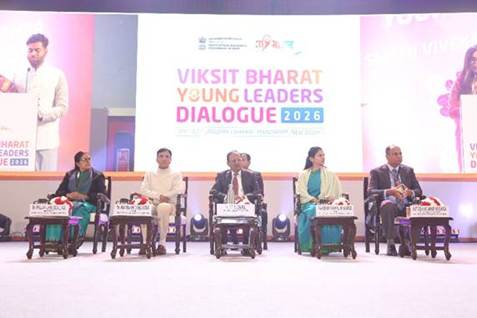
The Viksit Bharat Young Leaders Dialogue 2026 entered its second day at Bharat Mandapam in New Delhi on 10 January 2026, bringing together thousands of young leaders from across the country for intensive engagement with policymakers, industry leaders and subject experts on shaping India’s journey towards becoming a developed nation by 2047.
The second edition of the Dialogue was inaugurated by the Union Minister for Youth Affairs and Sports and Labour and Employment Mansukh Mandaviya in the presence of National Security Advisor Ajit Doval, Minister of State for Youth Affairs and Sports Raksha Nikhil Khadse, Secretary Department of Youth Affairs Pallavi Jain Govil, Additional Secretary Nitesh Kumar Mishra and other senior officials. The inaugural session began with a floral tribute to Swami Vivekananda followed by the lighting of the lamp.
Addressing the gathering, Mansukh Mandaviya highlighted the scale and inclusiveness of the initiative, noting that nearly 50 lakh youth participated in the initial nationwide quiz round. From these, three lakh youth were shortlisted to submit essays across ten thematic tracks, which were evaluated by eminent professors. Thirty thousand participants were then selected at the state level, culminating in the selection of 3,000 young leaders who will refine and present their ideas directly before the Prime Minister on National Youth Day.
The minister said the Dialogue represents a grassroots leadership model that nurtures future national leaders without political backing. He emphasised that the vision of Viksit Bharat cannot be realised by government action alone, but through collective effort by all citizens guided by the five national resolutions and the principle of Nation First. He also highlighted India’s favourable demographic dividend and noted that unemployment has declined steadily in the post pandemic period.
Delivering the keynote address, National Security Advisor Ajit Doval spoke on the central role of decision making and discipline in shaping individual lives and the destiny of nations. He urged young leaders to cultivate the habit of taking far sighted, disciplined and implementation oriented decisions. Stressing that motivation is temporary but discipline is enduring, he encouraged participants to commit to their goals with consistency and resilience, drawing lessons from India’s freedom struggle and historical experiences.
Pallavi Jain Govil, in her welcome address, described the Dialogue as the culmination of a five month nationwide process aimed at integrating youth voices into policymaking through a human centric, design thinking approach. She also highlighted initiatives such as the Viksit Bharat Run conducted in 144 cities, including participation from the Indian diaspora, as an expression of India’s soft power.
Following the plenary session, participants engaged in in depth deliberations across ten thematic tracks covering youth in democracy and governance, women led development, health and fitness, startups and entrepreneurship, cultural diplomacy, innovation rooted in tradition, self reliant India, sustainable agriculture, green development and future ready workforce development. Each track was guided by eminent policymakers, domain experts, industry leaders, sportspersons and grassroots practitioners who mentored young participants and facilitated focused discussions.
As part of the programme, participants visited the Prime Ministers Museum and Library to gain insights into India’s leadership legacy and democratic evolution. The day concluded with state wise regrouping and dinner interactions at the residences of Union Ministers and Members of Parliament, enabling informal mentorship and dialogue.
The second day concluded on a forward looking note, reinforcing the government’s commitment to placing youth at the centre of nation building. The Dialogue will culminate on 12 January 2026 with direct interaction between the Prime Minister and young leaders, alongside engagements with space scientists and cultural celebrations reflecting the diversity and spirit of Viksit Bharat.