
Archaeological evidence preserved at Prabhas Patan has brought renewed focus to the enduring legacy of the Somnath Temple, with inscriptions and architectural remains tracing its destruction, revival and central place in Sanatan culture. Among the most significant records is a 12th-century inscription at the Bhadrakali Temple that chronicles the temple’s continuity across eras and the pivotal role played by Solanki ruler Kumarapala in its reconstruction.
Prabhas Patan preserves a rich sacred past through copper plates, inscriptions and memorial stones that reflect its prosperity, heritage and enduring spirit of valour. Epigraphic records and authenticated remains revealing the history of Prabhas Patan and the Somnath Temple are spread across the Prabhas region. These include inscriptions, copper plates and remnants of temple structures destroyed during invasions, all preserved as symbols of devotion, resilience and cultural continuity. Many of these artefacts are housed at the Prabhas Patan Museum, which currently functions from the ancient Sun Temple at Prabhas Patan.
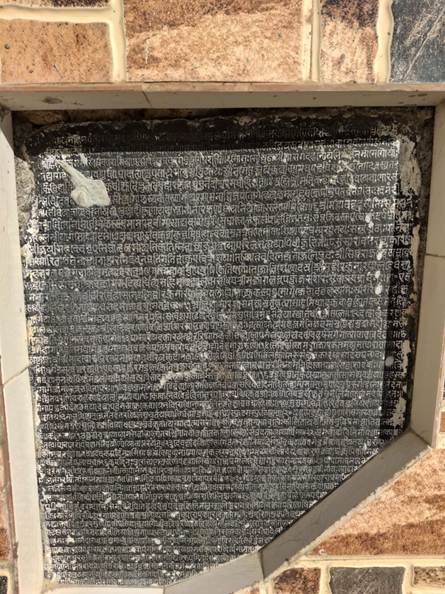
A key inscription, located near the museum beside the old Ram Temple in Bhadrakali lane, remains embedded in the wall of the ancient Bhadrakali Temple in a private courtyard and is protected by the State Department of Archaeology. According to the Curator of the Prabhas Patan Museum, the inscription was carved in 1169 CE, corresponding to Valabhi Samvat 850 and Vikram Samvat 1255. It is a eulogistic record of Param Pashupata Acharya Shriman Bhavabrihaspati, the spiritual preceptor of Maharajadhiraj Kumarapala of Anhilwad Patan.
The inscription documents the ancient and medieval history of the Somnath Temple, describing its construction across the four yugas. It records that in the Satya Yuga, Chandra, also known as Soma, built the shrine in gold; in the Treta Yuga, Ravana rebuilt it in silver; in the Dvapara Yuga, Shri Krishna constructed it in wood; and in the Kali Yuga, King Bhimdev Solanki raised a finely crafted stone temple.
Historical accounts confirm that Bhimdev Solanki erected the fourth temple on earlier remains, followed by the construction of a fifth temple by Kumarapala in 1169 CE at the same site. During the Solanki era, Prabhas Patan emerged as a major centre of religion, architecture and literature. The period was marked by administrative justice under Siddharaj Jaysinh and deep religious devotion under Kumarapala, elevating Somnath as a proud symbol of Gujarat’s golden age.
Beyond ruins and inscriptions, the sacred land of Prabhas Patan embodies the spiritual pride of Sanatan Dharma. The Bhadrakali inscription stands as testimony to the devotion of Solanki rulers and scholars such as Bhavabrihaspati. Through its legacy of art, architecture and literature, Prabhas Patan continues to inspire future generations, while the stones of Somnath echo a timeless narrative of faith, self-respect and cultural resilience.