
The Government has announced a major policy reform to accelerate India’s deep tech startup ecosystem, marking the 42nd Foundation Day of the Department of Scientific and Industrial Research. The Department has relaxed its mandatory three year existence requirement for the recognition of deep tech startups under the Industrial Research and Development Promotion framework, a move expected to provide early momentum to promising innovators and first generation entrepreneurs.
The announcement was made during the Foundation Day celebrations, underscoring the Government’s intent to remove early stage barriers for technology driven enterprises and enable faster scaling of innovation. The reform is aimed at supporting startups working in advanced domains such as artificial intelligence, robotics, semiconductors, biotechnology, clean energy and other critical and emerging technologies, even before they attain operational maturity.
The relaxation is expected to benefit early stage deep tech ventures that often require research validation and institutional support well before commercial sustainability is achieved. While existing schemes across science and technology departments already support early innovation, the revised norm will allow deep tech startups to access DSIR recognition at an earlier stage, thereby unlocking fiscal incentives, industry partnerships and R&D facilitation without waiting for a fixed operational timeline
During the event, it was highlighted that the reform reflects growing confidence in India’s startup ecosystem and its ability to deliver globally competitive technologies. The policy shift also aligns with the broader national push to translate laboratory research into market ready solutions and to strengthen private sector participation in research and development.
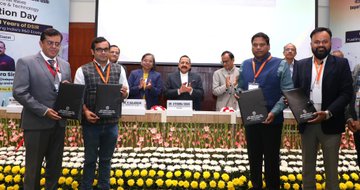
The Foundation Day also witnessed the launch of four new initiatives designed to further strengthen India’s innovation infrastructure. These included revised guidelines for recognition of in house R&D centres of deep tech startups, the PRISM Network Platform aimed at strengthening innovation pipelines, Creative India 2025 to promote innovation led entrepreneurship, and a comprehensive Disaster Management Plan for DSIR to reinforce preparedness and institutional resilience.
Several agreements and technology transfer arrangements were also formalised, including initiatives focused on technology led skill development for rural women and licensing of technologies developed under common research and technology development hubs to industry partners. These efforts reinforce DSIR’s role as a critical bridge between government, academia and industry, particularly for MSMEs and startups.
The celebrations highlighted the growing inclusivity of India’s innovation ecosystem, with more than ten thousand women beneficiaries and over fifty five women led self help groups currently supported under DSIR schemes. This participation reflects a steady shift towards broader representation and equitable access within the national research and development landscape.
Senior leaders from the scientific community emphasised that India is moving beyond the phase of self reliance to a stage where global economies increasingly depend on Indian technologies and products. The focus, they noted, is now on technology sovereignty, scaling innovation from laboratories to markets and strengthening research at higher technology readiness levels.
With the relaxation of eligibility norms and the launch of new support mechanisms, DSIR’s 42nd Foundation Day marked a decisive step towards building a future ready, industry integrated and globally competitive innovation ecosystem. The reforms are expected to accelerate deep tech entrepreneurship, strengthen research industry collaboration and reinforce India’s position as a leading hub for science driven growth.