
Global industry leaders outlined the next phase of artificial intelligence at the India AI Impact Summit 2026, describing a transition from experimental breakthroughs to large-scale deployment across healthcare, infrastructure, energy systems and daily life.
Keynote addresses by Alexander Wang, Chief AI Officer, Meta; Roy Jakobs, CEO, Philips; Martin Schroeter, Chairman and CEO, Kyndryl; and Olivier Blum, Global CEO, Schneider Electric, converged on a central theme: AI’s future will be defined not by model capabilities alone, but by responsible integration at societal scale.
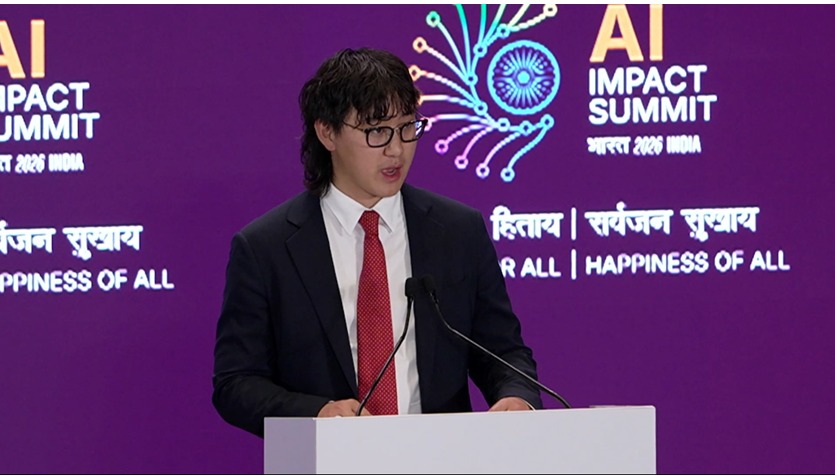
Alexander Wang positioned India as central to AI’s global trajectory, emphasising the emergence of what he termed “personal superintelligence.” He described a future where AI systems are deeply personalised and embedded in individual goals and workflows.
“Our vision is personal superintelligence, AI that knows you, your goals, your interests, and helps you with whatever you’re focused on doing. It serves you, whoever you are, wherever you are,” Wang said.
He underscored that such proximity to users demands strong governance. “Given how intimately your personal AI will know you, people aren’t going to hire us for the job if we’re not doing it responsibly. Trust, transparency and governance must move as fast as the models themselves,” he added.
Wang’s remarks reflected a broader industry shift toward user-centric AI systems, where trust, explainability and accountability are viewed as prerequisites for adoption.
Roy Jakobs identified healthcare as the sector where AI’s impact will be most visible and transformative. He described AI not as a substitute for clinical expertise, but as an enabler that restores time and focus to medical professionals facing systemic strain.
“AI is not about replacing clinicians; it is about giving time back to them, time to think, time to connect, time to care,” Jakobs said.
Looking ahead, he projected long-term societal gains. “When we look back a decade from now, AI in healthcare will not be remembered for what was optimised on a screen, but for the billions of lives it helped improve,” he noted.
His intervention highlighted the increasing use of AI in diagnostics, workflow optimisation and predictive analytics, aimed at improving outcomes while reducing administrative burdens.
Martin Schroeter turned attention to the operational challenge of scaling AI within enterprises and public systems. He emphasised that while technological innovation is advancing rapidly, institutional readiness remains uneven.
“The innovation is real. The challenge is readiness. AI today is not yet industrialised, infrastructure, data, operations and people must be prepared to support it at scale,” Schroeter said.
He warned that sustainable adoption depends on embedding AI into trusted systems that underpin daily life. “The future of AI will not be decided in research labs or boardrooms. It will be decided by how reliably and responsibly it is embedded into the systems society depends on every day,” he added.
His remarks underscored the importance of data governance, cybersecurity, workforce training and resilient digital infrastructure as foundational elements of AI industrialisation.
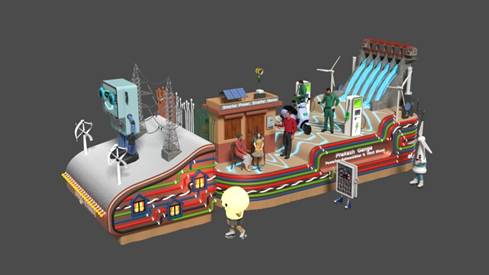
Olivier Blum addressed the critical intersection of AI expansion and global energy systems. He cautioned that compute-intensive AI workloads will significantly increase electricity demand, placing new pressures on grids worldwide.
“AI means more compute, and more compute means more energy. We cannot underestimate the pressure this will put on global energy systems,” Blum said.
At the same time, he highlighted AI’s capacity to drive efficiency gains. “For the first time in our history, we can truly connect the physical and digital worlds, making energy systems intelligent and unlocking 10 to 30 percent efficiency gains across applications,” he observed.
Blum framed AI not only as a driver of energy demand, but also as a tool to accelerate decarbonisation and optimise industrial processes through real-time data and predictive control systems.
Collectively, the four leaders articulated a shared understanding that AI’s next chapter will hinge on responsible scale. From personal digital assistants and predictive healthcare tools to resilient enterprise systems and intelligent energy grids, the focus is shifting from possibility to deployment.
The keynotes reinforced that long-term success will depend on balancing innovation with governance, compute expansion with sustainability, and rapid experimentation with institutional resilience. As deliberations continue at the India AI Impact Summit 2026, the consensus emerging from global industry leaders is clear: the real test of artificial intelligence lies not in its breakthroughs, but in how effectively and responsibly it serves people, economies and the planet at scale.